




The basicity of
(I) o—toluidine
(II) m—toluidine
(III) p—toluidine
(IV) aniline
follow the order:
A. I>II>III>IV
B. IV>III>II>I
C. III>II>IV>I
D. I>IV>II>III
Answer
 Verified
299.1k+ views
Hint: According to the concept of Lewis acid-base theory the compound or molecule can accept hydrogen ion is known as base. Higher the tendency to accept hydrogen ion higher will be the basicity of that compound.
Complete step by step solution:
Toluidine is an aromatic amine. The basicity of the aromatic amine is depending upon the availability of the lone pair. Higher the lone pair availability higher the donating ability of the lone pair as well as accept tendency of hydrogen ions.
In case of aromatic amine, the lone pair undergoes conjugation with the benzene . As a result, lone pair availability decreases. Therefore, in presence of an electron donating group increases the tendency of lone pair availability as well as basicity.
The structures of o—toluidine, m—toluidine, p—toluidine, aniline as follows,
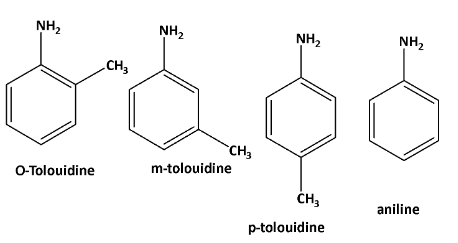
Now \[{\text{ - C}}{{\text{H}}_{\text{3}}}\] is an electron donating group. due to the positive inductive effect of the methyl group the lone pair of amine availability increases as well as the basicity.
In the case of o—toluidine, due to the steric hindrance of the methyl group , after accepting the hydrogen ion the ammonium ion gets out of the plane. As a result, corresponding conjugate acid stability gets decreased. That is why the basicity of o—toluidine is least among others.
In the case of p—toluidine due the hyperconjugation of methyl groups the basicity increases greater than others.
So, the overall order is, p—toluidine> m—toluidine> aniline> o—toluidine,
So, the correct option is, C. III>II>IV>I
Note: Acidity of an organic compound is depending upon the electron deficiency of the hydrogen atom. Higher the electron deficiency of the hydrogen higher will be the acidity character of that hydrogen.
Now to be an acidic hydrogen that hydrogen should be attached with a high electronegative group or electron withdrawing group. Higher the electronegativity of the group, higher will be the electron deficiency of the hydrogen, attached with that group as well as the acidity.
Complete step by step solution:
Toluidine is an aromatic amine. The basicity of the aromatic amine is depending upon the availability of the lone pair. Higher the lone pair availability higher the donating ability of the lone pair as well as accept tendency of hydrogen ions.
In case of aromatic amine, the lone pair undergoes conjugation with the benzene . As a result, lone pair availability decreases. Therefore, in presence of an electron donating group increases the tendency of lone pair availability as well as basicity.
The structures of o—toluidine, m—toluidine, p—toluidine, aniline as follows,
Now \[{\text{ - C}}{{\text{H}}_{\text{3}}}\] is an electron donating group. due to the positive inductive effect of the methyl group the lone pair of amine availability increases as well as the basicity.
In the case of o—toluidine, due to the steric hindrance of the methyl group , after accepting the hydrogen ion the ammonium ion gets out of the plane. As a result, corresponding conjugate acid stability gets decreased. That is why the basicity of o—toluidine is least among others.
In the case of p—toluidine due the hyperconjugation of methyl groups the basicity increases greater than others.
So, the overall order is, p—toluidine> m—toluidine> aniline> o—toluidine,
So, the correct option is, C. III>II>IV>I
Note: Acidity of an organic compound is depending upon the electron deficiency of the hydrogen atom. Higher the electron deficiency of the hydrogen higher will be the acidity character of that hydrogen.
Now to be an acidic hydrogen that hydrogen should be attached with a high electronegative group or electron withdrawing group. Higher the electronegativity of the group, higher will be the electron deficiency of the hydrogen, attached with that group as well as the acidity.
Recently Updated Pages
Differentiate between homogeneous and heterogeneous class 12 chemistry JEE_Main

What is isoelectric point class 12 chemistry JEE_Main
Chlorobenzene is extremely less reactive towards a class 12 chemistry JEE_Main
In order to convert Aniline into chlorobenzene the class 12 chemistry JEE_Main
Give one chemical test to distinguish between the following class 12 chemistry JEE_Main
The coordination number of an atom in a fcc lattice class 12 chemistry JEE_Main
Trending doubts
JEE Main 2026: Exam Dates, Session 2 Updates, City Slip, Admit Card & Latest News
Understanding the Electric Field of a Uniformly Charged Ring
Understanding Atomic Structure for Beginners
Electron Gain Enthalpy and Electron Affinity Explained
Derivation of Equation of Trajectory Explained for Students
How to Convert a Galvanometer into an Ammeter or Voltmeter
Other Pages
NCERT Solutions For Class 12 Chemistry Chapter 2 Electrochemistry - 2026-27 Free PDF Download (Sign-in Required)
NCERT Solutions For Class 12 Chemistry Chapter 1 Solutions - 2026-27 Free PDF Download (Sign-in Required)
NCERT Solutions For Class 12 Chemistry Chapter 3 Chemical Kinetics - 2026-27 Free PDF Download (Login Required)
CBSE Notes Class 12 Chemistry Chapter 1 - Solutions - 2026-27 PDF Download (Login Required)
NCERT Solutions for Class 12 Chemistry Chapter 6 Haloalkanes and Haloarenes - 2026-27 Free PDF Download (Sign-In Required)
NCERT Solutions For Class 12 Chemistry Chapter 7 Alcohol Phenol And Ether - 2026-27 Free PDF Download (Login Required)
NCERT Solutions For Class 12 Chemistry Chapter 2 Electrochemistry - 2026-27 Free PDF Download (Sign-in Required)
NCERT Solutions For Class 12 Chemistry Chapter 1 Solutions - 2026-27 Free PDF Download (Sign-in Required)
NCERT Solutions For Class 12 Chemistry Chapter 3 Chemical Kinetics - 2026-27 Free PDF Download (Login Required)