




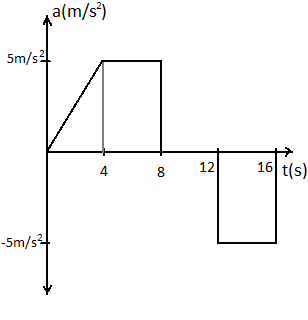
The acceleration of a train between two stations is shown in the figure. The maximum speed of the train is:
A) $60m{s^{ - 1}}$
B) $30m{s^{ - 1}}$
C) $120m{s^{ - 1}}$
D) $90m{s^{ - 1}}$
Answer
 Verified
262.2k+ views
Hint: Define acceleration and try to recall the mathematical expression of acceleration. From the graph and from the relation between velocity and acceleration we can easily estimate the maximum speed the train can reach.
Complete step by step solution:
Let’s have some nostalgia and revisit our classes of kinematics. Our physics teacher was yelling that acceleration is the rate of change of velocity.
For a small change in velocity \[dv\] over a time $dt$ acceleration of a body can be represented mathematically as,
$a = \dfrac{{dv}}{{dt}}$ ……….. (1)
Further simplifying,
$ \Rightarrow dv = a \times dt$
For the maximum velocity, we can integrate both sides of the above equation.
Taking integration both sides, we get
$ \Rightarrow v = \int {adt} $ ………. (2)
This is the expression for velocity in terms of acceleration.
Now we know that integrating a function/ curve, we get the area under that function/ curve. Thus from equation (2), we can conclude that the area under the acceleration-time graph is defined as the velocity of the train/ moving object.
Now from the diagram given in the question, we can see that after $12s$ mark, the acceleration of the train is negative, so in order to calculate the maximum velocity, we can take the area under the graph before the 12s mark.
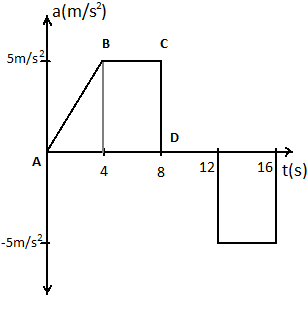
From the above diagram the area of the section $ABCD$ gives us the maximum velocity.
Area of $ABCD$ is the sum of area of right angled $\vartriangle ABE$ and the rectangle $BCDE$.
Area of $\vartriangle ABE$ is $\dfrac{1}{2} \times 4 \times 5 = 10$
Area of rectangle $BCDE$ is $5 \times 4 = 20$
Thus the maximum velocity of the train would be $10 + 20 = 30m{s^{ - 1}}$
So the correct answer is option B.
Note: Using this technique we can solve problems where we are provided with a graph in simple kinematics, for example, in a velocity time graph, the area under the graph represents the displacement of the moving body. Because the rate of change of displacement is defined as velocity.
Complete step by step solution:
Let’s have some nostalgia and revisit our classes of kinematics. Our physics teacher was yelling that acceleration is the rate of change of velocity.
For a small change in velocity \[dv\] over a time $dt$ acceleration of a body can be represented mathematically as,
$a = \dfrac{{dv}}{{dt}}$ ……….. (1)
Further simplifying,
$ \Rightarrow dv = a \times dt$
For the maximum velocity, we can integrate both sides of the above equation.
Taking integration both sides, we get
$ \Rightarrow v = \int {adt} $ ………. (2)
This is the expression for velocity in terms of acceleration.
Now we know that integrating a function/ curve, we get the area under that function/ curve. Thus from equation (2), we can conclude that the area under the acceleration-time graph is defined as the velocity of the train/ moving object.
Now from the diagram given in the question, we can see that after $12s$ mark, the acceleration of the train is negative, so in order to calculate the maximum velocity, we can take the area under the graph before the 12s mark.
From the above diagram the area of the section $ABCD$ gives us the maximum velocity.
Area of $ABCD$ is the sum of area of right angled $\vartriangle ABE$ and the rectangle $BCDE$.
Area of $\vartriangle ABE$ is $\dfrac{1}{2} \times 4 \times 5 = 10$
Area of rectangle $BCDE$ is $5 \times 4 = 20$
Thus the maximum velocity of the train would be $10 + 20 = 30m{s^{ - 1}}$
So the correct answer is option B.
Note: Using this technique we can solve problems where we are provided with a graph in simple kinematics, for example, in a velocity time graph, the area under the graph represents the displacement of the moving body. Because the rate of change of displacement is defined as velocity.
Recently Updated Pages
Circuit Switching vs Packet Switching: Key Differences Explained

Dimensions of Pressure in Physics: Formula, Derivation & SI Unit
JEE Extractive Metallurgy Important Concepts and Tips for Exam Preparation
JEE Atomic Structure and Chemical Bonding important Concepts and Tips
JEE Amino Acids and Peptides Important Concepts and Tips for Exam Preparation
Electricity and Magnetism Explained: Key Concepts & Applications
Trending doubts
JEE Main 2026: Exam Dates, Session 2 Updates, City Slip, Admit Card & Latest News
JEE Main Participating Colleges 2026 - A Complete List of Top Colleges
Hybridisation in Chemistry – Concept, Types & Applications
Understanding the Electric Field of a Uniformly Charged Ring
Derivation of Equation of Trajectory Explained for Students
Understanding Atomic Structure for Beginners
Other Pages
JEE Advanced 2026 Notification Out with Exam Date, Registration (Extended), Syllabus and More
JEE Advanced Marks vs Ranks 2025: Understanding Category-wise Qualifying Marks and Previous Year Cut-offs
CBSE Notes Class 11 Physics Chapter 1 - Units And Measurements - 2025-26
NCERT Solutions For Class 11 Physics Chapter 1 Units And Measurements - 2025-26
Important Questions For Class 11 Physics Chapter 1 Units and Measurement - 2025-26
JEE Advanced Weightage Chapter Wise 2026 for Physics, Chemistry, and Mathematics