




Switch ${{S}_{1}}$ is closed for a long time while ${{S}_{2}}$ remains open. Now at t=0, ${{S}_{2}}$ is closed while ${{S}_{1}}$ is opened. All the batteries are ideal and connecting wires are resistance-less. The capacitor C is initially uncharged.
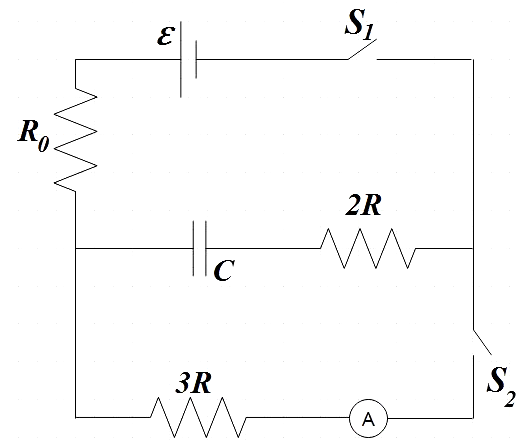
A. At time t=0, reading of ammeter is $\dfrac{\varepsilon }{5R}$
B. At time t=0, reading of ammeter is zero.
C. Heat developed till time $t=RC\ln 2$ in resistance 3R is $\dfrac{9}{40}C{{\varepsilon }^{2}}$
D. After time t > 0 charge on the capacitor follows the equation $C\varepsilon {{e}^{\dfrac{t}{5RC}}}$
Answer
 Verified
265.8k+ views
Hint: When ${{S}_{1}}$ closed with ${{S}_{2}}$ open, the capacitor develops a potential difference of $\varepsilon $ and when the ${{S}_{2}}$ closed with ${{S}_{1}}$ open at t =0, then the capacitor starts discharging. You could find the effective resistance in the circuit and then apply ohm’s law to find the current. Then recall the expression for charge stored in a capacitor at time t and do necessary substitutions to get the charge in the given capacitor at t>0. Using the above charge, find the energy stored at a given time t and then find the difference in energy stored from t=0 to t=t to find the heat developed. And then find heat developed by resistance 3R.
Formula used:
Ohm’s law,
$V=IR$
Charge at time t,
$q={{q}_{0}}{{e}^{-\dfrac{t}{\tau }}}$
Energy stored in a capacitor,
$E=\dfrac{1}{2}C{{V}^{2}}$
Complete step-by-step answer:
When switch ${{S}_{1}}$ is closed with ${{S}_{2}}$ open, after a longtime, the capacitor in circuit gets fully charged with potential difference equal to that in the cell.
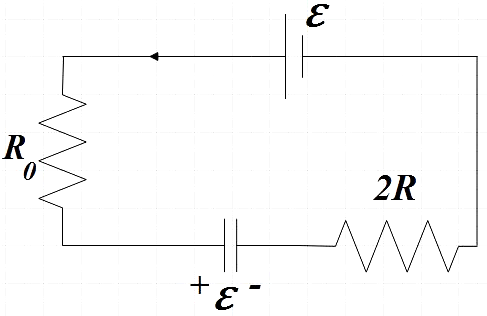
Now when the switch ${{S}_{1}}$ is kept open with ${{S}_{2}}$ turned on at t = 0, the capacitor starts discharging.
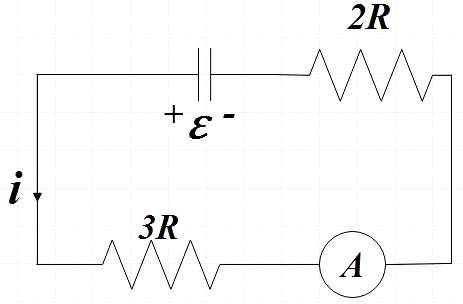
The charge in the capacitor at t =0 will be,
$Q=C\varepsilon $ …………………………….. (1)
From ohm’s law we know that,
$I=\dfrac{V}{R}$
Where R is the effective resistance of the given circuit,
$R=2R+3R=5R$ ……………………………… (2)
$\Rightarrow i=\dfrac{E}{5R}$ …………………………... (3)
Therefore option A is true.
We know that charge stored in a discharging capacitor at a time t is given by,
$q={{q}_{0}}{{e}^{-\dfrac{t}{\tau }}}$
Where, $\tau =RC$
For the given circuit, charge in the capacitor at t using (1) and (2) is given by,
$q=\left( C\varepsilon \right){{e}^{\dfrac{-t}{5RC}}}$ …………………………… (4)
Therefore option D is true.
When, $t=5RC\ln 2$
$q=C\varepsilon {{e}^{\dfrac{-5RC\ln 2}{5RC}}}$
$\Rightarrow q=C\varepsilon {{e}^{-\ln 2}}=C\varepsilon {{e}^{\ln \left( {{2}^{-1}} \right)}}$
But we know, ${{e}^{\ln x}}=x$
So, charge stored in the capacitor at time $t=5RC\ln 2$ is given by,
$q=\dfrac{C\varepsilon }{2}$
Energy stored by the capacitor at t =0 is,
${{E}_{i}}=\dfrac{1}{2}C{{\varepsilon }^{2}}$
Charged stored by capacitor at $t=5RC\ln 2$ will be,
${{E}_{f}}=\dfrac{1}{2}\dfrac{{{q}^{2}}}{C}$
$\Rightarrow {{E}_{f}}=\dfrac{1}{2}\dfrac{{{\left( \dfrac{1}{2}C\varepsilon \right)}^{2}}}{C}=\dfrac{1}{8}C{{\varepsilon }^{2}}$
The change energy from t =0 to $t=5RC\ln 2$ gives the heat total developed during that interval,
$\Delta E={{E}_{i}}-{{E}_{f}}=\dfrac{1}{8}C{{\varepsilon }^{2}}-\dfrac{1}{2}C{{\varepsilon }^{2}}=\dfrac{3}{8}C{{\varepsilon }^{2}}$
Heat developed across just the 3R resistor is given by,
${{H}_{3R}}=\dfrac{3}{8}C{{\varepsilon }^{2}}\times \dfrac{3}{5}$
$\Rightarrow {{H}_{3R}}=\dfrac{9}{40}C{{\varepsilon }^{2}}$
Therefore option C is also true.
Hence, we see that options A, C and D are true for a given situation.
So, the correct answers are “Option A, C and D”.
Note: In questions like this where we have to find the true statements among the given ones, we should check all the options one by one and then declare the correct answer. Chances are there for multiple options being true. So even when you find the very first option as true, you must check for the true statement in the other options too.
Formula used:
Ohm’s law,
$V=IR$
Charge at time t,
$q={{q}_{0}}{{e}^{-\dfrac{t}{\tau }}}$
Energy stored in a capacitor,
$E=\dfrac{1}{2}C{{V}^{2}}$
Complete step-by-step answer:
When switch ${{S}_{1}}$ is closed with ${{S}_{2}}$ open, after a longtime, the capacitor in circuit gets fully charged with potential difference equal to that in the cell.
Now when the switch ${{S}_{1}}$ is kept open with ${{S}_{2}}$ turned on at t = 0, the capacitor starts discharging.
The charge in the capacitor at t =0 will be,
$Q=C\varepsilon $ …………………………….. (1)
From ohm’s law we know that,
$I=\dfrac{V}{R}$
Where R is the effective resistance of the given circuit,
$R=2R+3R=5R$ ……………………………… (2)
$\Rightarrow i=\dfrac{E}{5R}$ …………………………... (3)
Therefore option A is true.
We know that charge stored in a discharging capacitor at a time t is given by,
$q={{q}_{0}}{{e}^{-\dfrac{t}{\tau }}}$
Where, $\tau =RC$
For the given circuit, charge in the capacitor at t using (1) and (2) is given by,
$q=\left( C\varepsilon \right){{e}^{\dfrac{-t}{5RC}}}$ …………………………… (4)
Therefore option D is true.
When, $t=5RC\ln 2$
$q=C\varepsilon {{e}^{\dfrac{-5RC\ln 2}{5RC}}}$
$\Rightarrow q=C\varepsilon {{e}^{-\ln 2}}=C\varepsilon {{e}^{\ln \left( {{2}^{-1}} \right)}}$
But we know, ${{e}^{\ln x}}=x$
So, charge stored in the capacitor at time $t=5RC\ln 2$ is given by,
$q=\dfrac{C\varepsilon }{2}$
Energy stored by the capacitor at t =0 is,
${{E}_{i}}=\dfrac{1}{2}C{{\varepsilon }^{2}}$
Charged stored by capacitor at $t=5RC\ln 2$ will be,
${{E}_{f}}=\dfrac{1}{2}\dfrac{{{q}^{2}}}{C}$
$\Rightarrow {{E}_{f}}=\dfrac{1}{2}\dfrac{{{\left( \dfrac{1}{2}C\varepsilon \right)}^{2}}}{C}=\dfrac{1}{8}C{{\varepsilon }^{2}}$
The change energy from t =0 to $t=5RC\ln 2$ gives the heat total developed during that interval,
$\Delta E={{E}_{i}}-{{E}_{f}}=\dfrac{1}{8}C{{\varepsilon }^{2}}-\dfrac{1}{2}C{{\varepsilon }^{2}}=\dfrac{3}{8}C{{\varepsilon }^{2}}$
Heat developed across just the 3R resistor is given by,
${{H}_{3R}}=\dfrac{3}{8}C{{\varepsilon }^{2}}\times \dfrac{3}{5}$
$\Rightarrow {{H}_{3R}}=\dfrac{9}{40}C{{\varepsilon }^{2}}$
Therefore option C is also true.
Hence, we see that options A, C and D are true for a given situation.
So, the correct answers are “Option A, C and D”.
Note: In questions like this where we have to find the true statements among the given ones, we should check all the options one by one and then declare the correct answer. Chances are there for multiple options being true. So even when you find the very first option as true, you must check for the true statement in the other options too.
Recently Updated Pages
JEE Main 2025-26 Experimental Skills Mock Test – Free Practice

JEE Main 2025-26 Electronic Devices Mock Test: Free Practice Online
JEE Main 2025-26 Mock Tests: Free Practice Papers & Solutions
JEE Main 2025-26: Magnetic Effects of Current & Magnetism Mock Test
JEE Main 2025-26 Atoms and Nuclei Mock Test – Free Practice Online
JEE Main Mock Test 2025-26: Experimental Skills Chapter Online Practice
Trending doubts
JEE Main 2026: Exam Dates, Session 2 Updates, City Slip, Admit Card & Latest News
JEE Main Participating Colleges 2026 - A Complete List of Top Colleges
Kinematics Mock Test for JEE Main 2025-26: Practice & Ace the Exam
Kinematics Mock Test for JEE Main 2025-26: Comprehensive Practice
Hybridisation in Chemistry – Concept, Types & Applications
Understanding the Electric Field of a Uniformly Charged Ring
Other Pages
CBSE Class 12 Physics Question Paper 2026: Download SET-wise PDF with Answer Key & Analysis
JEE Advanced 2026 Notification Out with Exam Date, Registration (Extended), Syllabus and More
JEE Advanced Percentile vs Marks 2026: JEE Main Cutoff, AIR & IIT Admission Guide
JEE Advanced 2026 Marks vs Rank: Estimate IIT Rank from Your Score
JEE Advanced Weightage Chapter Wise 2026 for Physics, Chemistry, and Mathematics
Derivation of Equation of Trajectory Explained for Students