




Structure formula of \[{H_2}{O_2}\] is
(a) 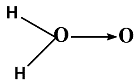
(b) \[H - O - O - H\](Straight line).
(c) Where, \[\angle H - O - O = \angle O - O - H' = {101.5^o}\]and all the four atoms are in the same plane. 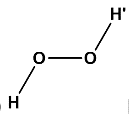
(d) Where, \[\angle H - O - O = \angle O - O - H' = {97^o}\]and the angle between \[H - O - O\]plane and \[O - O - H'\]plane is \[{101^o}\]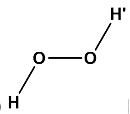
Answer
 Verified
281.4k+ views
Hint: Hydrogen peroxide (\[{H_2}{O_2}\]) is the type of simplest known peroxide with oxygen-oxygen single bond. It has a non-planar and open book-type structure. Depending upon the reaction medium, it can behave like an oxidizing and reducing agent.
Complete step by step solution:Hydrogen peroxide is like water with an extra oxygen atom. Due to the presence of \[ - OH\] groups, it has an acidic nature( \[pH = 4.5\]).
Hydrogen peroxide is \[100\% \]degradable compound.
Hydrogen peroxide is considered as non-planar in nature with an open book-like structure.
The structure of hydrogen peroxide indicates the presence of an oxygen-oxygen single bond( \[O - O\]) with bond length \[145.5pm\]. Whereas the \[O - H\]bond length is around \[98.8pm\].
The non-planar open-book structure of hydrogen peroxide has two planes and both the planes contain \[OH\]group. The bond angle between both the planes is \[{90.2^o}\].
The bond angle between the \[H - O - O\]is \[101.{9^o}\].
The open-book structure of hydrogen peroxide can be represented as below.
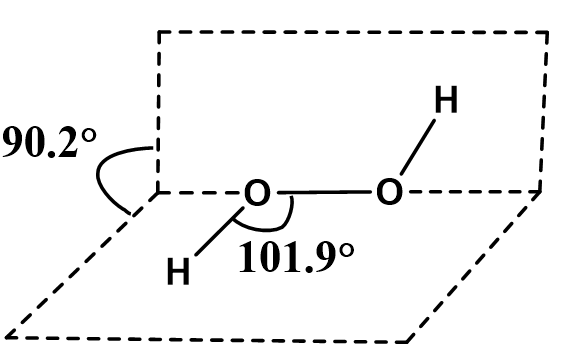
Image: An open-book structure of hydrogen peroxide.
Therefore from the above explanation we can say option (d) will be the correct option:
Note: The purest form of hydrogen peroxide is colorless in nature.
Hydrogen peroxide melts at \[272.4K\]and boils at \[423K\].
Hydrogen peroxide is miscible in water in all ratios.
The oxygen atom has -1 oxidation state in hydrogen peroxide.
Hydrogen peroxide is also used as a bleaching agent.
Complete step by step solution:Hydrogen peroxide is like water with an extra oxygen atom. Due to the presence of \[ - OH\] groups, it has an acidic nature( \[pH = 4.5\]).
Hydrogen peroxide is \[100\% \]degradable compound.
Hydrogen peroxide is considered as non-planar in nature with an open book-like structure.
The structure of hydrogen peroxide indicates the presence of an oxygen-oxygen single bond( \[O - O\]) with bond length \[145.5pm\]. Whereas the \[O - H\]bond length is around \[98.8pm\].
The non-planar open-book structure of hydrogen peroxide has two planes and both the planes contain \[OH\]group. The bond angle between both the planes is \[{90.2^o}\].
The bond angle between the \[H - O - O\]is \[101.{9^o}\].
The open-book structure of hydrogen peroxide can be represented as below.
Image: An open-book structure of hydrogen peroxide.
Therefore from the above explanation we can say option (d) will be the correct option:
Note: The purest form of hydrogen peroxide is colorless in nature.
Hydrogen peroxide melts at \[272.4K\]and boils at \[423K\].
Hydrogen peroxide is miscible in water in all ratios.
The oxygen atom has -1 oxidation state in hydrogen peroxide.
Hydrogen peroxide is also used as a bleaching agent.
Recently Updated Pages
Disproportionation Reaction: Definition, Example & JEE Guide

JEE Main 2025-26 Mock Test: Binomial Theorem & Quick Practice
Properties of Solids and Liquids Mock Test 2025
JEE Main Mock Test 2025-26: Principles Related To Practical
JEE Main Mock Test 2025-26: Dual Nature of Matter & Radiation
JEE Main 2025-26 Work, Energy and Power Mock Test – Free Practice Online
Trending doubts
JEE Main 2026: Exam Dates, Session 2 Updates, City Slip, Admit Card & Latest News
Understanding the Electric Field of a Uniformly Charged Ring
Understanding Atomic Structure for Beginners
Understanding the Different Types of Solutions in Chemistry
Derivation of Equation of Trajectory Explained for Students
Electron Gain Enthalpy and Electron Affinity Explained
Other Pages
JEE Advanced Percentile vs Marks 2026: JEE Main Cutoff, AIR & IIT Admission Guide
JEE Advanced 2026 Notification Out with Exam Date, Registration (Extended), Syllabus and More
NCERT Solutions For Class 11 Chemistry In Hindi Chapter 1 Some Basic Concepts Of Chemistry - 2026-27
How to Convert a Galvanometer into an Ammeter or Voltmeter
Understanding Instantaneous Velocity
Understanding Electromagnetic Waves and Their Importance