




Question:
The IUPAC name of chloretone is:
(A) Trichloroacetone
(B) Trichloronitromethane
(C) 1, 1, 1-trichloro-2-methyl-2-propanone
(D) 1, 1, 1-trichloro-2-methyl-2-propanol
Answer
 Verified
309.6k+ views
Hint: Chloretone has a hydroxyl group and a halide (chlorine) as a functional group. We can use –ol suffix to describe hydroxyl functional groups and use Halo- prefix to describe presence of halogen in IUPAC nomenclature.
Step by step answer:
First of all we should know about chloretone. Chloretone is also called chlorobutanol, or chlorbutol.
- It is an alcohol based preservative. We use it as a preservative, sedative, hypnotic and weak local anesthetic similar in nature to chloral hydrate. It has antibacterial and antifungal properties. Now, we will draw the structure of chloretone.
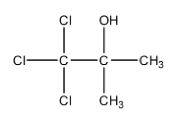
Let’s try to give the IUPAC name to this compound.
- To name this compound, we will first need to identify the longest carbon chain and we can see that there is a three carbon chain possible. We will start numbering the chain from the carbon that has a halogen group.
- There are 3 chlorine groups present at the first carbon chain and there is one alcohol group and one methyl group present on the second carbon of the chain. We will use –ol suffix to represent hydroxyl groups.
- So, we can say that the IUPAC name of chloretone is, 1, 1, 1- trichloro-2-methyl-2-propanol.
By this we can say that, option D is correct.
Note: Do not forget to arrange the substituent groups on the main carbon chain according to the alphabetical order in the process of naming a compound. Here, three chlorine atoms are present at the first carbon atom of the chain, so we will use trichloro- prefix instead of mentioning them separately.
Step by step answer:
First of all we should know about chloretone. Chloretone is also called chlorobutanol, or chlorbutol.
- It is an alcohol based preservative. We use it as a preservative, sedative, hypnotic and weak local anesthetic similar in nature to chloral hydrate. It has antibacterial and antifungal properties. Now, we will draw the structure of chloretone.
Let’s try to give the IUPAC name to this compound.
- To name this compound, we will first need to identify the longest carbon chain and we can see that there is a three carbon chain possible. We will start numbering the chain from the carbon that has a halogen group.
- There are 3 chlorine groups present at the first carbon chain and there is one alcohol group and one methyl group present on the second carbon of the chain. We will use –ol suffix to represent hydroxyl groups.
- So, we can say that the IUPAC name of chloretone is, 1, 1, 1- trichloro-2-methyl-2-propanol.
By this we can say that, option D is correct.
Note: Do not forget to arrange the substituent groups on the main carbon chain according to the alphabetical order in the process of naming a compound. Here, three chlorine atoms are present at the first carbon atom of the chain, so we will use trichloro- prefix instead of mentioning them separately.
Recently Updated Pages
JEE Main 2023 (February 1st Shift 2) Physics Question Paper with Answer Key

JEE Main 2023 (February 1st Shift 1) Maths Question Paper with Answer Key
JEE Main 2023 (February 1st Shift 2) Chemistry Question Paper with Answer Key
Hydrogen and Its Type Important Concepts and Tips for JEE Exam Preparation
JEE Main 2023 (February 1st Shift 1) Physics Question Paper with Answer Key
Apparent Frequency Explained: Formula, Uses & Examples
Trending doubts
JEE Main 2026: Exam Dates, Session 2 Updates, City Slip, Admit Card & Latest News
Understanding the Electric Field of a Uniformly Charged Ring
Derivation of Equation of Trajectory Explained for Students
Understanding Atomic Structure for Beginners
Electron Gain Enthalpy and Electron Affinity Explained
Hybridisation in Chemistry – Concept, Types & Applications
Other Pages
NCERT Solutions For Class 11 Chemistry In Hindi Chapter 1 Some Basic Concepts Of Chemistry - 2026-27 Free PDF Download (Sign-in Required)
JEE Advanced Percentile vs Marks 2026: JEE Main Cutoff, AIR & IIT Admission Guide
JEE Advanced 2026 Notification Out with Exam Date, Registration (Extended), Syllabus and More
CBSE Notes Class 11 Chemistry Chapter 5 - Thermodynamics - 2026-27 PDF Download (Login Required)
NCERT Solutions For Class 11 Chemistry Chapter 5 Thermodynamics - 2026-27 Free PDF Download (Sign-in Required)
NCERT Solutions For Class 11 Chemistry Chapter 7 Redox Reaction - 2026-27 Free PDF Download (Login Required)
NCERT Solutions For Class 11 Chemistry In Hindi Chapter 1 Some Basic Concepts Of Chemistry - 2026-27 Free PDF Download (Sign-in Required)
JEE Advanced Percentile vs Marks 2026: JEE Main Cutoff, AIR & IIT Admission Guide
JEE Advanced 2026 Notification Out with Exam Date, Registration (Extended), Syllabus and More