








How Does a Refracting Telescope Work and What Is It Used For?
A refracting telescope is an optical instrument that uses lenses to gather and focus light from distant objects, enabling magnified observation of astronomical and terrestrial bodies. It is based on the refraction of light through convex lenses to form a clear, enlarged image suitable for detailed study.
Principle of Refraction in Refracting Telescopes
The working of a refracting telescope relies on the principle of refraction, where light changes direction as it passes through materials with different refractive indices, such as air and glass. The extent of bending depends on the material’s refractive index.
When light travels from a rarer to a denser medium, such as from air into the glass lens, it slows down and bends towards the normal. This process allows lenses to converge or diverge light beams, depending on their shape and orientation.
Detailed concepts on light behavior through lenses are discussed on the Refraction Of Light Through Prism page.
Construction of a Refracting Telescope
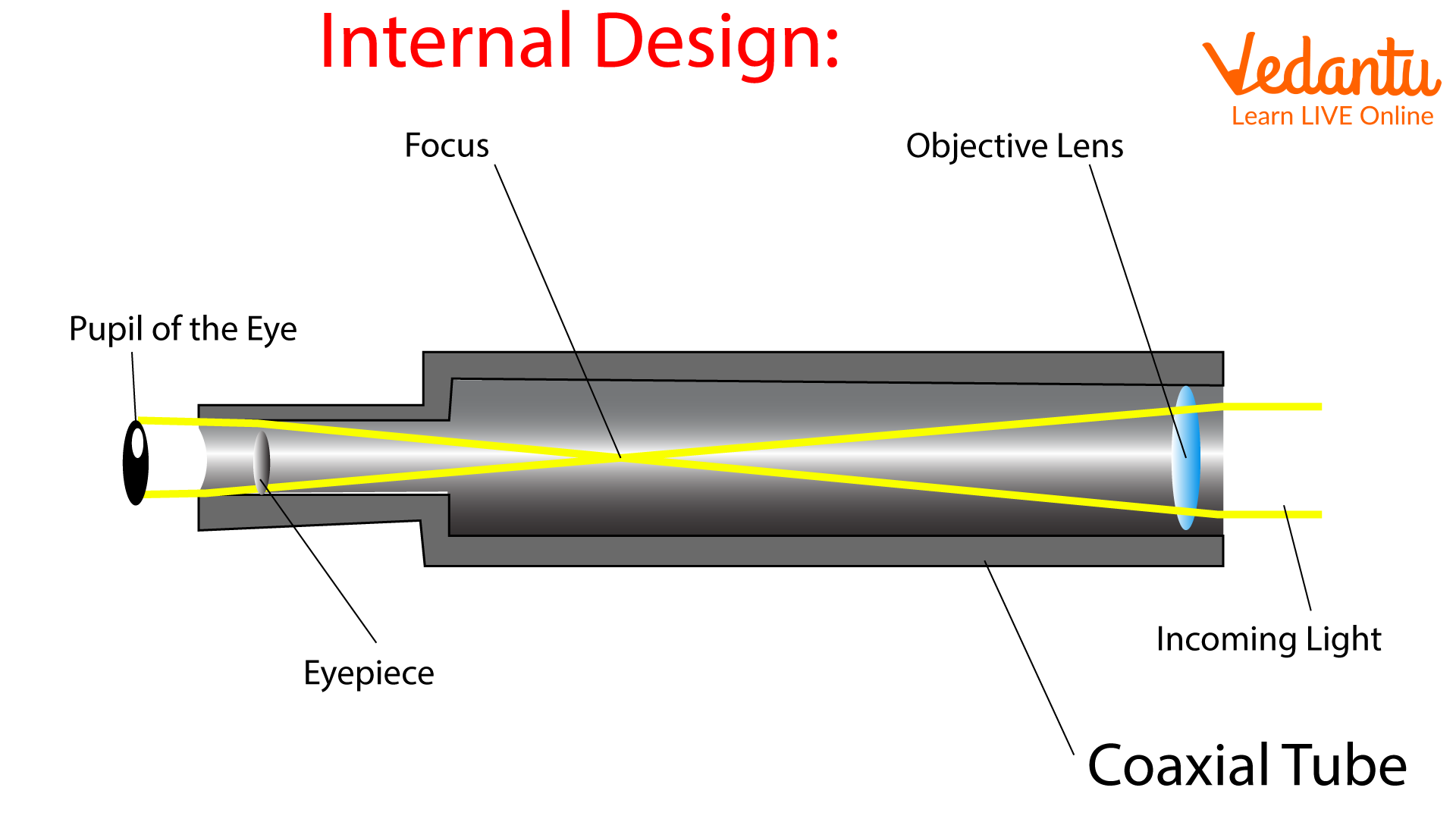
A typical refracting telescope consists of two convex lenses aligned along a common axis. The objective lens has a large aperture and long focal length, while the eyepiece lens has a shorter focal length and smaller aperture.
The objective lens is mounted at the front of the tube to collect and focus incoming light. The eyepiece is positioned such that the image formed by the objective lens lies within its focal length, allowing further magnification and comfortable viewing.
For a detailed exploration of lens types, visit the Convex And Concave Lenses resource.

Ray Diagram and Image Formation
The ray diagram of a refracting telescope illustrates how parallel rays from a distant object are converged by the objective lens to form a real, inverted image at its focal plane. The eyepiece is arranged so this intermediate image lies within its focal length.
Upon passing through the eyepiece, the rays emerge parallel, producing a final virtual, magnified image at infinity. This arrangement enables relaxed vision and is termed normal adjustment in ray optics.
Accurate ray diagrams with labeled focal points, principal axis, and lens orientations are essential for clarity and examination purposes. Refer to Lens for foundation topics.
Magnification in Refracting Telescopes
The angular magnification ($M$) of a refracting telescope in normal adjustment is given by the ratio of the focal length of the objective ($f_o$) to the focal length of the eyepiece ($f_e$):
$M = \dfrac{f_o}{f_e}$
Increasing the focal length of the objective or decreasing that of the eyepiece raises the magnifying power. This property is crucial for examining fine astronomical or terrestrial details.
Example: For $f_o = 100\,\text{cm}$ and $f_e = 4\,\text{cm}$, $M = 25$. Thus, the image appears 25 times larger in angular size compared to its naked-eye appearance.
Further details on image characteristics are found at Characteristic Of Image.
Parts of a Refracting Telescope
The refracting telescope comprises key components, each serving a specific function in image formation and magnification. The following table summarizes essential parts and their roles.
| Part | Function |
|---|---|
| Objective Lens (Convex) | Collects and focuses light |
| Eyepiece Lens (Convex) | Magnifies the image |
| Telescope Tube | Maintains lens alignment |
| Focusing Mechanism | Adjusts image sharpness |
| Mount or Stand | Stabilizes the instrument |
Types of Refracting Telescopes and Historical Development
The Galilean telescope employs a convex objective and a concave eyepiece to yield an upright image, useful for terrestrial viewing. The Keplerian design uses two convex lenses, producing inverted images but offering greater field of view and magnification.
Hans Lippershey is credited as the inventor of the refracting telescope in 1608. Galileo Galilei and Johannes Kepler introduced notable improvements, making the device fundamental in early astronomical discoveries.
Refracting Telescope vs Reflecting Telescope
Refracting and reflecting telescopes differ in their light-gathering and focusing mechanisms. The key distinction is the use of lenses in refractors and mirrors in reflectors. Chromatic aberration affects refracting designs, while reflecting telescopes mitigate this issue.
| Feature | Refracting Telescope |
|---|---|
| Light-gathering Element | Convex lens |
| Chromatic Aberration | Present |
| Lens/Mirror Size Limitation | Difficult to scale large lenses |
| Maintenance | Sealed, lower maintenance |
A detailed comparison between lenses and mirrors can be found at Difference Between Lens And Mirror.
Optical Aberrations and Limitations
Refracting telescopes suffer from chromatic aberration, where different colors focus at different points, causing fringing and blurred images. Spherical aberration and lens fabrication challenges also limit their practical size and usage.
As the lens diameter increases, fabrication becomes difficult, costs rise, and optical quality can suffer due to sagging or imperfections in the glass.
Applications of Refracting Telescopes
Refracting telescopes are primarily used for visual observation of the moon, planets, and double stars, where their image contrast and stability are advantageous. They remain popular in educational and amateur astronomy.
- Studying planets and lunar details
- Basic astronomical imaging
- Terrestrial viewing with upright devices
- Educational demonstrations in optics
Modern astrophotography and large observational research often employ reflecting or catadioptric telescopes due to fewer optical limitations.
Summary of Refracting Telescope Facts
- Uses convex lenses for magnified vision
- Invented in the early 17th century
- Suffers from chromatic aberration
- Key parts: objective, eyepiece, tube, mount
- Effective for bright and contrast-rich objects
A thorough understanding of refracting telescopes supports further study of optical instruments and is essential for solving competitive exam problems involving lens combinations and image formation. For related equations and magnification details, consult the Mirror Formula And Magnification article.


FAQs on Understanding Refracting Telescopes: A Student Guide
1. What is a refracting telescope?
A refracting telescope is an optical instrument that uses lenses to gather and focus light to create an image of distant objects, such as stars or planets. The main components include:
- Objective lens: The large lens at the front that collects light
- Eyepiece: The smaller lens that magnifies the image for viewing
- Tube: Holds and aligns the lenses
2. How does a refracting telescope work?
A refracting telescope works by bending or refracting light through lenses to form a magnified image. The process involves:
- Light enters through the objective lens, which bends the rays to a focus.
- The eyepiece lens further magnifies the focused image.
- This allows viewers to see distant objects with greater detail and brightness.
3. What are the main parts of a refracting telescope?
Refracting telescopes consist of several key parts:
- Objective lens: Collects and focuses incoming light
- Eyepiece lens: Magnifies the image produced by the objective
- Telescope tube: Keeps the lenses aligned
These parts work together to form and magnify images of distant objects.
4. Why do refracting telescopes use lenses instead of mirrors?
A refracting telescope uses lenses to bend light because lenses focus light by refraction, which creates a clear, upright image directly. Reflecting telescopes use mirrors, but refractors rely on precise lens shapes for image clarity, especially for observing planets and double stars.
5. What is the difference between a refracting and a reflecting telescope?
The main difference is:
- Refracting telescopes use lenses to bend and focus light.
- Reflecting telescopes use mirrors to reflect and focus light.
Refractors generally provide sharper images for planets, but reflectors can be made larger for more powerful astronomical observations.
6. What are the advantages of a refracting telescope?
Key advantages of refracting telescopes include:
- Simple optical design that is easy to maintain and align
- Sealed tube prevents dust and reduces maintenance
- Sharp, high-contrast images (especially for observing the Moon and planets)
7. What are the limitations of refracting telescopes?
The limitations of refracting telescopes involve:
- Chromatic aberration: Lenses can spread colors, causing blurry images
- Large lenses are heavy, difficult, and expensive to manufacture
- Limited aperture size compared to reflectors
8. Who invented the refracting telescope?
The refracting telescope was first invented in the early 17th century by Hans Lippershey, a Dutch spectacle-maker. Galileo Galilei improved the design and used it for astronomical observations, discovering Jupiter's moons and more.
9. What are some real-life uses of refracting telescopes?
Refracting telescopes are commonly used for:
- Astronomical observations (stars, planets, the Moon)
- Educational demonstrations in schools and observatories
- Terrestrial viewing (landscapes and distant objects on Earth)
10. How can chromatic aberration in refracting telescopes be minimized?
Chromatic aberration can be minimized by:
- Using achromatic lenses made of different types of glass to bring two colors (usually red and blue) to the same focus
- Employing apochromatic lenses for even better color correction, reducing blurring and halos
11. What is the function of the objective lens in a refracting telescope?
The objective lens in a refracting telescope collects light from distant objects and brings it to a focus, creating a real image. This image is then magnified by the eyepiece for observation.
12. What is meant by the focal length of a refracting telescope?
The focal length of a refracting telescope is the distance between the objective lens and the point where it brings incoming light to focus. A longer focal length gives higher magnification but a narrower field of view.
