




What is the physical meaning of cross-product?
Answer
 Verified
310.5k+ views
Hint: For a resultant vector, the cross product is known as the vector product of the two vectors and can be written as A x B. This resultant vector illustrates a cross-product between two vectors on a plane surface.
Complete step by step solution:
We know that A vector is a quantity with magnitude and direction used to locate one location in space in relation to another. It can be visualized as an arrow or a line segment with the direction in a geometrical representation.
Mathematically, the cross product of two non-zero vectors \[\overrightarrow a \] and \[\overrightarrow b \] , is
\[\overrightarrow a \times \overrightarrow b = |\overrightarrow a ||\overrightarrow b |sin\,\theta \widehat {\,n}\]
Where \[\theta \] is the angle between \[\overrightarrow a \] and \[\overrightarrow b \] , \[0 \leqslant \theta \leqslant \pi \] . Also, \[\widehat n\] is a unit vector perpendicular to both \[\overrightarrow a \] and \[\overrightarrow b \] such that \[\overrightarrow a ,\overrightarrow b \] and \[\widehat {\,n}\] form a right-handed system.
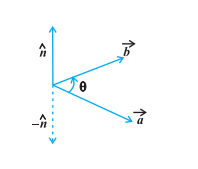
Image: cross product of two vectors
Hence, the physical meaning of cross product is a vector that is perpendicular to the two vectors is the cross product of any two vectors. It has magnitude as well as direction. The resultant vector has the same magnitude as the parallelogram, whose side lengths are the same as the magnitudes of the two provided vectors.
Note: Students should remember the right-hand thumb rule in which you stretch your right hand so that the index finger of the right hand is in the direction of the first vector and the middle finger is in the direction of the second vector. Then, the thumb of the right hand indicates the direction vector.
Complete step by step solution:
We know that A vector is a quantity with magnitude and direction used to locate one location in space in relation to another. It can be visualized as an arrow or a line segment with the direction in a geometrical representation.
Mathematically, the cross product of two non-zero vectors \[\overrightarrow a \] and \[\overrightarrow b \] , is
\[\overrightarrow a \times \overrightarrow b = |\overrightarrow a ||\overrightarrow b |sin\,\theta \widehat {\,n}\]
Where \[\theta \] is the angle between \[\overrightarrow a \] and \[\overrightarrow b \] , \[0 \leqslant \theta \leqslant \pi \] . Also, \[\widehat n\] is a unit vector perpendicular to both \[\overrightarrow a \] and \[\overrightarrow b \] such that \[\overrightarrow a ,\overrightarrow b \] and \[\widehat {\,n}\] form a right-handed system.
Image: cross product of two vectors
Hence, the physical meaning of cross product is a vector that is perpendicular to the two vectors is the cross product of any two vectors. It has magnitude as well as direction. The resultant vector has the same magnitude as the parallelogram, whose side lengths are the same as the magnitudes of the two provided vectors.
Note: Students should remember the right-hand thumb rule in which you stretch your right hand so that the index finger of the right hand is in the direction of the first vector and the middle finger is in the direction of the second vector. Then, the thumb of the right hand indicates the direction vector.
Recently Updated Pages
JEE Main 2023 (February 1st Shift 2) Physics Question Paper with Answer Key

JEE Main 2023 (February 1st Shift 1) Physics Question Paper with Answer Key
JEE Main 2023 (February 1st Shift 1) Maths Question Paper with Answer Key
Apparent Frequency Explained: Formula, Uses & Examples
JEE Main 2023 (February 1st Shift 2) Chemistry Question Paper with Answer Key
Hydrogen and Its Type Important Concepts and Tips for JEE Exam Preparation
Trending doubts
JEE Main 2026: Exam Dates, Session 2 Updates, City Slip, Admit Card & Latest News
Understanding the Electric Field of a Uniformly Charged Ring
Derivation of Equation of Trajectory Explained for Students
Hybridisation in Chemistry – Concept, Types & Applications
Understanding Uniform Acceleration in Physics
Understanding Electromagnetic Waves and Their Importance
Other Pages
CBSE Notes Class 11 Physics Chapter 1 - Units And Measurements - 2026-27 PDF Download (Login Required)
NCERT Solutions For Class 11 Physics Chapter 1 Units And Measurements - 2026-27 Free PDF Download (Login Required)
NCERT Solutions For Class 11 Physics Chapter 2 Motion In A Straight Line - 2026-27 Free PDF Download (Login Required)
Important Questions For Class 11 Physics Chapter 1 Units and Measurement - 2026-27 Free PDF Download (Sign-in Required)
CBSE Notes Class 11 Physics Chapter 2 - Motion in a Straight Line - 2026-27 PDF Download (Login Required)
NCERT Solutions For Class 11 Physics Chapter 3 Motion In A Plane - 2026-27 Free PDF Download (Sign-in Required)
CBSE Notes Class 11 Physics Chapter 1 - Units And Measurements - 2026-27 PDF Download (Login Required)
NCERT Solutions For Class 11 Physics Chapter 1 Units And Measurements - 2026-27 Free PDF Download (Login Required)
NCERT Solutions For Class 11 Physics Chapter 2 Motion In A Straight Line - 2026-27 Free PDF Download (Login Required)