




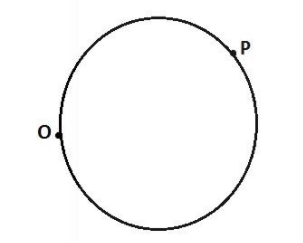
Particle P shown in the figure is moving in a circle of radius $R = 10cm$ with linear speed $v = 2m/s$. Find the angular speed of the particle about point O.
Answer
 Verified
249.9k+ views
Hint: The relationship between angular velocity and linear velocity has to be found. The values of the radius and linear velocity have to be substituted.
Formula Used: The formulae used in the solution are given here.
$\omega = \dfrac{v}{r}$ where, $v$ is the linear velocity and $r$ is the radius of the circular path.
Complete Step by Step Solution: Angular velocity is a vector quantity and is described as the rate of change of angular displacement which specifies the angular speed or rotational speed of an object and the axis about which the object is rotating. The amount of change of angular displacement of the particle at a given period of time is called angular velocity. The track of the angular velocity vector is vertical to the plane of rotation, in a direction which is usually indicated by the right-hand rule.
Mathematically, angular velocity $\omega = \dfrac{{d\theta }}{{dt}}$ where $d\theta $ is the change in angular displacement and $dt$ is the change in time $t$.
The Angular Velocity and Linear Velocity is articulated by the formula,
$\omega = \dfrac{v}{r}$ where, $v$ is the linear velocity and $r$ is the radius of the circular path.
Angular velocity is articulated in radian per second. Angular Velocity formula is used to compute the angular velocity of any moving body.
It has been given that particle P shown in figure is moving in a circle of radius $R = 10cm$ with linear speed $v = 2m/s$.
Thus, the angular velocity is given by, $\omega = \dfrac{v}{R}$. Substituting the values of the radius and velocity in this equation, we get,
$\omega = \dfrac{2}{{0.1}} = 20{s^{ - 1}}$.
Angular velocity about any point on circumference is given by, ${\omega _C} = \dfrac{\omega }{2}$.
Then the value of ${\omega _C}$ is given by, ${\omega _C} = \dfrac{{20}}{2} = 10{s^{ - 1}}$.
Note: A scalar measure of rotation rate is known as Angular Speed ($\omega $). In one complete rotation, angular distance travelled is $2\pi $ and time is time period ($T$) then, the angular speed is given by,
\[{\text{Angular Speed} = {2\pi }}/T\].
From the above equation, we can concur that $\omega $ is equivalent to $2\pi f$, where $1/T$ is equivalent to $f$ (frequency).
Thus, the rotation rate is also articulated as an angular frequency.
Formula Used: The formulae used in the solution are given here.
$\omega = \dfrac{v}{r}$ where, $v$ is the linear velocity and $r$ is the radius of the circular path.
Complete Step by Step Solution: Angular velocity is a vector quantity and is described as the rate of change of angular displacement which specifies the angular speed or rotational speed of an object and the axis about which the object is rotating. The amount of change of angular displacement of the particle at a given period of time is called angular velocity. The track of the angular velocity vector is vertical to the plane of rotation, in a direction which is usually indicated by the right-hand rule.
Mathematically, angular velocity $\omega = \dfrac{{d\theta }}{{dt}}$ where $d\theta $ is the change in angular displacement and $dt$ is the change in time $t$.
The Angular Velocity and Linear Velocity is articulated by the formula,
$\omega = \dfrac{v}{r}$ where, $v$ is the linear velocity and $r$ is the radius of the circular path.
Angular velocity is articulated in radian per second. Angular Velocity formula is used to compute the angular velocity of any moving body.
It has been given that particle P shown in figure is moving in a circle of radius $R = 10cm$ with linear speed $v = 2m/s$.
Thus, the angular velocity is given by, $\omega = \dfrac{v}{R}$. Substituting the values of the radius and velocity in this equation, we get,
$\omega = \dfrac{2}{{0.1}} = 20{s^{ - 1}}$.
Angular velocity about any point on circumference is given by, ${\omega _C} = \dfrac{\omega }{2}$.
Then the value of ${\omega _C}$ is given by, ${\omega _C} = \dfrac{{20}}{2} = 10{s^{ - 1}}$.
Note: A scalar measure of rotation rate is known as Angular Speed ($\omega $). In one complete rotation, angular distance travelled is $2\pi $ and time is time period ($T$) then, the angular speed is given by,
\[{\text{Angular Speed} = {2\pi }}/T\].
From the above equation, we can concur that $\omega $ is equivalent to $2\pi f$, where $1/T$ is equivalent to $f$ (frequency).
Thus, the rotation rate is also articulated as an angular frequency.
Recently Updated Pages
JEE Isolation, Preparation and Properties of Non-metals Important Concepts and Tips for Exam Preparation

Isoelectronic Definition in Chemistry: Meaning, Examples & Trends
Ionisation Energy and Ionisation Potential Explained
Iodoform Reactions - Important Concepts and Tips for JEE
Introduction to Dimensions: Understanding the Basics
Instantaneous Velocity Explained: Formula, Examples & Graphs
Trending doubts
JEE Main 2026: Exam Dates, Session 2 Updates, City Slip, Admit Card & Latest News
Hybridisation in Chemistry – Concept, Types & Applications
JEE Main 2026 Application Login: Direct Link, Registration, Form Fill, and Steps
Understanding the Electric Field of a Uniformly Charged Ring
Derivation of Equation of Trajectory Explained for Students
JEE Main Marking Scheme 2026- Paper-Wise Marks Distribution and Negative Marking Details
Other Pages
JEE Advanced Marks vs Ranks 2025: Understanding Category-wise Qualifying Marks and Previous Year Cut-offs
JEE Advanced 2026 - Exam Date (Released), Syllabus, Registration, Eligibility, Preparation, and More
CBSE Notes Class 11 Physics Chapter 1 - Units And Measurements - 2025-26
Important Questions For Class 11 Physics Chapter 1 Units and Measurement - 2025-26
NCERT Solutions For Class 11 Physics Chapter 1 Units And Measurements - 2025-26
CBSE Notes Class 11 Physics Chapter 4 - Laws of Motion - 2025-26