




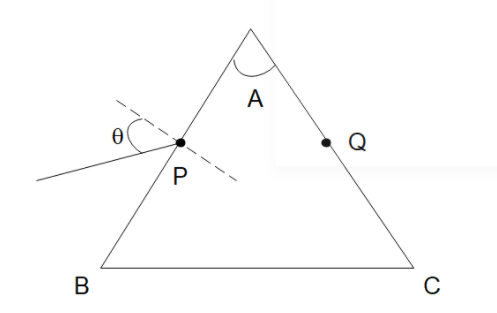
Monochromatic light is incident on a glass prism of angle A. If the refractive index of the material of the prism is \[\mu \], a ray incident at an angle \[\theta \], on the face AB would get transmitted through the face AC of the prism provided
A) \[\theta > si{n^{ - 1}}\left( {\mu sin\left( {A - si{n^{ - 1}}\left( {\dfrac{1}{\mu }} \right)} \right)} \right)\]
B) \[\theta < si{n^{ - 1}}\left( {\mu sin\left( {A - si{n^{ - 1}}\left( {\dfrac{1}{\mu }} \right)} \right)} \right)\]
C) \[\theta > {\cos ^{ - 1}}\left( {\mu sin\left( {A - si{n^{ - 1}}\left( {\dfrac{1}{\mu }} \right)} \right)} \right)\]
D) \[\theta < {\cos ^{ - 1}}\left( {\mu sin\left( {A - si{n^{ - 1}}\left( {\dfrac{1}{\mu }} \right)} \right)} \right)\]
Answer
 Verified
274.8k+ views
Hint: In this solution, we will use Schell’s law of refraction to determine the angle of refraction when the ray of light passes from the surface AB. This angle of refraction from the first surface should be such that the angle of incidence on the surface AC will be such that the ray will be internally reflected.
Formula used: In this solution, we will use the following formula:
Snell's law: ${\mu _1}\sin {\theta _1} = {\mu _2}\sin {\theta _2}$ where ${\mu _1}$ and ${\mu _2}$ are the refractive index of two different mediums and ${\theta _1}$ and ${\theta _2}$ are the angles made by the ray of light with the normal to the surface of refraction.
Complete step by step answer:
Let the angle of incidence on the surface AB be $\theta $. Then using Snell’s law on the first surface, the incident medium will be air so its refractive index will be 1.
$1\sin \theta = \mu \sin r$
Now the angle of incidence on the other surface will be $r'$. The relation between $r$ and $r'$ will be determined from the triangle APQ as the sum of all the angles in the triangle will be $180^\circ $.
$A + (90^\circ - r) + (90^\circ - r') = 180$
Which gives us
$r' = A - r$
Now for the surface, AC, the angle of incidence on the surface $r'$ will be such that the angle of reflection will be $90^\circ $ or greater which implies
$\mu \sin r' < 1\sin 90^\circ $
So, dividing both sides by $\mu $ and taking the sine inverse on both sides, we get
$r' < {\sin ^{ - 1}}\dfrac{1}{\mu }$
Since $r' = A - r$, we can write
$A - r < {\sin ^{ - 1}}\dfrac{1}{\mu }$
$r > A - {\sin ^{ - 1}}\dfrac{1}{\mu }$
Again as $1\sin \theta = \mu \sin r$, we can write
\[\theta > si{n^{ - 1}}\left( {\mu sin\left( {A - si{n^{ - 1}}\left( {\dfrac{1}{\mu }} \right)} \right)} \right)\] which corresponds to option (A).
Note: To solve such questions, we must be aware of the phenomenon of internal reflection and how it behaves in a prism. Unless mentioned otherwise, we must assume the medium outside the prism to be air and have a refractive index of 1.
Formula used: In this solution, we will use the following formula:
Snell's law: ${\mu _1}\sin {\theta _1} = {\mu _2}\sin {\theta _2}$ where ${\mu _1}$ and ${\mu _2}$ are the refractive index of two different mediums and ${\theta _1}$ and ${\theta _2}$ are the angles made by the ray of light with the normal to the surface of refraction.
Complete step by step answer:
Let the angle of incidence on the surface AB be $\theta $. Then using Snell’s law on the first surface, the incident medium will be air so its refractive index will be 1.
$1\sin \theta = \mu \sin r$
Now the angle of incidence on the other surface will be $r'$. The relation between $r$ and $r'$ will be determined from the triangle APQ as the sum of all the angles in the triangle will be $180^\circ $.
$A + (90^\circ - r) + (90^\circ - r') = 180$
Which gives us
$r' = A - r$
Now for the surface, AC, the angle of incidence on the surface $r'$ will be such that the angle of reflection will be $90^\circ $ or greater which implies
$\mu \sin r' < 1\sin 90^\circ $
So, dividing both sides by $\mu $ and taking the sine inverse on both sides, we get
$r' < {\sin ^{ - 1}}\dfrac{1}{\mu }$
Since $r' = A - r$, we can write
$A - r < {\sin ^{ - 1}}\dfrac{1}{\mu }$
$r > A - {\sin ^{ - 1}}\dfrac{1}{\mu }$
Again as $1\sin \theta = \mu \sin r$, we can write
\[\theta > si{n^{ - 1}}\left( {\mu sin\left( {A - si{n^{ - 1}}\left( {\dfrac{1}{\mu }} \right)} \right)} \right)\] which corresponds to option (A).
Note: To solve such questions, we must be aware of the phenomenon of internal reflection and how it behaves in a prism. Unless mentioned otherwise, we must assume the medium outside the prism to be air and have a refractive index of 1.
Recently Updated Pages
Mass vs Weight: Key Differences Explained for Students

Circuit Switching vs Packet Switching: Key Differences Explained
Uniform Acceleration Explained: Formula, Examples & Graphs
Length vs. Height: Key Differences Explained for Students
Rows vs Columns: Key Differences Explained Simply
Place Value vs Face Value: Key Differences Explained for Students
Trending doubts
JEE Main 2026: Exam Dates, Session 2 Updates, City Slip, Admit Card & Latest News
Understanding the Electric Field of a Uniformly Charged Ring
Understanding Atomic Structure for Beginners
Derivation of Equation of Trajectory Explained for Students
Electron Gain Enthalpy and Electron Affinity Explained
How to Convert a Galvanometer into an Ammeter or Voltmeter
Other Pages
JEE Advanced 2026 Notification Out with Exam Date, Registration (Extended), Syllabus and More
JEE Advanced Percentile vs Marks 2026: JEE Main Cutoff, AIR & IIT Admission Guide
CBSE Notes Class 11 Physics Chapter 1 - Units And Measurements - 2026-27
NCERT Solutions For Class 11 Physics Chapter 1 Units And Measurements - 2026-27
Important Questions For Class 11 Physics Chapter 1 Units and Measurement - 2026-27
JEE Advanced Weightage Chapter Wise 2026 for Physics, Chemistry, and Mathematics