









Step-by-Step Example: Finding the Sum of an Infinite GP
The sum of an infinite geometric progression (GP) is defined for common ratios whose absolute value is less than one, resulting in a finite sum for the series. The formal structure, derivation, and evaluation techniques are fundamental in advanced mathematics and competitive exam contexts such as JEE.
General Form and Notation of the Infinite Geometric Progression
Definition: A geometric progression is an ordered set $\{a, ar, ar^2, ar^3, \ldots\}$ where $a \neq 0$ is the first term and $r$ $(r \neq 0)$ is the common ratio, constant for all terms. The infinite GP sum refers to summing all terms as $n \to \infty$.
The sum of the first $n$ terms of a GP is denoted by $S_n = a + ar + ar^2 + \ldots + ar^{n-1}$, with the formula $S_n = a \frac{1 - r^n}{1 - r}$, $r \neq 1$. In the infinite case, $S_\infty = \lim_{n \to \infty} S_n$.
Derivation of the Infinite Geometric Progression Sum ($|r| < 1$)
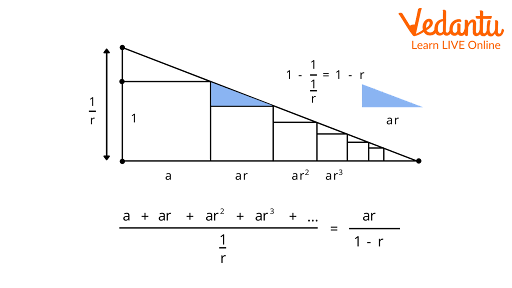
To derive the sum, consider $S = a + ar + ar^2 + ar^3 + \cdots$ with $|r| < 1$. Multiply both sides by $r$ to get $rS = ar + ar^2 + ar^3 + \cdots$. Subtracting, $S - rS = a$.
This gives $S(1 - r) = a$. Upon division, $S = \frac{a}{1 - r}$. Thus, the infinite GP sum converges only when $|r| < 1$.
Convergence Criteria for the Sum of an Infinite Geometric Series
The convergence of $S_\infty$ depends entirely on the common ratio. If $|r| \geq 1$, the terms do not approach zero, so the sum diverges. If $|r| < 1$, $r^n \to 0$ as $n \to \infty$, allowing the finite sum formula to simplify.
For $|r| < 1,$ $\lim_{n \to \infty} a r^n = 0,$ so $S_\infty = a/(1 - r)$ is strictly defined. For $|r| \geq 1$, the sum does not exist in the finite sense.
Formula Specification and Variable Roles in Infinite GP Sum
For $\{a, ar, ar^2, \ldots\}$, the result is $S_\infty = a/(1 - r)$, valid only if $|r| < 1$. Here, $a$ is the initial term, and $r$ is the constant ratio. If $|r| \geq 1$, the sum diverges to infinity or minus infinity, depending on the sign of $a$ and $r$.
Evaluation of Sums for Specific Infinite GP Series
For direct calculation, ensure to verify $|r| < 1$ before applying the sum formula. Cases with $|r| = 1$ (e.g., $r = 1$ or $r = -1$) are undefined in the context of convergence.
Illustrative Examples for Infinite GP Summation
Example: $S = 1 + \frac{1}{2} + \frac{1}{4} + \frac{1}{8} + \cdots$
Here, $a = 1$, $r = \frac{1}{2}$, so $|r| = \frac{1}{2} < 1$.
Substitute: $S = \frac{1}{1 - \frac{1}{2}} = 2$
Example: $S = 1 - \frac{1}{2} + \frac{1}{4} - \frac{1}{8} + \cdots$
Given $a = 1$, $r = -\frac{1}{2}$, so $|r| = \frac{1}{2} < 1$.
Compute: $S = \frac{1}{1-(-\frac{1}{2})} = \frac{1}{1.5} = \frac{2}{3}$
Example: $S = \frac{1}{3} + \frac{1}{9} + \frac{1}{27} + \cdots$
Here, $a = \frac{1}{3}$, $r = \frac{1}{3}$.
Calculate: $S = \frac{\frac{1}{3}}{1 - \frac{1}{3}} = \frac{\frac{1}{3}}{\frac{2}{3}} = \frac{1}{2}$
Example: $S = 3 - 6 + 12 - 24 + \cdots$
Here, $a = 3$, $r = -2$.
Since $|r| = 2 \geq 1$, the series diverges and the sum is not defined.
Example: $S = \frac{1}{3} + \frac{1}{25} + \frac{1}{27} + \frac{1}{625} + \cdots$
Group as two interleaved series.
First: $a_1 = \frac{1}{3}$, $r_1 = \frac{1}{9}$, yields $S_1 = \frac{\frac{1}{3}}{1 - \frac{1}{9}} = \frac{3}{8}$.
Second: $a_2 = \frac{1}{25}$, $r_2 = \frac{1}{25}$, gives $S_2 = \frac{\frac{1}{25}}{1 - \frac{1}{25}} = \frac{1}{24}$.
Final result: $S = \frac{3}{8} + \frac{1}{24} = \frac{10}{24} = \frac{5}{12}$.
Characteristic Misconceptions and Divergent Cases in Infinite GP
A common error is to apply the sum formula without checking if $|r| < 1$. For $|r| \geq 1$, terms remain large or oscillatory, and the sum formula is invalid. When $r=1$, consecutively added terms cannot form a finite sum.
For advanced practice on related topics, refer to Sum To Product Formulae and explore additional links to strengthen foundational skills.
- Standard form of infinite GP
- Convergence criterion for $|r|$
- Finite sum when $|r| < 1$
- Divergence when $|r| \geq 1$
- Stepwise sum derivation
- Representative worked examples
- Interleaved series evaluation


FAQs on How to Calculate the Sum of an Infinite Geometric Progression
1. What is the sum of an infinite geometric progression (GP)?
The sum of an infinite geometric progression (GP) is found when the absolute value of the common ratio is less than 1 (|r| < 1), and is calculated using the formula:
- Sum S = a / (1 - r), where a is the first term and r is the common ratio
- Applicable only when |r| < 1
- Useful for series that approach a finite value
2. What is the formula for the sum to infinity of a geometric series?
The formula for the sum to infinity of a geometric series is:
- S = a / (1 - r)
- Here, a is the first term;
- r is the common ratio
- This formula is valid only when |r| < 1
3. When does the sum of an infinite GP exist?
The sum of an infinite GP exists when the absolute value of the common ratio is strictly less than 1.
- If |r| < 1, the terms keep decreasing, and the sum converges to a finite value
- If |r| ≥ 1, the series diverges and does not have a finite sum
- This concept is crucial for questions on convergence in mathematics exams
4. How do you find the sum of infinite terms in a GP?
To find the sum of infinite terms in a GP, use the formula if |r| < 1.
- Identify the first term (a) and the common ratio (r)
- Apply S = a / (1 - r)
- Ensure |r| < 1 for validity
5. Why must |r| be less than 1 for the sum of an infinite GP?
The condition |r| < 1 is necessary for the sum to exist because:
- If |r| < 1, each term approaches zero as n increases, making the series converge
- If |r| ≥ 1, terms do not decrease to zero; the series diverges
- This ensures the infinite series does not grow indefinitely
6. Give an example of finding the sum of an infinite geometric progression.
Example: Find the sum of the infinite GP with a = 2 and r = 1/2.
- Since |r| = 1/2 < 1, formula applies
- S = 2 / (1 - 1/2) = 2 / (1/2) = 4
7. What are the applications of infinite GP sums in real life?
The sum of infinite GP has various real-life applications:
- Calculating recurring decimals as fractions
- Finding present value in finance (annuities)
- Physics: Damping, signal processing, population models
- Computer science: Certain algorithms and error correction
8. What is the condition for convergence of an infinite GP?
An infinite GP converges if the absolute value of its common ratio is less than one.
- If |r| < 1 – the series converges (finite sum)
- If |r| ≥ 1 – the series diverges (no finite sum)
9. What happens if the common ratio is negative in an infinite GP?
When the common ratio is negative but |r| < 1, the infinite GP’s terms alternate in sign and the sum converges.
- Example: a = 3, r = -1/2 → S = 3 / (1 - (-1/2)) = 3 / (1 + 1/2) = 3 / (3/2) = 2
- The sum exists as long as |r| < 1
- The terms form an alternating series
10. Can the sum of an infinite geometric series be negative?
Yes, the sum of an infinite GP can be negative if either the first term or the common ratio is negative and |r| < 1.
- For example, if a = -3, r = 1/2, then S = -3 / (1-1/2) = -6
- Sign of the sum depends on the values of a and r
11. What is the general term of a geometric progression?
The general term of a geometric progression is given by:
- Tn = a × rn-1
- a – first term
- r – common ratio
- n – term number
