




Iodine oxidises sodium borohydride to give:
A) ${B_2}{H_6}$
B) Sodium hydride
C) $HI$
D) ${I_3}^{ - 1}$
Answer
 Verified
288.6k+ views
Hint: Hydrogen borohydride is a minor reducing agent. It does selective reduction and it reduces substances by transfer of hydride ions (${H^ - }$).
Complete step by step solution:
-Sodium borohydride is an organic compound with molecular formula: $NaB{H_4}$. It is a salt consisting of a tetrahedral ($B{H_4}^ - $).
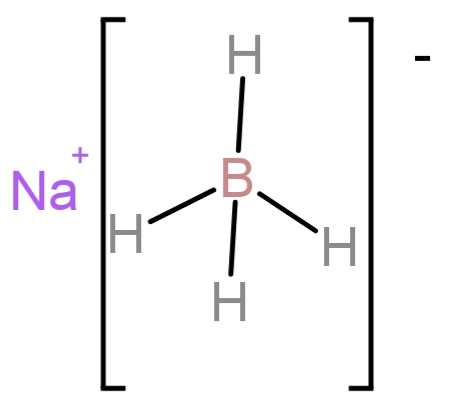
-It is an effective source of nucleophilic hydride ions in polar aprotic solvents like sulfolane, DMSO, DMF, HMPA or diglyme.
- So, it acts as a minor reducing agent and does selective reduction that is it reduces aldehydes and ketones to corresponding alcohols. It does not reduce double bonds. It reduces substance by transfer of the hydride ions.
-When one sodium borohydride molecule reacts with iodine, a borane ($B{H_3}$) molecule is produced along with sodium iodide ($NaI$) and hydrogen iodide ($HI$). Hydrogen iodide then reacts with another sodium borohydride molecule producing another borane and hydrogen iodide molecule. These 2 borane molecules thus do the bridging forming diborane (${B_2}{H_6}$). This is shown in the below reaction:
$NaB{H_4} + {I_2} \to B{H_3} + NaI + HI\xrightarrow{{NaB{H_4}}}B{H_3} + HI$
-This reaction takes place in the presence of Diglyme which acts as a catalyst.
-So, this reaction can also be written as:
$2NaB{H_4} + {I_2}\xrightarrow{{Diglyme}}2NaI + {B_2}{H_6} + {H_2}$
So, the correct option is: A) ${B_2}{H_6}$
Additional information: Diborane is found to be a rocket propellant because it is highly flammable. It undergoes a highly exothermic complete combustion. But it is unable to undergo complete combustion in a rocket engine and thus produces some amount of boron monoxide ($BO$).
Note: Before attempting read the question carefully about iodine oxidising sodium borohydride and not the other way round. And do not get confused between reducing agent (donates electron) and oxidising agent (accepts electron).
Complete step by step solution:
-Sodium borohydride is an organic compound with molecular formula: $NaB{H_4}$. It is a salt consisting of a tetrahedral ($B{H_4}^ - $).
-It is an effective source of nucleophilic hydride ions in polar aprotic solvents like sulfolane, DMSO, DMF, HMPA or diglyme.
- So, it acts as a minor reducing agent and does selective reduction that is it reduces aldehydes and ketones to corresponding alcohols. It does not reduce double bonds. It reduces substance by transfer of the hydride ions.
-When one sodium borohydride molecule reacts with iodine, a borane ($B{H_3}$) molecule is produced along with sodium iodide ($NaI$) and hydrogen iodide ($HI$). Hydrogen iodide then reacts with another sodium borohydride molecule producing another borane and hydrogen iodide molecule. These 2 borane molecules thus do the bridging forming diborane (${B_2}{H_6}$). This is shown in the below reaction:
$NaB{H_4} + {I_2} \to B{H_3} + NaI + HI\xrightarrow{{NaB{H_4}}}B{H_3} + HI$
-This reaction takes place in the presence of Diglyme which acts as a catalyst.
-So, this reaction can also be written as:
$2NaB{H_4} + {I_2}\xrightarrow{{Diglyme}}2NaI + {B_2}{H_6} + {H_2}$
So, the correct option is: A) ${B_2}{H_6}$
Additional information: Diborane is found to be a rocket propellant because it is highly flammable. It undergoes a highly exothermic complete combustion. But it is unable to undergo complete combustion in a rocket engine and thus produces some amount of boron monoxide ($BO$).
Note: Before attempting read the question carefully about iodine oxidising sodium borohydride and not the other way round. And do not get confused between reducing agent (donates electron) and oxidising agent (accepts electron).
Recently Updated Pages
JEE Main 2023 (February 1st Shift 2) Physics Question Paper with Answer Key

JEE Main 2023 (February 1st Shift 1) Maths Question Paper with Answer Key
JEE Main 2023 (February 1st Shift 2) Chemistry Question Paper with Answer Key
Hydrogen and Its Type Important Concepts and Tips for JEE Exam Preparation
Concept of CP and CV of Gas - Important Concepts and Tips for JEE
[Awaiting the three content sources: Ask AI Response, Competitor 1 Content, and Competitor 2 Content. Please provide those to continue with the analysis and optimization.]
Trending doubts
Electron Gain Enthalpy and Electron Affinity Explained
Understanding the Different Types of Solutions in Chemistry
Understanding Atomic Structure for Beginners
Understanding the Angle of Deviation in a Prism
Understanding Average and RMS Value in Electrical Circuits
Understanding Elastic Collisions in Two Dimensions
Other Pages
JEE Advanced Weightage Chapter Wise 2026 for Physics, Chemistry, and Mathematics
NCERT Solutions For Class 11 Chemistry Chapter 8 Organic Chemistry - Some Basic Principles And Techniques - 2026-27 Free PDF Download (Sign-in Required)
JEE Advanced 2026 Marks vs Rank: Estimate IIT Rank from Your Score
CBSE Notes Class 11 Chemistry Chapter 9 - Hydrocarbons - 2026-27 PDF Download (Login Required)
Understanding Collisions: Types and Examples for Students
How Temperature Influences Electrical Resistance