




In Young's double slit experiment, in an interference pattern second minimum is observed exactly in front of one slit. The distance between the two coherent sources is ′d′ and the distance between source and screen is ′D′. The wavelength of light source used is :
(A) $\dfrac{{{d^2}}}{D}$
(B) $\dfrac{{{d^2}}}{{2D}}$
(C) $\dfrac{{{d^2}}}{{3D}}$
(D) $\dfrac{{{d^2}}}{{4D}}$
Answer
 Verified
283.8k+ views
Hint: As this is the case of young double slit experiment and minima is formed so the condition of minima is used in the required formula of the path difference i.e. $Y = \left( {n + \dfrac{1}{2}} \right)\dfrac{{\lambda D}}{d}$, Y is the position of second minima in front of one slit i.e. $Y = \dfrac{d}{2}$, here n is order of fringe and for second minima n=1, then substitute the values and we will get the value of wavelength.
Diagram:
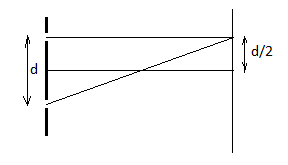
Complete step by step solution:
Minima is produced when the crust of one wave falls on the trough of another wave. Here, a second minima is produced in front of one slit so we use the condition of dark fringes.
The position of second minima just in front of one slit $Y = \dfrac{d}{2}$
The formula for minima is $Y = \left( {n + \dfrac{1}{2}} \right)\dfrac{{\lambda D}}{d}$…………………………(1)
Where, λ is the wavelength of light used
D is the distance of screen from the slit
D isn the distance between the slits
n is the order of fringes
For second minimum n=1 then put these values in equation (1) we get,
⇒ $\dfrac{d}{2} = \left( {1 + \dfrac{1}{2}} \right)\dfrac{{\lambda D}}{d} = \dfrac{{3\lambda D}}{{2d}}$
⇒ $\lambda = \dfrac{{2{d^2}}}{{6D}} = \dfrac{{{d^2}}}{{3D}}$
This the required value of wavelength used. Hence, C option is correct.
Note: As here we are talking about the second minima so just remember that for second minima n is equal to 1. And we must use the correct formula that the position of the fringe is equal to the odd multiple of fringe width. i.e. $Y = \left( {n + \dfrac{1}{2}} \right)\dfrac{{\lambda D}}{d}$, where $\dfrac{{\lambda D}}{d}$ is the fringe width which is the distance between the two crust and trough.
Diagram:
Complete step by step solution:
Minima is produced when the crust of one wave falls on the trough of another wave. Here, a second minima is produced in front of one slit so we use the condition of dark fringes.
The position of second minima just in front of one slit $Y = \dfrac{d}{2}$
The formula for minima is $Y = \left( {n + \dfrac{1}{2}} \right)\dfrac{{\lambda D}}{d}$…………………………(1)
Where, λ is the wavelength of light used
D is the distance of screen from the slit
D isn the distance between the slits
n is the order of fringes
For second minimum n=1 then put these values in equation (1) we get,
⇒ $\dfrac{d}{2} = \left( {1 + \dfrac{1}{2}} \right)\dfrac{{\lambda D}}{d} = \dfrac{{3\lambda D}}{{2d}}$
⇒ $\lambda = \dfrac{{2{d^2}}}{{6D}} = \dfrac{{{d^2}}}{{3D}}$
This the required value of wavelength used. Hence, C option is correct.
Note: As here we are talking about the second minima so just remember that for second minima n is equal to 1. And we must use the correct formula that the position of the fringe is equal to the odd multiple of fringe width. i.e. $Y = \left( {n + \dfrac{1}{2}} \right)\dfrac{{\lambda D}}{d}$, where $\dfrac{{\lambda D}}{d}$ is the fringe width which is the distance between the two crust and trough.
Recently Updated Pages
Properties of Solids and Liquids Mock Test 2025

JEE Main Mock Test 2025-26: Dual Nature of Matter & Radiation
JEE Main 2025-26 Work, Energy and Power Mock Test – Free Practice Online
JEE Main Mock Test 2025-26: Experimental Skills Chapter Online Practice
JEE Main 2025-26 Mock Test: Properties of Solids and Liquids
JEE Main 2025 Kinetic Theory Of Gases Mock Test: Practice & Solutions
Trending doubts
JEE Main 2026: Exam Dates, Session 2 Updates, City Slip, Admit Card & Latest News
Understanding the Electric Field of a Uniformly Charged Ring
Understanding Atomic Structure for Beginners
Derivation of Equation of Trajectory Explained for Students
Electron Gain Enthalpy and Electron Affinity Explained
How to Convert a Galvanometer into an Ammeter or Voltmeter
Other Pages
CBSE Class 12 Physics Question Paper 2026: Download SET-wise PDF with Answer Key & Analysis
JEE Advanced Percentile vs Marks 2026: JEE Main Cutoff, AIR & IIT Admission Guide
JEE Advanced 2026 Notification Out with Exam Date, Registration (Extended), Syllabus and More
Understanding Uniform Acceleration in Physics
Understanding Electromagnetic Waves and Their Importance
Understanding Instantaneous Velocity