




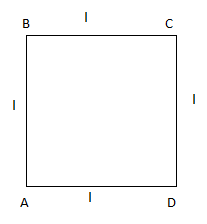
In the square frame of side l of metallic rods, corners A and C are maintained at ${T_1}$ and ${T_2}$ respectively. The rate of heat flow from A to C is ω. If A and D are instead maintained at ${T_1}$ and ${T_2}$ respectively, the total rate of heat flow is \[\left( {\dfrac{x}{3}} \right)\omega \]. Find ‘x’.
Answer
 Verified
265.2k+ views
Hint: The amount of heat transferred per unit of time in the material is called the rate of heat flow. The rate of heat flow depends on the conductivity of the material, the cross sectional area and the temperature difference between the objects.
Complete step by step solution:
Given data:
The Side of the square = l
The rate of heat flow from A to C = $\omega $
X =?
We know that thermal resistance, R is given by the formula,
$R = \dfrac{L}{{KA}}$
Where R is the resistance, L is the length of the conductor, K is thermal conductivity, and, A is the cross
Sectional area.
It is given that A and C are maintained at a temperature ${T_1}$ and ${T_2}$respectively. Thus we can consider that ${R_{AB}}$ and ${R_{BC}}$ are in series.
Thus ${R_{AC - upper}} = {R_{AB}} + {R_{BC}} = \dfrac{L}{{KA}} + \dfrac{L}{{KA}} = \dfrac{{2L}}{{KA}}$ and
${R_{AC - lower}} = {R_{AD}} + {R_{DC}} = \dfrac{L}{{KA}} + \dfrac{L}{{KA}} = \dfrac{{2L}}{{KA}}$
Thus ${R_{AC - upper}}$and \[{R_{AC - lower}}\]will be in parallel.
$\therefore \dfrac{1}{{{R_{AC}}}} = \dfrac{1}{{{R_{Ac - upper}}}} + \dfrac{1}{{{R_{AC - lower}}}}$
$ \Rightarrow {R_{AC}} = \dfrac{L}{{KA}}$
Thus, \[{\left( {\dfrac{{dQ}}{{dt}}} \right)_{AC}} = \dfrac{{{T_2} - {T_1}}}{{{R_{AC}}}} = \left( {{T_2} - {T_1}} \right)\dfrac{{KA}}{L} = \omega \]
( $\because $ it is given that the rate of heat flow from A to C is $\omega $)
It is also given that A and D are maintained at a temperature ${T_1}$ and ${T_2}$respectively. Thus we can consider that ${R_{AB}}$ , ${R_{BC}}$, and, ${R_{CD}}$ are in series.
$\therefore {\dfrac{1}{{\left( {{R_{AD}}} \right)}}_{equ}} = \dfrac{{{R_{AB}} + {R_{BC}} + {R_{CD}}}}{{{R_{AD}}}}$
$ \Rightarrow {\dfrac{1}{{\left( {{R_{AD}}} \right)}}_{equ}} = \dfrac{{\dfrac{L}{{KA}} + \dfrac{L}{{KA}} + \dfrac{L}{{KA}}}}{{\dfrac{L}{{KA}}}}$
\[ \Rightarrow {\left( {{R_{AD}}} \right)_{equ}} = \dfrac{{3L}}{{4KA}}\]
Thus, \[{\left( {\dfrac{{dQ}}{{dt}}} \right)_{AD}} = \dfrac{{{T_2} - {T_1}}}{{{{\left( {{R_{AD}}} \right)}_{equ}}}} = \dfrac{{\left( {{T_2} - {T_1}} \right)}}{{\dfrac{{3L}}{{4KA}}}} = \dfrac{4}{3}\omega \]
( $\because $ it is given that the rate of heat flow from A to D is \[\left( {\dfrac{x}{3}} \right)\omega \])
Thus, $x = 4$.
Note: 1. The flow which is caused due to the temperature difference between the two objects is called heat. It is represented by the letter Q and the unit is Joule.
2. When heat flows into the system, the heat flow will be positive and when heat flows out the system, the heat flow will be negative.
Complete step by step solution:
Given data:
The Side of the square = l
The rate of heat flow from A to C = $\omega $
X =?
We know that thermal resistance, R is given by the formula,
$R = \dfrac{L}{{KA}}$
Where R is the resistance, L is the length of the conductor, K is thermal conductivity, and, A is the cross
Sectional area.
It is given that A and C are maintained at a temperature ${T_1}$ and ${T_2}$respectively. Thus we can consider that ${R_{AB}}$ and ${R_{BC}}$ are in series.
Thus ${R_{AC - upper}} = {R_{AB}} + {R_{BC}} = \dfrac{L}{{KA}} + \dfrac{L}{{KA}} = \dfrac{{2L}}{{KA}}$ and
${R_{AC - lower}} = {R_{AD}} + {R_{DC}} = \dfrac{L}{{KA}} + \dfrac{L}{{KA}} = \dfrac{{2L}}{{KA}}$
Thus ${R_{AC - upper}}$and \[{R_{AC - lower}}\]will be in parallel.
$\therefore \dfrac{1}{{{R_{AC}}}} = \dfrac{1}{{{R_{Ac - upper}}}} + \dfrac{1}{{{R_{AC - lower}}}}$
$ \Rightarrow {R_{AC}} = \dfrac{L}{{KA}}$
Thus, \[{\left( {\dfrac{{dQ}}{{dt}}} \right)_{AC}} = \dfrac{{{T_2} - {T_1}}}{{{R_{AC}}}} = \left( {{T_2} - {T_1}} \right)\dfrac{{KA}}{L} = \omega \]
( $\because $ it is given that the rate of heat flow from A to C is $\omega $)
It is also given that A and D are maintained at a temperature ${T_1}$ and ${T_2}$respectively. Thus we can consider that ${R_{AB}}$ , ${R_{BC}}$, and, ${R_{CD}}$ are in series.
$\therefore {\dfrac{1}{{\left( {{R_{AD}}} \right)}}_{equ}} = \dfrac{{{R_{AB}} + {R_{BC}} + {R_{CD}}}}{{{R_{AD}}}}$
$ \Rightarrow {\dfrac{1}{{\left( {{R_{AD}}} \right)}}_{equ}} = \dfrac{{\dfrac{L}{{KA}} + \dfrac{L}{{KA}} + \dfrac{L}{{KA}}}}{{\dfrac{L}{{KA}}}}$
\[ \Rightarrow {\left( {{R_{AD}}} \right)_{equ}} = \dfrac{{3L}}{{4KA}}\]
Thus, \[{\left( {\dfrac{{dQ}}{{dt}}} \right)_{AD}} = \dfrac{{{T_2} - {T_1}}}{{{{\left( {{R_{AD}}} \right)}_{equ}}}} = \dfrac{{\left( {{T_2} - {T_1}} \right)}}{{\dfrac{{3L}}{{4KA}}}} = \dfrac{4}{3}\omega \]
( $\because $ it is given that the rate of heat flow from A to D is \[\left( {\dfrac{x}{3}} \right)\omega \])
Thus, $x = 4$.
Note: 1. The flow which is caused due to the temperature difference between the two objects is called heat. It is represented by the letter Q and the unit is Joule.
2. When heat flows into the system, the heat flow will be positive and when heat flows out the system, the heat flow will be negative.
Recently Updated Pages
JEE Main Mock Test 2025-26: Principles Related To Practical

JEE Main 2025-26 Experimental Skills Mock Test – Free Practice
JEE Main 2025-26 Electronic Devices Mock Test: Free Practice Online
JEE Main 2025-26 Mock Tests: Free Practice Papers & Solutions
JEE Main 2025-26: Magnetic Effects of Current & Magnetism Mock Test
JEE Main Statistics and Probability Mock Test 2025-26
Trending doubts
JEE Main 2026: Exam Dates, Session 2 Updates, City Slip, Admit Card & Latest News
JEE Main Participating Colleges 2026 - A Complete List of Top Colleges
Hybridisation in Chemistry – Concept, Types & Applications
Understanding the Electric Field of a Uniformly Charged Ring
Derivation of Equation of Trajectory Explained for Students
Understanding Atomic Structure for Beginners
Other Pages
JEE Advanced 2026 Notification Out with Exam Date, Registration (Extended), Syllabus and More
JEE Advanced Percentile vs Marks 2026: JEE Main Cutoff, AIR & IIT Admission Guide
CBSE Notes Class 11 Physics Chapter 1 - Units And Measurements - 2025-26
JEE Advanced Marks vs Rank 2025 - Predict Your IIT Rank Based on Score
NCERT Solutions For Class 11 Physics Chapter 1 Units And Measurements - 2025-26
Important Questions For Class 11 Physics Chapter 1 Units and Measurement - 2025-26