




In the given figure, mass of man is $60\,Kg$ and the reading of weighing machine is $90\,Kg$ , the acceleration lift is:
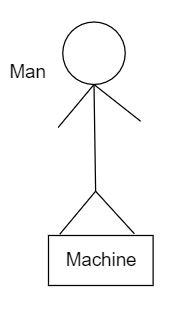
A) $\dfrac{g}{2}$ in upward direction
B) $g$ in upward direction
C) $\dfrac{g}{2}$ in downward direction
D) $g$ in downward direction
Answer
 Verified
260.7k+ views
Hint: From the diagram given in the question, assume that the machine is upward lifting, then the equivalent forces are considered. From that find the value of the accelerating potential and whether it acts upward or downward by comparing the value of the true and the reading weight.
Useful formula:
The newton’s second law of motion is given by
$F = ma$
Where the $F$ is the force acting on the man, $m$ is the mass of the man and $a$ is the accelerating potential of the man.
Complete step by step solution:
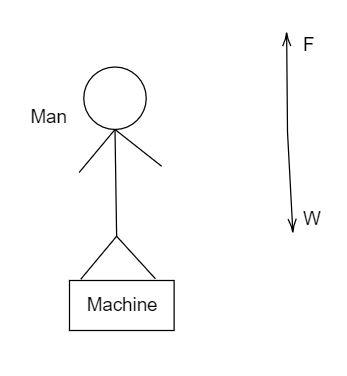
The true weight of the man, $w = 60\,Kg$
The reading weight of the man by the weighing machine, $W = 90\,Kg$
From the diagram it is clear that
$W = w + F$
Substitute the formula of the newton’s law of motion in the above step,
$W = w + ma$
The weight of the man is converted into the true mass by multiplying it with the gravity.
Substitute the value of the weight of the man and the reading of the weighing machine in the above step,
$90g = 60 + 60a$
Simplifying the above equation,
$60a = 30g$
By the further simplification,
$a = \dfrac{g}{2}$
The value of the reading provided by the machine is more than the true man weight. Hence the machine must be accelerated upward.
Thus the option (A) is correct.
Note: In case if the lift of the weighing machine acts downward, the reading shown by the machine as the weight of the man must be less when compared to that of the true weight of the man. In this case it is a downward lifting machine, it should show a weight less than the true weight of the man.
Useful formula:
The newton’s second law of motion is given by
$F = ma$
Where the $F$ is the force acting on the man, $m$ is the mass of the man and $a$ is the accelerating potential of the man.
Complete step by step solution:
The true weight of the man, $w = 60\,Kg$
The reading weight of the man by the weighing machine, $W = 90\,Kg$
From the diagram it is clear that
$W = w + F$
Substitute the formula of the newton’s law of motion in the above step,
$W = w + ma$
The weight of the man is converted into the true mass by multiplying it with the gravity.
Substitute the value of the weight of the man and the reading of the weighing machine in the above step,
$90g = 60 + 60a$
Simplifying the above equation,
$60a = 30g$
By the further simplification,
$a = \dfrac{g}{2}$
The value of the reading provided by the machine is more than the true man weight. Hence the machine must be accelerated upward.
Thus the option (A) is correct.
Note: In case if the lift of the weighing machine acts downward, the reading shown by the machine as the weight of the man must be less when compared to that of the true weight of the man. In this case it is a downward lifting machine, it should show a weight less than the true weight of the man.
Recently Updated Pages
Algebra Made Easy: Step-by-Step Guide for Students

JEE Isolation, Preparation and Properties of Non-metals Important Concepts and Tips for Exam Preparation
JEE Energetics Important Concepts and Tips for Exam Preparation
Chemical Properties of Hydrogen - Important Concepts for JEE Exam Preparation
JEE General Topics in Chemistry Important Concepts and Tips
JEE Amino Acids and Peptides Important Concepts and Tips for Exam Preparation
Trending doubts
JEE Main 2026: Exam Dates, Session 2 Updates, City Slip, Admit Card & Latest News
JEE Main Participating Colleges 2026 - A Complete List of Top Colleges
Hybridisation in Chemistry – Concept, Types & Applications
Understanding the Electric Field of a Uniformly Charged Ring
Derivation of Equation of Trajectory Explained for Students
Understanding Atomic Structure for Beginners
Other Pages
JEE Advanced 2026 Notification Out with Exam Date, Registration (Extended), Syllabus and More
JEE Advanced Marks vs Ranks 2025: Understanding Category-wise Qualifying Marks and Previous Year Cut-offs
CBSE Notes Class 11 Physics Chapter 1 - Units And Measurements - 2025-26
NCERT Solutions For Class 11 Physics Chapter 1 Units And Measurements - 2025-26
Important Questions For Class 11 Physics Chapter 1 Units and Measurement - 2025-26
JEE Advanced Weightage Chapter Wise 2026 for Physics, Chemistry, and Mathematics