




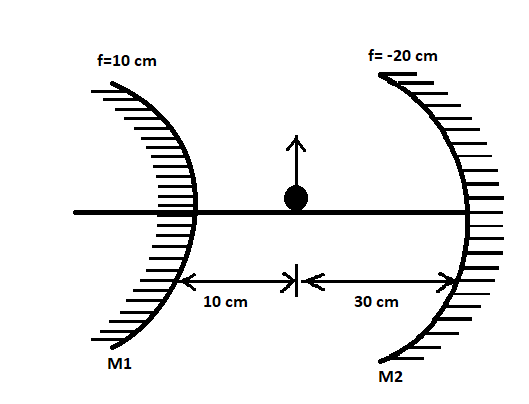
In the figure shown, find the total magnification after two successive reflections first on ${M_1}$ and then on ${M_2}$ .
A. $ + 1$
B. $ - 2$
C. $ + 2$
D. $ - 1$
Answer
 Verified
271.2k+ views
Hint: The two reflections M1 and M2's magnification must first be determined. Here, we need to use the mirror formula to find the image distance i.e, v. The value of u, is already given. After that, we can find the total magnification.
Formula used:
1. Mirror Formula:
$\dfrac{1}{f} = \dfrac{1}{v} + \dfrac{1}{u}$ … (1)
Here, $f$ is the focal length of the mirror,
$u$ is the object distance and
$v$ is the image distance.
Magnification :
$M=-\dfrac{v}{u}$
Magnification = ${M_1} \times {M_2}$
Complete answer:
Let’s first determine $M_{1}$’s magnification:
Given:
Mirror1’s distance from the object is u=-30
The focal length is f=-20cm
The image’s distance from the mirror is given by, v which needs to be determined.
According to the mirror formula,
$\dfrac{1}{f} = \dfrac{1}{v} + \dfrac{1}{u}$
Rearranging the equation,
$\dfrac{1}{v} = \dfrac{1}{f} - \dfrac{1}{u}$
By putting the values in the above equation we get that,
$\dfrac{1}{v} = \dfrac{1}{{ - 20}} + \dfrac{1}{{30}}$
Further solving we get,
$v = \dfrac{{ - 20 \times 30}}{{10}}$
By completing the calculation we get the value of v as,
$v = - 60cm$
Now $M_{1}$ will be,
$M_{1}=-\dfrac{v}{u}$
By putting the values in the above equation we get,
$M_{1}=-\dfrac{-60}{-30}$
$M_{1}=-2$
Next, determine $M_{2}$'s magnification:
Given:
Mirror1’s distance from the object is u=20 (The image that is created will serve as an object for ${M_2}$ and will be located 20cm left of ${M_2}$ )
The focal length is f=10cm
The image’s distance from the mirror is given by, v which needs to be determined.
Let’s put values in the above-used mirror formula to find v.
$\dfrac{1}{v} = \dfrac{1}{{10}} - \dfrac{1}{{20}}$
Further solving we get,
$v = \dfrac{{10 \times 20}}{{10}} = 20cm$
Now $M_{2}$ will be,
$M_{2}=-\dfrac{v}{u}$
By putting the values in the above equation we get,
$M_{2}=-\dfrac{20}{20}$
$M_{1}=-1$
The total magnification can be determined by the below-mentioned formula,
Magnification = ${M_1} \times {M_2}$
By putting the value we get that,
Magnification = $M=\lgroup-2\rgroup\times\lgroup-1\rgroup$
Therefore, the total magnification is 2.
The correct option is C.
Note:Be careful regarding sign convention. All distances are calculated starting at the mirror's pole. Also, the image that is created will serve as an object for ${M_2}$. So, don’t take the object distance for ${M_2}$ to be 30 cm by blindly following the diagram.
Formula used:
1. Mirror Formula:
$\dfrac{1}{f} = \dfrac{1}{v} + \dfrac{1}{u}$ … (1)
Here, $f$ is the focal length of the mirror,
$u$ is the object distance and
$v$ is the image distance.
Magnification :
$M=-\dfrac{v}{u}$
Magnification = ${M_1} \times {M_2}$
Complete answer:
Let’s first determine $M_{1}$’s magnification:
Given:
Mirror1’s distance from the object is u=-30
The focal length is f=-20cm
The image’s distance from the mirror is given by, v which needs to be determined.
According to the mirror formula,
$\dfrac{1}{f} = \dfrac{1}{v} + \dfrac{1}{u}$
Rearranging the equation,
$\dfrac{1}{v} = \dfrac{1}{f} - \dfrac{1}{u}$
By putting the values in the above equation we get that,
$\dfrac{1}{v} = \dfrac{1}{{ - 20}} + \dfrac{1}{{30}}$
Further solving we get,
$v = \dfrac{{ - 20 \times 30}}{{10}}$
By completing the calculation we get the value of v as,
$v = - 60cm$
Now $M_{1}$ will be,
$M_{1}=-\dfrac{v}{u}$
By putting the values in the above equation we get,
$M_{1}=-\dfrac{-60}{-30}$
$M_{1}=-2$
Next, determine $M_{2}$'s magnification:
Given:
Mirror1’s distance from the object is u=20 (The image that is created will serve as an object for ${M_2}$ and will be located 20cm left of ${M_2}$ )
The focal length is f=10cm
The image’s distance from the mirror is given by, v which needs to be determined.
Let’s put values in the above-used mirror formula to find v.
$\dfrac{1}{v} = \dfrac{1}{{10}} - \dfrac{1}{{20}}$
Further solving we get,
$v = \dfrac{{10 \times 20}}{{10}} = 20cm$
Now $M_{2}$ will be,
$M_{2}=-\dfrac{v}{u}$
By putting the values in the above equation we get,
$M_{2}=-\dfrac{20}{20}$
$M_{1}=-1$
The total magnification can be determined by the below-mentioned formula,
Magnification = ${M_1} \times {M_2}$
By putting the value we get that,
Magnification = $M=\lgroup-2\rgroup\times\lgroup-1\rgroup$
Therefore, the total magnification is 2.
The correct option is C.
Note:Be careful regarding sign convention. All distances are calculated starting at the mirror's pole. Also, the image that is created will serve as an object for ${M_2}$. So, don’t take the object distance for ${M_2}$ to be 30 cm by blindly following the diagram.
Recently Updated Pages
JoSAA Counselling 2026: JoSAA 2026 Mock Seat Allotment LIVE: Round 2 Result Released, Registration, Choice Filling and Ranks

Circuit Switching vs Packet Switching: Key Differences Explained
JEE General Topics in Chemistry Important Concepts and Tips
JEE Extractive Metallurgy Important Concepts and Tips for Exam Preparation
JEE Atomic Structure and Chemical Bonding important Concepts and Tips
JEE Amino Acids and Peptides Important Concepts and Tips for Exam Preparation
Trending doubts
JEE Main 2026: Exam Dates, Session 2 Updates, City Slip, Admit Card & Latest News
JEE Main Participating Colleges 2026 - A Complete List of Top Colleges
Kinematics Mock Test for JEE Main 2025-26: Comprehensive Practice
Understanding the Electric Field of a Uniformly Charged Ring
Understanding Atomic Structure for Beginners
Derivation of Equation of Trajectory Explained for Students
Other Pages
CBSE Class 12 Physics Question Paper 2026: Download SET-wise PDF with Answer Key & Analysis
JEE Advanced 2026 Notification Out with Exam Date, Registration (Extended), Syllabus and More
JEE Advanced Percentile vs Marks 2026: JEE Main Cutoff, AIR & IIT Admission Guide
JEE Advanced Weightage Chapter Wise 2026 for Physics, Chemistry, and Mathematics
JEE Main Marking Scheme 2026- Paper-Wise Marks Distribution and Negative Marking Details
Kinematics Mock Test for JEE Main 2025-26: Practice & Ace the Exam