




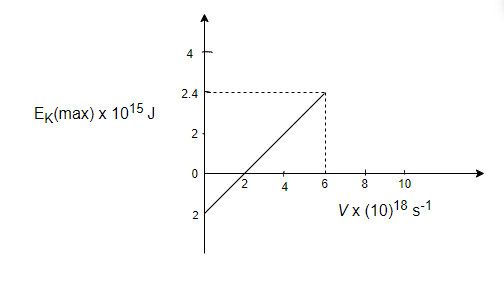
In the experiment on the photoelectric effect, the graph between \[\mathop E\nolimits_K (\max )\] and \[\nu \] is found to be a straight line as shown in fig. The threshold frequency and Planck's constant according to this graph are:
A) \[3.33 \times \mathop {10}\nolimits^{18} \]$s^{-1}$, \[6 \times \mathop {10}\nolimits^{ - 34} \]J-s
B) \[6 \times \mathop {10}\nolimits^{18} \] $s^{-1}$, \[6 \times \mathop {10}\nolimits^{ - 34} \] J-s
C) \[2.66 \times \mathop {10}\nolimits^{18} \] $s^{-1}$, \[4 \times \mathop {10}\nolimits^{ - 34} \] J-s
D) \[4 \times \mathop {10}\nolimits^{18} \] $s^{-1}$, \[3 \times \mathop {10}\nolimits^{ - 34} \] J-s
Answer
 Verified
265.2k+ views
Hint: This given problem can be solved by Einstein’s photoelectric equation. Einstein explained the various laws of photoelectric emission on the basis of Planck’s quantum theory. According to Planck’s quantum theory, the energy of a photon is given by \[E = h\nu \].
Complete step by step solution:
Step 1:
Einstein assumed that one photoelectron is ejected from a metal surface if one photon of suitable light radiation falls on it.
Let us consider a photon of light of frequency \[\nu \], incident on a photosensitive metal surface. The energy of the photon is \[h\nu \], spent in two ways:
A part of the energy of the photon will be used in liberating the electron from the metal surface which is equal to the work function \[\mathop \phi \nolimits_0 \] of the metal.
The rest of the energy of the photon will be used in imparting the maximum kinetic energy \[\mathop K\nolimits_{\max } \] to the emitted photoelectron.
So, from above two points, we will get-
\[h\nu = \mathop \phi \nolimits_0 + \mathop K\nolimits_{\max } \].................(1)
This equation (1) is known as Einstein’s photoelectric equation.
Step 2: Now from the equation (1) –
\[h\nu = \mathop \phi \nolimits_0 + \mathop K\nolimits_{\max } \]; where \[\mathop \phi \nolimits_0 = \]work function of metal, \[h = \]Planck’s constant, and \[\nu = \]frequency of incident photon
If we rearrange the equation (1) in the form of \[\mathop K\nolimits_{\max } = h\nu + \mathop \phi \nolimits_0 \] and this equation can be compared with the \[y = mx + c\] .
So, the slope of the given line will be \[h\] and the intercept will be \[ - \mathop \phi \nolimits_0 \].
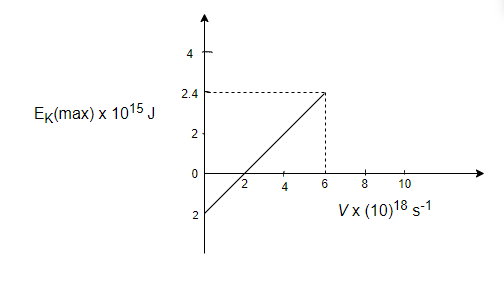
So, from the graph, \[h = \dfrac{{\mathop K\nolimits_{\max } }}{{\mathop \nu \nolimits_2 - \mathop \nu \nolimits_1 }}\]
\[h = \dfrac{{2.4 \times \mathop {10}\nolimits^{ - 15} }}{{\left( {6 - 2} \right) \times \mathop {10}\nolimits^{18} }}\]
\[h = 6 \times \mathop {10}\nolimits^{ - 34} \]J-s
And \[\mathop \phi \nolimits_0 = 2 \times \mathop {10}\nolimits^{ - 15} \]J
\[\mathop \phi \nolimits_0 = h\mathop \nu \nolimits_0 \]; where \[\mathop \nu \nolimits_0 = \] threshold frequency
\[\mathop \nu \nolimits_0 = \dfrac{{\mathop \phi \nolimits_0 }}{h} = \dfrac{{2 \times \mathop {10}\nolimits^{ - 15} }}{{6 \times \mathop {10}\nolimits^{ - 34} }}\]
\[\mathop \nu \nolimits_0 = 3.33 \times \mathop {10}\nolimits^{18} \]$s^{-1}$
So, the correct option is (A).
Note: If \[\nu < \mathop \nu \nolimits_0 \] , then maximum K.E. will be negative, which is not possible. So, Photoelectric emission does not occur if the frequency of incident radiation is less than the threshold frequency.
Complete step by step solution:
Step 1:
Einstein assumed that one photoelectron is ejected from a metal surface if one photon of suitable light radiation falls on it.
Let us consider a photon of light of frequency \[\nu \], incident on a photosensitive metal surface. The energy of the photon is \[h\nu \], spent in two ways:
A part of the energy of the photon will be used in liberating the electron from the metal surface which is equal to the work function \[\mathop \phi \nolimits_0 \] of the metal.
The rest of the energy of the photon will be used in imparting the maximum kinetic energy \[\mathop K\nolimits_{\max } \] to the emitted photoelectron.
So, from above two points, we will get-
\[h\nu = \mathop \phi \nolimits_0 + \mathop K\nolimits_{\max } \].................(1)
This equation (1) is known as Einstein’s photoelectric equation.
Step 2: Now from the equation (1) –
\[h\nu = \mathop \phi \nolimits_0 + \mathop K\nolimits_{\max } \]; where \[\mathop \phi \nolimits_0 = \]work function of metal, \[h = \]Planck’s constant, and \[\nu = \]frequency of incident photon
If we rearrange the equation (1) in the form of \[\mathop K\nolimits_{\max } = h\nu + \mathop \phi \nolimits_0 \] and this equation can be compared with the \[y = mx + c\] .
So, the slope of the given line will be \[h\] and the intercept will be \[ - \mathop \phi \nolimits_0 \].
So, from the graph, \[h = \dfrac{{\mathop K\nolimits_{\max } }}{{\mathop \nu \nolimits_2 - \mathop \nu \nolimits_1 }}\]
\[h = \dfrac{{2.4 \times \mathop {10}\nolimits^{ - 15} }}{{\left( {6 - 2} \right) \times \mathop {10}\nolimits^{18} }}\]
\[h = 6 \times \mathop {10}\nolimits^{ - 34} \]J-s
And \[\mathop \phi \nolimits_0 = 2 \times \mathop {10}\nolimits^{ - 15} \]J
\[\mathop \phi \nolimits_0 = h\mathop \nu \nolimits_0 \]; where \[\mathop \nu \nolimits_0 = \] threshold frequency
\[\mathop \nu \nolimits_0 = \dfrac{{\mathop \phi \nolimits_0 }}{h} = \dfrac{{2 \times \mathop {10}\nolimits^{ - 15} }}{{6 \times \mathop {10}\nolimits^{ - 34} }}\]
\[\mathop \nu \nolimits_0 = 3.33 \times \mathop {10}\nolimits^{18} \]$s^{-1}$
So, the correct option is (A).
Note: If \[\nu < \mathop \nu \nolimits_0 \] , then maximum K.E. will be negative, which is not possible. So, Photoelectric emission does not occur if the frequency of incident radiation is less than the threshold frequency.
Recently Updated Pages
JEE Main 2025-26 Experimental Skills Mock Test – Free Practice

JEE Main 2025-26 Electronic Devices Mock Test: Free Practice Online
JEE Main 2025-26 Mock Tests: Free Practice Papers & Solutions
JEE Main 2025-26: Magnetic Effects of Current & Magnetism Mock Test
JEE Main 2025-26 Atoms and Nuclei Mock Test – Free Practice Online
JEE Main Mock Test 2025-26: Experimental Skills Chapter Online Practice
Trending doubts
JEE Main 2026: Exam Dates, Session 2 Updates, City Slip, Admit Card & Latest News
JEE Main Participating Colleges 2026 - A Complete List of Top Colleges
Kinematics Mock Test for JEE Main 2025-26: Practice & Ace the Exam
Kinematics Mock Test for JEE Main 2025-26: Comprehensive Practice
Hybridisation in Chemistry – Concept, Types & Applications
Understanding the Electric Field of a Uniformly Charged Ring
Other Pages
CBSE Class 12 Physics Question Paper 2026: Download SET-wise PDF with Answer Key & Analysis
JEE Advanced 2026 Notification Out with Exam Date, Registration (Extended), Syllabus and More
JEE Advanced Percentile vs Marks 2026: JEE Main Cutoff, AIR & IIT Admission Guide
JEE Advanced Weightage Chapter Wise 2026 for Physics, Chemistry, and Mathematics
JEE Advanced Marks vs Rank 2025 - Predict Your IIT Rank Based on Score
Derivation of Equation of Trajectory Explained for Students