




If the resultant vector of $\overrightarrow A $ and $\overrightarrow B $ makes an angle $\alpha $ with $\overrightarrow A $ and $\beta $ with $\overrightarrow B $ , then:
A) $\alpha < \beta $
B) $\alpha < \beta $ if $A < B$
C) $\alpha < \beta $ if $A > B$
D) $\alpha < \beta $ if $A = B$
Answer
 Verified
252k+ views
Hint: Always the resultant vector incline towards the vector which is higher in magnitude. If the two vectors have the same magnitude, the resultant vector will make equal angles with the both two vectors.
Complete step by step solution:
Let’s solve this problem with the help of a diagram. Two vectors $\overrightarrow A $ and $\overrightarrow B $ are drawn and the resultant is a vector $\overrightarrow R $ . The resultant vector $\overrightarrow R $ makes an angle $\alpha $ with the vector $\overrightarrow A $ and the resultant vector $\overrightarrow R $ makes an angle $\beta $ with the vector $\overrightarrow B $
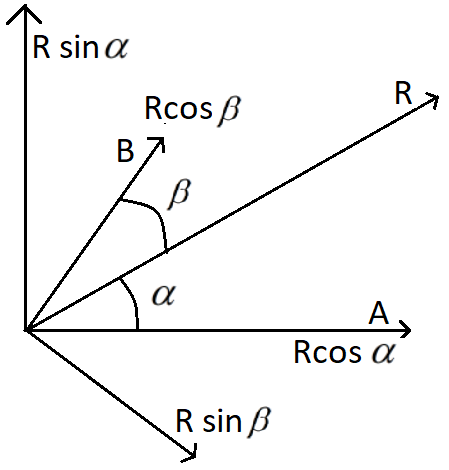
From the details given in the diagram we can see that
Angle between the vector $\overrightarrow A $ and the resultant vector $\overrightarrow R $ = $\alpha $ .
Angle between the vector $\overrightarrow B $ and the resultant vector $\overrightarrow R $ = $\beta $ .
Total angle between the vector $\overrightarrow A $ and vector $\overrightarrow B $ = $\alpha + \beta $ .
From the diagram it is known that,
$A = R\cos \alpha $
$B = R\cos \beta $
Let’s discuss the three cases :
When $\overrightarrow A $ = $\overrightarrow B $
Applying the values of vector $\overrightarrow A $ and vector $\overrightarrow B $ ,
$\overrightarrow A $ = $\overrightarrow B $
$ \Rightarrow R\cos \alpha = R\cos \beta $
Cancelling equal terms on the right hand side and left hand side of the above equation we get:
$\cos \alpha = \cos \beta $
$ \Rightarrow \alpha = \beta $
When $\overrightarrow A $<$\overrightarrow B $
Applying the values of vector $\overrightarrow A $ and vector $\overrightarrow B $ ,
$\overrightarrow A $<$\overrightarrow B $
\[ \Rightarrow R\cos \alpha < R\cos \beta \]
Cancelling equal terms on the right hand side and left hand side of the above equation we get:
$\cos \alpha < \cos \beta $
$ \Rightarrow \alpha > \beta $
When $\overrightarrow A $>$\overrightarrow B $
Applying the values of vector $\overrightarrow A $ and vector $\overrightarrow B $ ,
$\overrightarrow A $>$\overrightarrow B $
\[ \Rightarrow R\cos \alpha > R\cos \beta \]
Cancelling equal terms on the right hand side and left hand side of the above equation we get:
$\cos \alpha > \cos \beta $
$ \Rightarrow \alpha < \beta $
By analysing these three cases we get the angle between the resultant vector $\overrightarrow R $ and the vector $\overrightarrow A $ , $\alpha $ is less than angle between the resultant vector $\overrightarrow R $ and the vector $\overrightarrow B $ , $\beta $
That is, $\alpha < \beta $ when $A > B$
Final answer is option (C): $\alpha < \beta $ if $A > B$.
Note: If two vectors acting simultaneously at a point can be represented both in magnitude and direction by the adjacent sides of a parallelogram drawn from a point, then the resultant vector is represented both in magnitude and direction by the diagonal of the parallelogram passing through that point.
Complete step by step solution:
Let’s solve this problem with the help of a diagram. Two vectors $\overrightarrow A $ and $\overrightarrow B $ are drawn and the resultant is a vector $\overrightarrow R $ . The resultant vector $\overrightarrow R $ makes an angle $\alpha $ with the vector $\overrightarrow A $ and the resultant vector $\overrightarrow R $ makes an angle $\beta $ with the vector $\overrightarrow B $
From the details given in the diagram we can see that
Angle between the vector $\overrightarrow A $ and the resultant vector $\overrightarrow R $ = $\alpha $ .
Angle between the vector $\overrightarrow B $ and the resultant vector $\overrightarrow R $ = $\beta $ .
Total angle between the vector $\overrightarrow A $ and vector $\overrightarrow B $ = $\alpha + \beta $ .
From the diagram it is known that,
$A = R\cos \alpha $
$B = R\cos \beta $
Let’s discuss the three cases :
When $\overrightarrow A $ = $\overrightarrow B $
Applying the values of vector $\overrightarrow A $ and vector $\overrightarrow B $ ,
$\overrightarrow A $ = $\overrightarrow B $
$ \Rightarrow R\cos \alpha = R\cos \beta $
Cancelling equal terms on the right hand side and left hand side of the above equation we get:
$\cos \alpha = \cos \beta $
$ \Rightarrow \alpha = \beta $
When $\overrightarrow A $<$\overrightarrow B $
Applying the values of vector $\overrightarrow A $ and vector $\overrightarrow B $ ,
$\overrightarrow A $<$\overrightarrow B $
\[ \Rightarrow R\cos \alpha < R\cos \beta \]
Cancelling equal terms on the right hand side and left hand side of the above equation we get:
$\cos \alpha < \cos \beta $
$ \Rightarrow \alpha > \beta $
When $\overrightarrow A $>$\overrightarrow B $
Applying the values of vector $\overrightarrow A $ and vector $\overrightarrow B $ ,
$\overrightarrow A $>$\overrightarrow B $
\[ \Rightarrow R\cos \alpha > R\cos \beta \]
Cancelling equal terms on the right hand side and left hand side of the above equation we get:
$\cos \alpha > \cos \beta $
$ \Rightarrow \alpha < \beta $
By analysing these three cases we get the angle between the resultant vector $\overrightarrow R $ and the vector $\overrightarrow A $ , $\alpha $ is less than angle between the resultant vector $\overrightarrow R $ and the vector $\overrightarrow B $ , $\beta $
That is, $\alpha < \beta $ when $A > B$
Final answer is option (C): $\alpha < \beta $ if $A > B$.
Note: If two vectors acting simultaneously at a point can be represented both in magnitude and direction by the adjacent sides of a parallelogram drawn from a point, then the resultant vector is represented both in magnitude and direction by the diagonal of the parallelogram passing through that point.
Recently Updated Pages
States of Matter Chapter For JEE Main Chemistry

Circuit Switching vs Packet Switching: Key Differences Explained
Mass vs Weight: Key Differences Explained for Students
[Awaiting the three content sources: Ask AI Response, Competitor 1 Content, and Competitor 2 Content. Please provide those to continue with the analysis and optimization.]
JEE Isolation, Preparation and Properties of Non-metals Important Concepts and Tips for Exam Preparation
Isoelectronic Definition in Chemistry: Meaning, Examples & Trends
Trending doubts
JEE Main 2026 Application Login: Direct Link, Registration, Form Fill, and Steps
Electron Gain Enthalpy and Electron Affinity Explained
Understanding the Angle of Deviation in a Prism
JEE Main Participating Colleges 2026 - A Complete List of Top Colleges
Understanding Electromagnetic Waves and Their Importance
How to Convert a Galvanometer into an Ammeter or Voltmeter
Other Pages
CBSE Notes Class 11 Physics Chapter 11 - Thermodynamics - 2025-26
CBSE Notes Class 11 Physics Chapter 8 - Mechanical Properties Of Solids - 2025-26
NCERT Solutions For Class 11 Physics Chapter 3 Motion In A Plane - 2025-26
JEE Advanced Marks vs Rank 2025 - Predict Your IIT Rank Based on Score
Degree of Dissociation: Meaning, Formula, Calculation & Uses
Understanding Collisions: Types and Examples for Students