




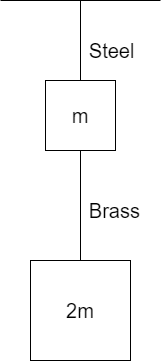
If the ratio of lengths, radii and Young's modulus of steel and brass wires in the figure are a,b and c respectively, then the corresponding is:
A) $\dfrac{{2{a^2}c}}{b}$
B) $\dfrac{{3a}}{{2{b^2}c}}$
C) $\dfrac{{2ac}}{{{b^2}}}$
D) $\dfrac{{3c}}{{2a{b^2}}}$
Answer
 Verified
256.8k+ views
Hint: Recall that Young’s modulus is the mechanical property of a material such that it can withstand the stretching or contraction with respect to the length. The value of Young’s modulus is most commonly used. It describes the relation between stress and strain.
Complete step by step solution:
Step I: The formula for Young’s modulus for a material is given by the formula
$\Delta L = \dfrac{{FL}}{{AY}}$
Where ‘F’ is the force applied
‘L’ is the length
‘A’ is the area
‘Y’ is the Young’s modulus of elasticity
Step II: Given that ratio of length, radii and Young’s modulus is a, b and c. The force on the steel wire will be due to both the masses and the force of gravity acting downwards. Therefore,
$ \Rightarrow {F_s} = (m + 2m)g = 3mg$
The Young’s modulus due to steel is given by
\[\Delta {L_s} = \dfrac{{F{L_s}}}{{A{Y_s}}}\]
$ \Rightarrow \Delta {L_s} = \dfrac{{3mg \times {L_s}}}{{\pi r_s^2 \times {Y_s}}}$---(i)
Step III: Similarly, the force on brass wire will only be due to mass ‘2m’. The Young’s modulus due to brass wire is given by
$ \Rightarrow \Delta {L_B} = \dfrac{{2mg \times {L_B}}}{{\pi r_B^2 \times {Y_B}}}$---(ii)
Step IV: The ratio of steel and brass wires can be written using equation (i) and equation (ii)
\[ \Rightarrow \dfrac{{\Delta {L_S}}}{{\Delta {L_B}}} = \dfrac{{\dfrac{{3mg \times {L_S}}}{{\pi r_S^2 \times {Y_S}}}}}{{\dfrac{{2mg \times {L_B}}}{{\pi r_B^2 \times {Y_B}}}}}\]
$ \Rightarrow \dfrac{{\Delta {L_S}}}{{\Delta {L_B}}} = \dfrac{{3mg \times {L_S} \times \pi r_B^2 \times {Y_B}}}{{2mg \times {L_B} \times \pi r_S^2 \times {Y_S}}}$
$ \Rightarrow \dfrac{{\Delta {L_S}}}{{\Delta {L_B}}} = \dfrac{{3a}}{{2{b^2}c}}$
Option B is the right answer.
Note: It is important to note that if the Young’s modulus of a substance is known then it can be known whether the substance is rigid or not and to what extent. By knowing, the rigidity of a substance, its tendency to experience the change in its shape can be known. In other words, it determines the effect of applied force on the shape of a certain substance.
Complete step by step solution:
Step I: The formula for Young’s modulus for a material is given by the formula
$\Delta L = \dfrac{{FL}}{{AY}}$
Where ‘F’ is the force applied
‘L’ is the length
‘A’ is the area
‘Y’ is the Young’s modulus of elasticity
Step II: Given that ratio of length, radii and Young’s modulus is a, b and c. The force on the steel wire will be due to both the masses and the force of gravity acting downwards. Therefore,
$ \Rightarrow {F_s} = (m + 2m)g = 3mg$
The Young’s modulus due to steel is given by
\[\Delta {L_s} = \dfrac{{F{L_s}}}{{A{Y_s}}}\]
$ \Rightarrow \Delta {L_s} = \dfrac{{3mg \times {L_s}}}{{\pi r_s^2 \times {Y_s}}}$---(i)
Step III: Similarly, the force on brass wire will only be due to mass ‘2m’. The Young’s modulus due to brass wire is given by
$ \Rightarrow \Delta {L_B} = \dfrac{{2mg \times {L_B}}}{{\pi r_B^2 \times {Y_B}}}$---(ii)
Step IV: The ratio of steel and brass wires can be written using equation (i) and equation (ii)
\[ \Rightarrow \dfrac{{\Delta {L_S}}}{{\Delta {L_B}}} = \dfrac{{\dfrac{{3mg \times {L_S}}}{{\pi r_S^2 \times {Y_S}}}}}{{\dfrac{{2mg \times {L_B}}}{{\pi r_B^2 \times {Y_B}}}}}\]
$ \Rightarrow \dfrac{{\Delta {L_S}}}{{\Delta {L_B}}} = \dfrac{{3mg \times {L_S} \times \pi r_B^2 \times {Y_B}}}{{2mg \times {L_B} \times \pi r_S^2 \times {Y_S}}}$
$ \Rightarrow \dfrac{{\Delta {L_S}}}{{\Delta {L_B}}} = \dfrac{{3a}}{{2{b^2}c}}$
Option B is the right answer.
Note: It is important to note that if the Young’s modulus of a substance is known then it can be known whether the substance is rigid or not and to what extent. By knowing, the rigidity of a substance, its tendency to experience the change in its shape can be known. In other words, it determines the effect of applied force on the shape of a certain substance.
Recently Updated Pages
Electricity and Magnetism Explained: Key Concepts & Applications

JEE Energetics Important Concepts and Tips for Exam Preparation
JEE Isolation, Preparation and Properties of Non-metals Important Concepts and Tips for Exam Preparation
JEE Main 2023 (February 1st Shift 1) Maths Question Paper with Answer Key
JEE Main 2023 (February 1st Shift 2) Maths Question Paper with Answer Key
JEE Main 2023 (February 1st Shift 2) Chemistry Question Paper with Answer Key
Trending doubts
JEE Main 2026: Exam Dates, Session 2 Updates, City Slip, Admit Card & Latest News
JEE Main Participating Colleges 2026 - A Complete List of Top Colleges
JEE Main 2026 Application Login: Direct Link, Registration, Form Fill, and Steps
JEE Main Colleges 2026: Complete List of Participating Institutes
JEE Main Marking Scheme 2026- Paper-Wise Marks Distribution and Negative Marking Details
Hybridisation in Chemistry – Concept, Types & Applications
Other Pages
JEE Advanced 2026 - Exam Date (Released), Syllabus, Registration, Eligibility, Preparation, and More
JEE Advanced Marks vs Ranks 2025: Understanding Category-wise Qualifying Marks and Previous Year Cut-offs
CBSE Notes Class 11 Physics Chapter 1 - Units And Measurements - 2025-26
NCERT Solutions For Class 11 Physics Chapter 1 Units And Measurements - 2025-26
Important Questions For Class 11 Physics Chapter 1 Units and Measurement - 2025-26
JEE Advanced Weightage 2025 Chapter-Wise for Physics, Maths and Chemistry