




If periodic table would have contained 10 periods, maximum elements in that periodic table would be:
A. 72
B. 190
C. 144
D. 290
Answer
 Verified
300.9k+ views
Hint: Periodic table is a tabular display of the chemical elements, which are arranged by atomic numbers, electronic configuration and recurring chemical properties. There are seven rows known as periods, which have metals on the left and nonmetals on the right and 18 columns known as groups. These columns contain elements with similar chemical behaviors.
Formula used:
Even number of periods $ = {\dfrac{{(n + 2)}}{2}^2}$
Complete step by step answer:
The periodic table is a representation of various elements.
A period is a horizontal row of the periodic table. There are seven periods with each one beginning at the far left. A new period begins when a new principal energy level begins filling with electrons.
A group is a vertical column of the periodic table, based on the organization of the outer shell electrons. There are a total of eighteen groups. The periodic table is as shown:
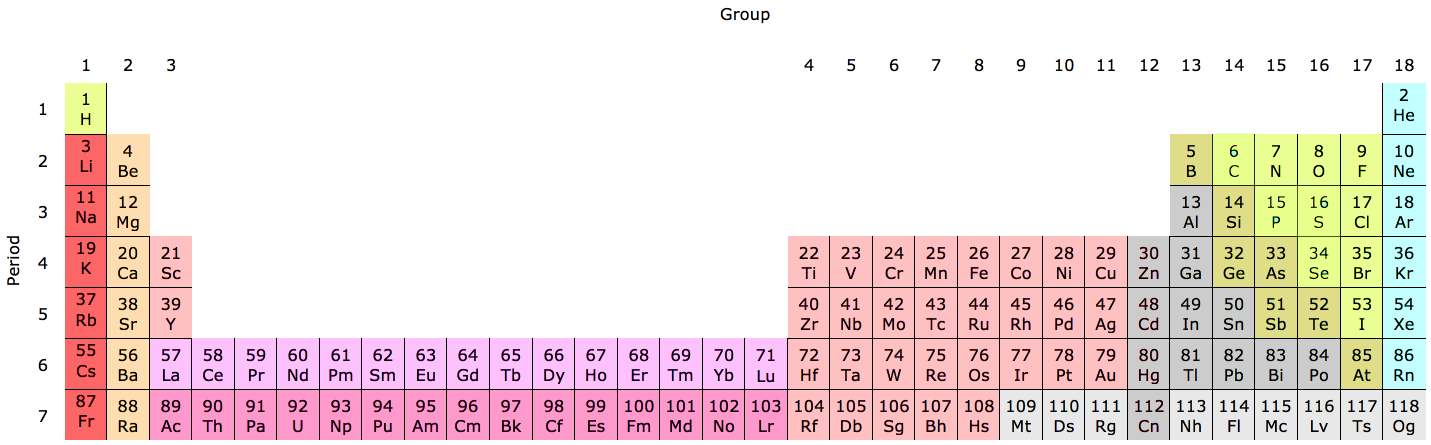
Now, let us assume that the periodic table consists of 10 periods, then the number of elements would be:
n=10
Therefore, for even number of periods, according to the above formula:
We have,
10 Periods= $\dfrac{{{{(10 + 2)}^2}}}{2}$
=72
Therefore, the number of elements will be 72
Hence, option A is correct.
Note:
Dimitri Mendeleev is the father of the periodic table. In1869, he completed the first of his numerous periodic charts. It included 63 known elements arranged according to their increasing atomic weight. He also left spaces for as yet undiscovered elements for which he predicted the atomic weights.
Formula used:
Even number of periods $ = {\dfrac{{(n + 2)}}{2}^2}$
Complete step by step answer:
The periodic table is a representation of various elements.
A period is a horizontal row of the periodic table. There are seven periods with each one beginning at the far left. A new period begins when a new principal energy level begins filling with electrons.
A group is a vertical column of the periodic table, based on the organization of the outer shell electrons. There are a total of eighteen groups. The periodic table is as shown:
Now, let us assume that the periodic table consists of 10 periods, then the number of elements would be:
n=10
Therefore, for even number of periods, according to the above formula:
We have,
10 Periods= $\dfrac{{{{(10 + 2)}^2}}}{2}$
=72
Therefore, the number of elements will be 72
Hence, option A is correct.
Note:
Dimitri Mendeleev is the father of the periodic table. In1869, he completed the first of his numerous periodic charts. It included 63 known elements arranged according to their increasing atomic weight. He also left spaces for as yet undiscovered elements for which he predicted the atomic weights.
Recently Updated Pages
Normality of 03 M phosphorus acid H3PO3 is A 05 B 06 class 11 chemistry JEE_Main

A molecule with highest bond energy A Fluorine B Chlorine class 11 chemistry JEE_Main
A 30 solution of H2O2 is marketed as 100 volume hydrogen class 11 chemistry JEE_Main
Covalent compounds generally have low melting and boiling class 11 chemistry JEE_Main
When an acid reacts with a metal carbonate or metal class 11 chemistry JEE_Main
The degeneracy of hydrogen atom that has equal energy class 11 chemistry JEE_Main
Trending doubts
JEE Main 2026: Exam Dates, Session 2 Updates, City Slip, Admit Card & Latest News
Understanding the Electric Field of a Uniformly Charged Ring
Electron Gain Enthalpy and Electron Affinity Explained
Derivation of Equation of Trajectory Explained for Students
Understanding Atomic Structure for Beginners
How to Convert a Galvanometer into an Ammeter or Voltmeter
Other Pages
JEE Advanced Percentile vs Marks 2026: JEE Main Cutoff, AIR & IIT Admission Guide
NCERT Solutions For Class 11 Chemistry In Hindi Chapter 1 Some Basic Concepts Of Chemistry - 2026-27 Free PDF Download (Sign-in Required)
Hybridisation in Chemistry – Concept, Types & Applications
Understanding the Different Types of Solutions in Chemistry
What Are Elastic Collisions in One Dimension?
Effective Nuclear Charge for JEE