




If a bar magnet is cut into 3 parts, the total number of poles will be:
(A) 2
(B) 3
(C) 4
(D) 6
Answer
 Verified
273.9k+ views
Hint Having two poles is a property of the magnet, so no matter how many times you cut every piece has its two respective poles north and south. This is a consequence of the fact that magnetic monopoles do not exist in real life.
Complete step by step answer:
A magnet has two poles which are equal and opposite. They are called the North and South Pole. If a magnet is broken into a number of pieces, each piece becomes a magnet. This in turn implies that monopoles do not exist; that is the ultimate individual unit of magnetism in any magnet is called dipole.
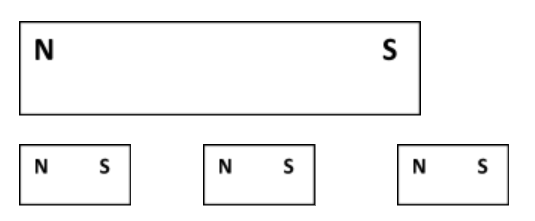
So, when a bar magnet is cut into 3 parts each part has its own north and south pole, so the total number of poles is 6.
The correct option is D.
Note: For a bar magnet, two poles are at opposite ends which are separated by a small distance. Poles are not exactly at the ends. The shortest distance between two poles is called effective length which is less than the length of the magnet.
Complete step by step answer:
A magnet has two poles which are equal and opposite. They are called the North and South Pole. If a magnet is broken into a number of pieces, each piece becomes a magnet. This in turn implies that monopoles do not exist; that is the ultimate individual unit of magnetism in any magnet is called dipole.
So, when a bar magnet is cut into 3 parts each part has its own north and south pole, so the total number of poles is 6.
The correct option is D.
Note: For a bar magnet, two poles are at opposite ends which are separated by a small distance. Poles are not exactly at the ends. The shortest distance between two poles is called effective length which is less than the length of the magnet.
Recently Updated Pages
Mass vs Weight: Key Differences Explained for Students

Uniform Acceleration Explained: Formula, Examples & Graphs
Circuit Switching vs Packet Switching: Key Differences Explained
Wheatstone Bridge – Principle, Formula, Diagram & Applications
Classification of Drugs in Chemistry: Types, Examples & Exam Guide
Area vs Volume: Key Differences Explained for Students
Trending doubts
JEE Main 2026: Exam Dates, Session 2 Updates, City Slip, Admit Card & Latest News
JEE Main Participating Colleges 2026 - A Complete List of Top Colleges
Understanding the Electric Field of a Uniformly Charged Ring
Understanding Atomic Structure for Beginners
Derivation of Equation of Trajectory Explained for Students
How to Convert a Galvanometer into an Ammeter or Voltmeter
Other Pages
JEE Advanced 2026 Notification Out with Exam Date, Registration (Extended), Syllabus and More
JEE Advanced Percentile vs Marks 2026: JEE Main Cutoff, AIR & IIT Admission Guide
CBSE Notes Class 11 Physics Chapter 1 - Units And Measurements - 2026-27
NCERT Solutions For Class 11 Physics Chapter 1 Units And Measurements - 2025-26
Important Questions For Class 11 Physics Chapter 1 Units and Measurement - 2026-27
JEE Advanced Weightage Chapter Wise 2026 for Physics, Chemistry, and Mathematics