




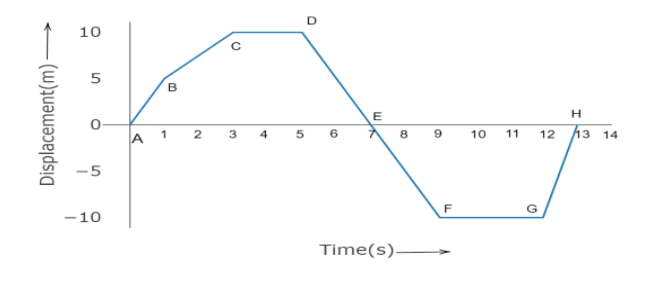
From the displacement-time graph of a cyclist given in the figure, find the average velocity in the first four seconds.
(A) $0.5m{s^ - }^1$
(B) $5m{s^ - }^1$
(C) $2.5m{s^ - }^1$
(D) $0m{s^ - }^1$
Answer
 Verified
274.2k+ views
Hint: Average velocity over a period of time is the amount by which the cyclist has displaced divided by the time taken to travel that distance. It can be zero if the cyclist comes back to his/her starting position at that time. The distance a cyclist covers before coming back to the starting position doesn’t matter.
Formula used:
We know that,
$Average\ velocity = \dfrac{{Total\ displacement}}{{Total\ time\ taken}}$
Or, $v = \dfrac{s}{t}$
Where, $v$ is the average velocity,
$s$ is the displacement,
And, $t$ is the time taken.
Complete step by step answer
When you observe this plot, point A is the starting point at $t = 0$.
At point C, we can observe that the cyclist has traveled $10m$ in $t = 3s$.
At point D, we can observe that the cyclist takes a rest. Thus, no change in displacement at $t = 5s$.
From this information, we can conclude that at$t = 4s$, the cyclist has displaced $10m$.
We know that,
$v = \dfrac{s}{t}$
Putting the numerical values from the plot, we get
$v = \dfrac{{10}}{4}$
$ \Rightarrow v = 2.5m{s^ - }^1$
Additional information There is a difference between distance and displacement. The cyclist can move $10m$ from the starting point and come back. In this case, displacement will be zero, but the distance traveled by the cyclist will be$2 \times 10 = 20m$. The same thing can be said about speed and velocity. Speed is the distance traveled over a given time while velocity is displacement over time. Distance and speed are scalars while displacement and velocity are vectors.
Note While reading the graph, take care of the units of displacement and time. It can be something other than meters and seconds. Always be careful about whether it is a distance-time graph or a displacement-time graph.
Formula used:
We know that,
$Average\ velocity = \dfrac{{Total\ displacement}}{{Total\ time\ taken}}$
Or, $v = \dfrac{s}{t}$
Where, $v$ is the average velocity,
$s$ is the displacement,
And, $t$ is the time taken.
Complete step by step answer
When you observe this plot, point A is the starting point at $t = 0$.
At point C, we can observe that the cyclist has traveled $10m$ in $t = 3s$.
At point D, we can observe that the cyclist takes a rest. Thus, no change in displacement at $t = 5s$.
From this information, we can conclude that at$t = 4s$, the cyclist has displaced $10m$.
We know that,
$v = \dfrac{s}{t}$
Putting the numerical values from the plot, we get
$v = \dfrac{{10}}{4}$
$ \Rightarrow v = 2.5m{s^ - }^1$
Additional information There is a difference between distance and displacement. The cyclist can move $10m$ from the starting point and come back. In this case, displacement will be zero, but the distance traveled by the cyclist will be$2 \times 10 = 20m$. The same thing can be said about speed and velocity. Speed is the distance traveled over a given time while velocity is displacement over time. Distance and speed are scalars while displacement and velocity are vectors.
Note While reading the graph, take care of the units of displacement and time. It can be something other than meters and seconds. Always be careful about whether it is a distance-time graph or a displacement-time graph.
Recently Updated Pages
Mass vs Weight: Key Differences Explained for Students

Circuit Switching vs Packet Switching: Key Differences Explained
Uniform Acceleration Explained: Formula, Examples & Graphs
Wheatstone Bridge – Principle, Formula, Diagram & Applications
Classification of Drugs in Chemistry: Types, Examples & Exam Guide
Area vs Volume: Key Differences Explained for Students
Trending doubts
JEE Main 2026: Exam Dates, Session 2 Updates, City Slip, Admit Card & Latest News
JEE Main Participating Colleges 2026 - A Complete List of Top Colleges
Understanding the Electric Field of a Uniformly Charged Ring
Understanding Atomic Structure for Beginners
Derivation of Equation of Trajectory Explained for Students
How to Convert a Galvanometer into an Ammeter or Voltmeter
Other Pages
JEE Advanced 2026 Notification Out with Exam Date, Registration (Extended), Syllabus and More
JEE Advanced Percentile vs Marks 2026: JEE Main Cutoff, AIR & IIT Admission Guide
CBSE Notes Class 11 Physics Chapter 1 - Units And Measurements - 2026-27
NCERT Solutions For Class 11 Physics Chapter 1 Units And Measurements - 2025-26
Important Questions For Class 11 Physics Chapter 1 Units and Measurement - 2026-27
JEE Advanced Weightage Chapter Wise 2026 for Physics, Chemistry, and Mathematics