




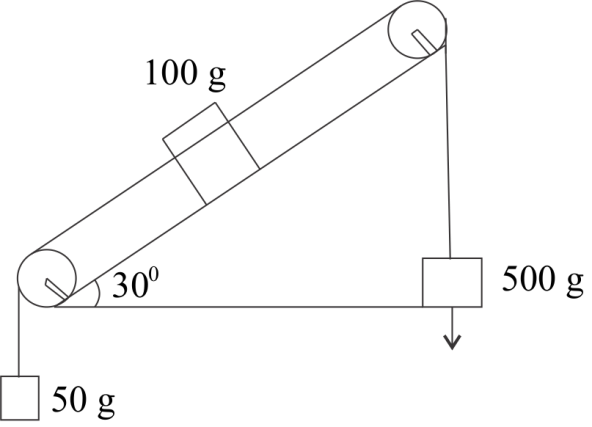
Find the acceleration of ${{500gm}}$ block.
A) $\dfrac{{{{8g}}}}{{{{13}}}}{{downward}}$
B) $\dfrac{{{g}}}{{{{13}}}}{{upward}}$
C) $\dfrac{{{{8g}}}}{{{3}}}{{downward}}$
D) $\dfrac{{{{8g}}}}{{{7}}}{{upward}}$
Answer
 Verified
269.1k+ views
Hint: In this question, we have a system of three given masses, out of which ${{{M}}_{{1}}}$ is heavy than others which will be pulled downward by gravity and if will further pull the two other masses ${{{m}}_{{1}}}$ and ${{{m}}_{{2}}}$ so by assuming that string is inextensible other masses will move with same acceleration ${{'a'}}$ so by summing up all the forces along with their signs will find acceleration.
Complete step by step solution:
As the block of mass ${{{m}}_{{1}}}$ is suspended with a string it is acted upon by gravity, so force on mass ${{{M}}_{{1}}}$ is.
${{{F}}_{{1}}}{{ = }}{{{M}}_{{1}}}{{g}}{{\_\_\_}}\left( 1 \right)$
As the mass ${{{M}}_{{2}}}$ is lying on an inclined plane of angle of inclination ${{3}}{{{0}}^{{o}}}$, the force acting tangentially downward to the block of mass ${{{M}}_{{2}}}$ is ${{{M}}_{{2}}}{{g sin\theta }}$ as shown in fig. but this is in a direction opposite to the motion of rope so, it will be taken as ${{ - ve}}$ , here we assume that there is no frictional force, so
${{{F}}_{{2}}}{{ = }}{{ - }}{{{M}}_{{2}}}{{g}}{{Sin3}}{{{0}}^{{o}}}\_\_\_\left( 2 \right)$
Further the mass ${{{M}}_{{3}}}$ is pulled upward by the rope so, force which pulled if upward is given by
${{{F}}_{{3}}}{{ = }}{{{M}}_{{3}}}{{g}}$
The net force on the system of three masses is down word i.e. pulls the weight ${{{M}}_{{1}}}$ downward with acceleration ${{a,}}$ so, if ${{M}}$ is net mass of the system i.e. $\left( {{{{M}}_{{1}}}{{ + }}{{{M}}_{{2}}}{{ + }}{{{M}}_{{3}}}} \right){{ = }}{{M,}}$ so net force on the system in given as,
${{F = }}{{Ma}}{{\_\_\_}}\left( 3 \right)$
As we know net force on the system is the sum of all the forces acting on the system i.e.
${{F}}{{ = }}{{{F}}_{{1}}}{{ + }}{{{F}}_{{2}}}{{ + }}{{{F}}_{{3}}}$
Substituting the values of ${{{F}}_{{0}}}{{,}}{{{F}}_{{1}}}{{,}}{{{F}}_{{{2,}}}}{{{F}}_{{3}}}{{,}}$ in above equation we get
${{{M}}_{{a}}}{{ = }}{{{M}}_{{1}}}{{g - }}{{{M}}_{{2}}}{{g}}{{sin3}}{{{0}}^{{o}}}{{ + }}{{{M}}_{{3}}}{{G}}$
$\left( {{{{M}}_{{1}}}{{ + }}{{{M}}_{{2}}}{{ + }}{{{M}}_{{3}}}} \right){{a}}{{ = }}{{g}}\left( {{{{M}}_{{1}}}{{ - }}{{{M}}_{{2}}}{{Sin3}}{{{0}}^{{o}}}{{ + }}{{{M}}_{{3}}}} \right)\_\_\_\left( 4 \right)$
It is given that ${{{M}}_{{1}}}{{ = 500gm}}\,$ or $\dfrac{{{{500}}}}{{{{1000}}}}{{Kg}}$
${{{M}}_{{2}}}{{ = }}{{100gm}}$ or $\dfrac{{{{100}}}}{{{{1000}}}}{{kg}}$
${{{M}}_{{3}}}{{ = }}{{50gm}}$ or $\dfrac{{{{50}}}}{{{{1000}}}}{{ kg }}$ and ${{sin3}}{{{0}}^{{o}}}{{ = }}\dfrac{{{1}}}{{{2}}}$
So, substituting all values in eqn $(4)$ we get
$\dfrac{{\left( {{{50 + 100 + 500}}} \right){{a}}}}{{{{1000}}}}{{ = }}{{g}}\left( {\dfrac{{{{500}}}}{{{{1000}}}}{{ - }}\dfrac{{{{100}}}}{{{{1000}}}}{{ \times }}\dfrac{{{1}}}{{{2}}}{{ + }}\dfrac{{{{50}}}}{{{{1000}}}}} \right)$
$\left( {\dfrac{{{{650}}}}{{{{1000}}}}} \right){{a}}{{ = }}{{g}}\left( {\dfrac{{{{800}}}}{{{{2000}}}}} \right)$
${{65a}}{{ = }}{{g \times 40}}$
${{a}}{{ = }}\dfrac{{{{40g}}}}{{{{65}}}} \Rightarrow {{a}}{{ = }}\dfrac{{{{8g}}}}{{{{13}}}}$
Note: i) If the coefficient of friction is not given n the question then assume that the surface is frictionless
ii) Always consider the string is inextensible in such questions.
iii) It’s always better to draw a free body diagram and depict forces with direction and solve accordingly.
Complete step by step solution:
As the block of mass ${{{m}}_{{1}}}$ is suspended with a string it is acted upon by gravity, so force on mass ${{{M}}_{{1}}}$ is.
${{{F}}_{{1}}}{{ = }}{{{M}}_{{1}}}{{g}}{{\_\_\_}}\left( 1 \right)$
As the mass ${{{M}}_{{2}}}$ is lying on an inclined plane of angle of inclination ${{3}}{{{0}}^{{o}}}$, the force acting tangentially downward to the block of mass ${{{M}}_{{2}}}$ is ${{{M}}_{{2}}}{{g sin\theta }}$ as shown in fig. but this is in a direction opposite to the motion of rope so, it will be taken as ${{ - ve}}$ , here we assume that there is no frictional force, so
${{{F}}_{{2}}}{{ = }}{{ - }}{{{M}}_{{2}}}{{g}}{{Sin3}}{{{0}}^{{o}}}\_\_\_\left( 2 \right)$
Further the mass ${{{M}}_{{3}}}$ is pulled upward by the rope so, force which pulled if upward is given by
${{{F}}_{{3}}}{{ = }}{{{M}}_{{3}}}{{g}}$
The net force on the system of three masses is down word i.e. pulls the weight ${{{M}}_{{1}}}$ downward with acceleration ${{a,}}$ so, if ${{M}}$ is net mass of the system i.e. $\left( {{{{M}}_{{1}}}{{ + }}{{{M}}_{{2}}}{{ + }}{{{M}}_{{3}}}} \right){{ = }}{{M,}}$ so net force on the system in given as,
${{F = }}{{Ma}}{{\_\_\_}}\left( 3 \right)$
As we know net force on the system is the sum of all the forces acting on the system i.e.
${{F}}{{ = }}{{{F}}_{{1}}}{{ + }}{{{F}}_{{2}}}{{ + }}{{{F}}_{{3}}}$
Substituting the values of ${{{F}}_{{0}}}{{,}}{{{F}}_{{1}}}{{,}}{{{F}}_{{{2,}}}}{{{F}}_{{3}}}{{,}}$ in above equation we get
${{{M}}_{{a}}}{{ = }}{{{M}}_{{1}}}{{g - }}{{{M}}_{{2}}}{{g}}{{sin3}}{{{0}}^{{o}}}{{ + }}{{{M}}_{{3}}}{{G}}$
$\left( {{{{M}}_{{1}}}{{ + }}{{{M}}_{{2}}}{{ + }}{{{M}}_{{3}}}} \right){{a}}{{ = }}{{g}}\left( {{{{M}}_{{1}}}{{ - }}{{{M}}_{{2}}}{{Sin3}}{{{0}}^{{o}}}{{ + }}{{{M}}_{{3}}}} \right)\_\_\_\left( 4 \right)$
It is given that ${{{M}}_{{1}}}{{ = 500gm}}\,$ or $\dfrac{{{{500}}}}{{{{1000}}}}{{Kg}}$
${{{M}}_{{2}}}{{ = }}{{100gm}}$ or $\dfrac{{{{100}}}}{{{{1000}}}}{{kg}}$
${{{M}}_{{3}}}{{ = }}{{50gm}}$ or $\dfrac{{{{50}}}}{{{{1000}}}}{{ kg }}$ and ${{sin3}}{{{0}}^{{o}}}{{ = }}\dfrac{{{1}}}{{{2}}}$
So, substituting all values in eqn $(4)$ we get
$\dfrac{{\left( {{{50 + 100 + 500}}} \right){{a}}}}{{{{1000}}}}{{ = }}{{g}}\left( {\dfrac{{{{500}}}}{{{{1000}}}}{{ - }}\dfrac{{{{100}}}}{{{{1000}}}}{{ \times }}\dfrac{{{1}}}{{{2}}}{{ + }}\dfrac{{{{50}}}}{{{{1000}}}}} \right)$
$\left( {\dfrac{{{{650}}}}{{{{1000}}}}} \right){{a}}{{ = }}{{g}}\left( {\dfrac{{{{800}}}}{{{{2000}}}}} \right)$
${{65a}}{{ = }}{{g \times 40}}$
${{a}}{{ = }}\dfrac{{{{40g}}}}{{{{65}}}} \Rightarrow {{a}}{{ = }}\dfrac{{{{8g}}}}{{{{13}}}}$
Note: i) If the coefficient of friction is not given n the question then assume that the surface is frictionless
ii) Always consider the string is inextensible in such questions.
iii) It’s always better to draw a free body diagram and depict forces with direction and solve accordingly.
Recently Updated Pages
Circuit Switching vs Packet Switching: Key Differences Explained

Dimensions of Pressure in Physics: Formula, Derivation & SI Unit
JEE General Topics in Chemistry Important Concepts and Tips
JEE Extractive Metallurgy Important Concepts and Tips for Exam Preparation
JEE Atomic Structure and Chemical Bonding important Concepts and Tips
JEE Amino Acids and Peptides Important Concepts and Tips for Exam Preparation
Trending doubts
JEE Main 2026: Exam Dates, Session 2 Updates, City Slip, Admit Card & Latest News
JEE Main Participating Colleges 2026 - A Complete List of Top Colleges
Understanding the Electric Field of a Uniformly Charged Ring
Derivation of Equation of Trajectory Explained for Students
Understanding Atomic Structure for Beginners
JEE Main Marking Scheme 2026- Paper-Wise Marks Distribution and Negative Marking Details
Other Pages
JEE Advanced 2026 Notification Out with Exam Date, Registration (Extended), Syllabus and More
JEE Advanced Percentile vs Marks 2026: JEE Main Cutoff, AIR & IIT Admission Guide
CBSE Notes Class 11 Physics Chapter 1 - Units And Measurements - 2026-27
JEE Advanced 2026 Marks vs Rank: Estimate IIT Rank from Your Score
NCERT Solutions For Class 11 Physics Chapter 1 Units And Measurements - 2025-26
Important Questions For Class 11 Physics Chapter 1 Units and Measurement - 2025-26