




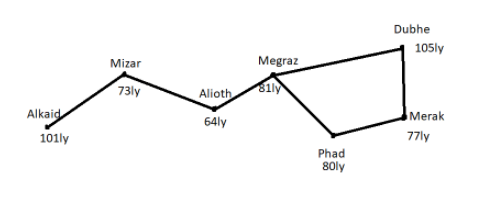
Find distance in light years from Alkaid to Merak.
A) $46ly$
B) $56ly$
C) $66.3ly$
D) $69.9ly$
Answer
 Verified
249.3k+ views
Hint: A light year is a distance measurement and not a time measurement (as the name suggests). A light-year distance is $6$ trillion miles ($9.7$ trillion km) from a light beam travelling on a single Earth year.
The calculation of lengths in kilometres or miles does not minimise the world.
It is most commonly used when expressing distances from stars and other galactic distances, especially in non-specialist and popular publications on science. The parsec is the most common unit for practising astronomers.
Complete step by step solution:
Light year is a method of measuring long distances.
Let’s consider Alkaid's position $\overrightarrow a $ as and Merak's position vector as $\overrightarrow b $, then distance between them is given as magnitude if resultant of these vectors,
Distance is given by $\sqrt {{a^2} + {b^2} - 2ab\cos \theta} $
Where the angle of inclination is $\theta $
$ \Rightarrow \sqrt {{{101} ^2} + {{77} ^2} - 2 \times 101 \times 77 \times \cos ({{25.6} ^0})} $
$ \Rightarrow 45.85ly$ Which is nearly $46ly$
Correct option is (A).
Note: Another benefit is the use of a light year as a distance indicator-it allows you to assess age. Let’s say it's One million light years away from a star. The light from the star came to us at light level. It took a million years for the star to come here and a million years after the light we see was formed. So the star that we are seeing actually is how the star looked, not how it looks now, a million years ago. Similarly, we're Eight minutes away from our sun. When the sun burst unexpectedly, we would not know for eight minutes, and it would take as long for the eruption to get here.
The calculation of lengths in kilometres or miles does not minimise the world.
It is most commonly used when expressing distances from stars and other galactic distances, especially in non-specialist and popular publications on science. The parsec is the most common unit for practising astronomers.
Complete step by step solution:
Light year is a method of measuring long distances.
Let’s consider Alkaid's position $\overrightarrow a $ as and Merak's position vector as $\overrightarrow b $, then distance between them is given as magnitude if resultant of these vectors,
Distance is given by $\sqrt {{a^2} + {b^2} - 2ab\cos \theta} $
Where the angle of inclination is $\theta $
$ \Rightarrow \sqrt {{{101} ^2} + {{77} ^2} - 2 \times 101 \times 77 \times \cos ({{25.6} ^0})} $
$ \Rightarrow 45.85ly$ Which is nearly $46ly$
Correct option is (A).
Note: Another benefit is the use of a light year as a distance indicator-it allows you to assess age. Let’s say it's One million light years away from a star. The light from the star came to us at light level. It took a million years for the star to come here and a million years after the light we see was formed. So the star that we are seeing actually is how the star looked, not how it looks now, a million years ago. Similarly, we're Eight minutes away from our sun. When the sun burst unexpectedly, we would not know for eight minutes, and it would take as long for the eruption to get here.
Recently Updated Pages
JEE Isolation, Preparation and Properties of Non-metals Important Concepts and Tips for Exam Preparation

Isoelectronic Definition in Chemistry: Meaning, Examples & Trends
Ionisation Energy and Ionisation Potential Explained
Iodoform Reactions - Important Concepts and Tips for JEE
Introduction to Dimensions: Understanding the Basics
Instantaneous Velocity Explained: Formula, Examples & Graphs
Trending doubts
JEE Main 2026: Exam Dates, Session 2 Updates, City Slip, Admit Card & Latest News
Hybridisation in Chemistry – Concept, Types & Applications
Understanding the Electric Field of a Uniformly Charged Ring
JEE Main 2026 Application Login: Direct Link, Registration, Form Fill, and Steps
Derivation of Equation of Trajectory Explained for Students
JEE Main Marking Scheme 2026- Paper-Wise Marks Distribution and Negative Marking Details
Other Pages
JEE Advanced Marks vs Ranks 2025: Understanding Category-wise Qualifying Marks and Previous Year Cut-offs
JEE Advanced 2026 - Exam Date (Released), Syllabus, Registration, Eligibility, Preparation, and More
CBSE Notes Class 11 Physics Chapter 1 - Units And Measurements - 2025-26
Important Questions For Class 11 Physics Chapter 1 Units and Measurement - 2025-26
NCERT Solutions For Class 11 Physics Chapter 1 Units And Measurements - 2025-26
CBSE Notes Class 11 Physics Chapter 4 - Laws of Motion - 2025-26