




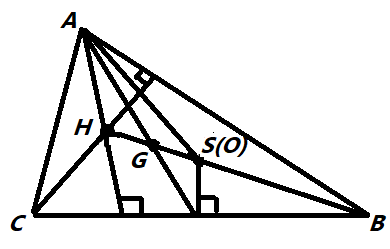
f S is circumcentre, G is the centroid, O is the orthocentre of $\vartriangle ABC$ , then $SA + SB + SC$ is equal to?
A). $SG$
B). $OS$
C). $SO$
D). $OG$
Answer
 Verified
257.4k+ views
Hint: To easily do this type of question firstly take the given points which is given in the question on a line and represent all the points on it then justify which of the lines are making relation with each other from which you can easily do this type of question. As this is a vector based question you must use vector identities as you know in it to easily simplify the answer.
Complete step by step solution:
Firstly we can write all the given points which are provided in the question,
Circumcentre = S in $\vartriangle ABC$
Centroid = G in $\vartriangle ABC$
Orthocentre = O in $\vartriangle ABC$
We have to find, $SA + SB + SC$
Let, we assume D is the mid-point of BC
$BD = DC$
As per vector, we know that
$
DB + DC = 0 \\
\\
$ (zero vector or null vector)
By using Plane of Geometry we can say that,
$2SD = AO$
By further simplification we get,
$SA + SB + SC = SA + (SD + DB) + (SD + DC)$
From which by opening brackets and simplifying,
$ = SA + 2SD + (DB + DC)$
In above equation we find that $
DB + DC = 0 \\
\\
$ putting this,
$ = SA + AO + 0$
From which we say that,
$ = SO$
As detail we get that,
Hence the answer is $SA + SB + SC = SO$ .
Therefore, the correct option is (C)..
Note: In this type of question calculation is very important for everyone as any type of calculation error may reject you from the question because there are many circumstances where you got confused from this you have to be very careful to do this and the identities should be used correctly.
Complete step by step solution:
Firstly we can write all the given points which are provided in the question,
Circumcentre = S in $\vartriangle ABC$
Centroid = G in $\vartriangle ABC$
Orthocentre = O in $\vartriangle ABC$
We have to find, $SA + SB + SC$
Let, we assume D is the mid-point of BC
$BD = DC$
As per vector, we know that
$
DB + DC = 0 \\
\\
$ (zero vector or null vector)
By using Plane of Geometry we can say that,
$2SD = AO$
By further simplification we get,
$SA + SB + SC = SA + (SD + DB) + (SD + DC)$
From which by opening brackets and simplifying,
$ = SA + 2SD + (DB + DC)$
In above equation we find that $
DB + DC = 0 \\
\\
$ putting this,
$ = SA + AO + 0$
From which we say that,
$ = SO$
As detail we get that,
Hence the answer is $SA + SB + SC = SO$ .
Therefore, the correct option is (C)..
Note: In this type of question calculation is very important for everyone as any type of calculation error may reject you from the question because there are many circumstances where you got confused from this you have to be very careful to do this and the identities should be used correctly.
Recently Updated Pages
Electricity and Magnetism Explained: Key Concepts & Applications

JEE Energetics Important Concepts and Tips for Exam Preparation
JEE Isolation, Preparation and Properties of Non-metals Important Concepts and Tips for Exam Preparation
JEE Main 2023 (February 1st Shift 1) Maths Question Paper with Answer Key
JEE Main 2023 (February 1st Shift 2) Maths Question Paper with Answer Key
JEE Main 2023 (February 1st Shift 2) Chemistry Question Paper with Answer Key
Trending doubts
JEE Main 2026: Exam Dates, Session 2 Updates, City Slip, Admit Card & Latest News
JEE Main Participating Colleges 2026 - A Complete List of Top Colleges
JEE Main 2026 Application Login: Direct Link, Registration, Form Fill, and Steps
JEE Main Colleges 2026: Complete List of Participating Institutes
JEE Main Marking Scheme 2026- Paper-Wise Marks Distribution and Negative Marking Details
Hybridisation in Chemistry – Concept, Types & Applications
Other Pages
JEE Advanced 2026 - Exam Date (Released), Syllabus, Registration, Eligibility, Preparation, and More
JEE Advanced Marks vs Ranks 2025: Understanding Category-wise Qualifying Marks and Previous Year Cut-offs
JEE Advanced Weightage 2025 Chapter-Wise for Physics, Maths and Chemistry
Understanding the Electric Field of a Uniformly Charged Ring
Derivation of Equation of Trajectory Explained for Students
Understanding Atomic Structure for Beginners