




Distillation of phenol with zinc-dust gives:
(A) Benzene
(B) Diphenyl - zinc
(C) Diphenyl Ether
(D) none of the above
Answer
 Verified
570.6k+ views
The product was discovered by Kekule. It has the molecular formula \[{{C}_{6}}{{H}_{6}}\].
It is an aromatic compound as it obeys Huckel’s rule of \[(4n+2)\pi \]electrons. It is a very stable compound due to resonance.
Complete step by step answer:
Distillation of phenol with zinc-dust gives benzene and ZnO as a side-product.
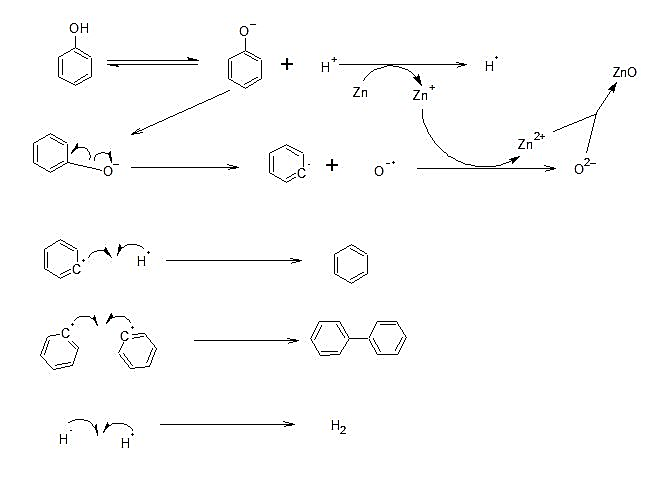
The reaction proceeds as follows:
 Detailed Mechanism:
- Zn is in the +2 oxidation state.
- The phenol gets converted into phenoxide ion and the released proton accepts an electron from Zn forming hydrogen radical. Due to the heating, there is homolytic fission of C of the phenyl ring and\[{{O}^{-}}\].
- Then\[{{O}^{-}}\]forms an electron from Zn and forms an oxide ion. In this way, zinc forms zinc oxide, and the phenyl radical produced forms a bond with hydrogen radical to form Benzene and bi-phenyl.
So, the correct option is A.
Note: The yield of this reaction used for benzene formation is lower.
Homolytic fission is the equal splitting of a pair of electrons between two separated atoms.
It is a reduction reaction of phenol to benzene by zinc dust. So, zinc is a reducing agent.
Benzene formed is volatile in nature. It is separated by fractional distillation.
It is an aromatic compound as it obeys Huckel’s rule of \[(4n+2)\pi \]electrons. It is a very stable compound due to resonance.
Complete step by step answer:
Distillation of phenol with zinc-dust gives benzene and ZnO as a side-product.
The reaction proceeds as follows:
Detailed Mechanism:- Zn is in the +2 oxidation state.
- The phenol gets converted into phenoxide ion and the released proton accepts an electron from Zn forming hydrogen radical. Due to the heating, there is homolytic fission of C of the phenyl ring and\[{{O}^{-}}\].
- Then\[{{O}^{-}}\]forms an electron from Zn and forms an oxide ion. In this way, zinc forms zinc oxide, and the phenyl radical produced forms a bond with hydrogen radical to form Benzene and bi-phenyl.
So, the correct option is A.
Note: The yield of this reaction used for benzene formation is lower.
Homolytic fission is the equal splitting of a pair of electrons between two separated atoms.
It is a reduction reaction of phenol to benzene by zinc dust. So, zinc is a reducing agent.
Benzene formed is volatile in nature. It is separated by fractional distillation.
Recently Updated Pages
JEE Main Mock Test 2025-26: Principles Related To Practical

JEE Main 2025 Organic Compounds Containing Oxygen Mock Test
JEE Main 2025-26 Organic Compounds Containing Oxygen Mock Test
JEE Main 2025-26 Mock Test: Purification & Characterisation of Organic Compounds
JEE Main 2025-26 Mock Test: Principles Related To Practical
JEE Main Mock Test 2025-26: Free Practice & Solutions
Trending doubts
JEE Main 2026: Exam Dates, Session 2 Updates, City Slip, Admit Card & Latest News
Understanding the Electric Field of a Uniformly Charged Ring
Understanding Atomic Structure for Beginners
Derivation of Equation of Trajectory Explained for Students
Electron Gain Enthalpy and Electron Affinity Explained
How to Convert a Galvanometer into an Ammeter or Voltmeter
Other Pages
JEE Advanced Percentile vs Marks 2026: JEE Main Cutoff, AIR & IIT Admission Guide
NCERT Solutions For Class 12 Chemistry Chapter 2 Electrochemistry - 2026-27
NCERT Solutions For Class 12 Chemistry Chapter 1 Solutions - 2026-27 Free PDF Download (Sign-in Required)
NCERT Solutions For Class 12 Chemistry Chapter 3 Chemical Kinetics - 2026-27
CBSE Notes Class 12 Chemistry Chapter 1 - Solutions - 2026-27
NCERT Solutions For Class 12 Chemistry Chapter 6 Haloalkanes And Haloarenes - 2026-27 PDF Download (Login Required)