




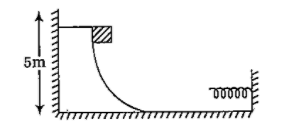
Consider the situation shown in the figure. A spring of spring constant \[400{\text{ }}Nm\]is attached at one end to a wedge fixed rigidly with the horizontal part. A \[40g\] mass is released from rest while situated at a height 5cm the curved track. The maximum deformation in the spring is nearly equal to (take \[g = 10m/{s^2}\]
(A) $9.8m$
(B) \[9.8cm\]
(C) $0.98m$
(D) $0.009km $
Answer
 Verified
249.3k+ views
Hint In this situation energy from one form is converted into another form hence we can use the conservation of energy theorem with the given values to calculate the spring deformation
Formula Used:
\[{K_i} + {P_i} = {K_f} + {P_f}\]
Complete step by step answer
Since the block is released then initial velocity,$u = 0$and it will follow the curved path and compress the spring till the final velocity of block will be zero after that the spring will regain its position and the block will be thrown back.
Since it is a friction less path, no external force exists. Only conservative forces are present hence you can say that the mechanical energy is conserved between the point of drop till the point of maximum compression of spring.
\[{K_i} + {P_i} = {K_f} + {P_f}\] , where $K_i$ and $K_f$ are the initial and final kinetic energy ---(1)
And $P_i$ and $P_f$ are the initial and final potential energy
We know that potential energy at a height ‘h’ of mass ‘m’ is given by \[mgh\]where g is the acceleration due to gravity and the potential energy stored in the spring is $\dfrac{1}{2}k{x^2}$ where k is the spring constant and x is the displacement.
\[{K_i} = 0\]and\[{K_f} = 0\]as the initial and final velocities are zero
As you can see that the final potential of block is also zero since its final velocity is zero, but the elastic potential energy will be acting thus
Substituting these in equation (1),
\[0 + mgh = 0 + \dfrac{1}{2}k{x^2} \Rightarrow x = \sqrt {\dfrac{{2mgh}}{k}} = \sqrt {\dfrac{{2 \times 0.04 \times 10 \times 5}}{{400}}} = \dfrac{1}{{10}}m = 10cm \cong 9.8cm\]
Hence, the correct option is B.
Note
If a string is compressed or stretched then we see that work is done due to spring elasticity, this work done is stored in the spring in the form of elastic potential energy.
Formula Used:
\[{K_i} + {P_i} = {K_f} + {P_f}\]
Complete step by step answer
Since the block is released then initial velocity,$u = 0$and it will follow the curved path and compress the spring till the final velocity of block will be zero after that the spring will regain its position and the block will be thrown back.
Since it is a friction less path, no external force exists. Only conservative forces are present hence you can say that the mechanical energy is conserved between the point of drop till the point of maximum compression of spring.
\[{K_i} + {P_i} = {K_f} + {P_f}\] , where $K_i$ and $K_f$ are the initial and final kinetic energy ---(1)
And $P_i$ and $P_f$ are the initial and final potential energy
We know that potential energy at a height ‘h’ of mass ‘m’ is given by \[mgh\]where g is the acceleration due to gravity and the potential energy stored in the spring is $\dfrac{1}{2}k{x^2}$ where k is the spring constant and x is the displacement.
\[{K_i} = 0\]and\[{K_f} = 0\]as the initial and final velocities are zero
As you can see that the final potential of block is also zero since its final velocity is zero, but the elastic potential energy will be acting thus
Substituting these in equation (1),
\[0 + mgh = 0 + \dfrac{1}{2}k{x^2} \Rightarrow x = \sqrt {\dfrac{{2mgh}}{k}} = \sqrt {\dfrac{{2 \times 0.04 \times 10 \times 5}}{{400}}} = \dfrac{1}{{10}}m = 10cm \cong 9.8cm\]
Hence, the correct option is B.
Note
If a string is compressed or stretched then we see that work is done due to spring elasticity, this work done is stored in the spring in the form of elastic potential energy.
Recently Updated Pages
JEE Isolation, Preparation and Properties of Non-metals Important Concepts and Tips for Exam Preparation

Isoelectronic Definition in Chemistry: Meaning, Examples & Trends
Ionisation Energy and Ionisation Potential Explained
Iodoform Reactions - Important Concepts and Tips for JEE
Introduction to Dimensions: Understanding the Basics
Instantaneous Velocity Explained: Formula, Examples & Graphs
Trending doubts
JEE Main 2026: Exam Dates, Session 2 Updates, City Slip, Admit Card & Latest News
Hybridisation in Chemistry – Concept, Types & Applications
JEE Main 2026 Application Login: Direct Link, Registration, Form Fill, and Steps
Understanding the Electric Field of a Uniformly Charged Ring
Derivation of Equation of Trajectory Explained for Students
JEE Main Marking Scheme 2026- Paper-Wise Marks Distribution and Negative Marking Details
Other Pages
JEE Advanced Marks vs Ranks 2025: Understanding Category-wise Qualifying Marks and Previous Year Cut-offs
JEE Advanced 2026 - Exam Date (Released), Syllabus, Registration, Eligibility, Preparation, and More
CBSE Notes Class 11 Physics Chapter 1 - Units And Measurements - 2025-26
Important Questions For Class 11 Physics Chapter 1 Units and Measurement - 2025-26
NCERT Solutions For Class 11 Physics Chapter 1 Units And Measurements - 2025-26
CBSE Notes Class 11 Physics Chapter 4 - Laws of Motion - 2025-26