




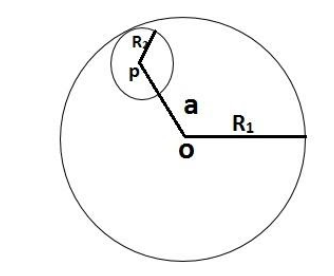
Consider a uniform spherical charge distribution of radius ${R_1}$ centred at the origin O. In this distribution a spherical cavity of radius${R_2}$, centred at P with distance $OP = a = {R_1} = {R_2}$ is made. If the electric field inside the cavity at position $\vec r$ is $\vec E\left( {\vec r} \right)$, then the correct statement is
(A) $\vec E$ is uniform, its magnitude is independent of ${R_2}$ but its direction depends on $\vec r$
(B) $\vec E$ is uniform, its magnitude is dependent of ${R_2}$ but its direction depends on $\vec r$
(C) $\vec E$ is uniform, its magnitude is independent of $a$ but its direction depends on $\vec a$
(D) $\vec E$ is uniform and both its magnitude and direction depend on $\vec a$.
Answer
 Verified
266.1k+ views
Hint: Due to the larger sphere without the cavity and a smaller sphere with opposite charge density, the principle of superposition of electric fields can be applied. We need to apply Gauss’s Law to get the final answer.
Complete Step by Step Solution: Every charged particle creates an electric field in the universe in the space surrounding it. The electric field created due to the charge is independent of the presence or absence of all other charges. The electric field created can be calculated with the help of Coulomb’s law. The principle of superposition allows for the combination of two or more electric fields.
Superposition Principle gives the total force on a given charge due to any number of point charges acting on it. The principle of superposition states that every charge in space creates an electric field at a point independent of the presence of other charges in that medium. The resultant electric field is a vector sum of the electric field due to individual charges.
Since it has been given that, a uniform spherical charge distribution centred at the origin O has a radius ${R_1}$. In this distribution a spherical cavity of radius${R_2}$, centred at P with distance $OP = a = {R_1} = {R_2}$ is made and the electric field inside the cavity at position $\vec r$ is $\vec E\left( {\vec r} \right)$.
The problem can be considered as a superposition of electric fields due to the larger sphere without the cavity and a smaller sphere with opposite charge density.
By application of Gauss’ Law, for an internal point inside the spherical charge distribution, we have,
$\vec E\left( {\vec r} \right) = \dfrac{{\rho r}}{{3{ \in _r}}}$ where $\rho $ is the density.
By principle of superposition, $\vec E = {\vec E_1} + {\vec E_2}$.
$\dfrac{\rho }{{3{ \in _0}}}O\vec A + \dfrac{\rho }{{3{ \in _0}}}\vec AP + \dfrac{\rho }{{3{ \in _0}}}\left( {O\vec A + \vec AP} \right)$
We can write,
$\vec E = \dfrac{\rho }{{3{ \in _0}}}O\vec A = \dfrac{\rho }{{3{ \in _0}}}\vec a$
Hence, $\vec E$ is uniform and both its magnitude and direction depend on $\vec a$.
The correct answer is Option D.
Note: Gauss Law states that the total electric flux out of a closed surface is equal to the charge enclosed divided by the permittivity. The electric flux in an area is defined as the electric field multiplied by the area of the surface projected in a plane and perpendicular to the field.
Complete Step by Step Solution: Every charged particle creates an electric field in the universe in the space surrounding it. The electric field created due to the charge is independent of the presence or absence of all other charges. The electric field created can be calculated with the help of Coulomb’s law. The principle of superposition allows for the combination of two or more electric fields.
Superposition Principle gives the total force on a given charge due to any number of point charges acting on it. The principle of superposition states that every charge in space creates an electric field at a point independent of the presence of other charges in that medium. The resultant electric field is a vector sum of the electric field due to individual charges.
Since it has been given that, a uniform spherical charge distribution centred at the origin O has a radius ${R_1}$. In this distribution a spherical cavity of radius${R_2}$, centred at P with distance $OP = a = {R_1} = {R_2}$ is made and the electric field inside the cavity at position $\vec r$ is $\vec E\left( {\vec r} \right)$.
The problem can be considered as a superposition of electric fields due to the larger sphere without the cavity and a smaller sphere with opposite charge density.
By application of Gauss’ Law, for an internal point inside the spherical charge distribution, we have,
$\vec E\left( {\vec r} \right) = \dfrac{{\rho r}}{{3{ \in _r}}}$ where $\rho $ is the density.
By principle of superposition, $\vec E = {\vec E_1} + {\vec E_2}$.
$\dfrac{\rho }{{3{ \in _0}}}O\vec A + \dfrac{\rho }{{3{ \in _0}}}\vec AP + \dfrac{\rho }{{3{ \in _0}}}\left( {O\vec A + \vec AP} \right)$
We can write,
$\vec E = \dfrac{\rho }{{3{ \in _0}}}O\vec A = \dfrac{\rho }{{3{ \in _0}}}\vec a$
Hence, $\vec E$ is uniform and both its magnitude and direction depend on $\vec a$.
The correct answer is Option D.
Note: Gauss Law states that the total electric flux out of a closed surface is equal to the charge enclosed divided by the permittivity. The electric flux in an area is defined as the electric field multiplied by the area of the surface projected in a plane and perpendicular to the field.
Recently Updated Pages
States of Matter Chapter For JEE Main Chemistry

Young’s Double Slit Experiment Derivation Explained
Wheatstone Bridge – Principle, Formula, Diagram & Applications
Circuit Switching vs Packet Switching: Key Differences Explained
Mass vs Weight: Key Differences Explained for Students
[Awaiting the three content sources: Ask AI Response, Competitor 1 Content, and Competitor 2 Content. Please provide those to continue with the analysis and optimization.]
Trending doubts
JEE Main 2026: Exam Dates, Session 2 Updates, City Slip, Admit Card & Latest News
JEE Main Participating Colleges 2026 - A Complete List of Top Colleges
Kinematics Mock Test for JEE Main 2025-26: Practice & Ace the Exam
Kinematics Mock Test for JEE Main 2025-26: Comprehensive Practice
Hybridisation in Chemistry – Concept, Types & Applications
Understanding the Electric Field of a Uniformly Charged Ring
Other Pages
CBSE Class 12 Physics Question Paper 2026: Download SET-wise PDF with Answer Key & Analysis
JEE Advanced 2026 Notification Out with Exam Date, Registration (Extended), Syllabus and More
JEE Advanced Percentile vs Marks 2026: JEE Main Cutoff, AIR & IIT Admission Guide
JEE Advanced 2026 Marks vs Rank: Estimate IIT Rank from Your Score
JEE Advanced Weightage Chapter Wise 2026 for Physics, Chemistry, and Mathematics
Derivation of Equation of Trajectory Explained for Students