




$C{H_3}C{H_2}Br\xrightarrow{{aqKOH}}A\xrightarrow{{KMn{O_4}/{H^ + }}}B\xrightarrow[\vartriangle ]{{N{H_3}}}C\xrightarrow[{alkali}]{{B{r_2}}}D$ . D is:
A) $C{H_3}Br$
B) $C{H_3}CON{H_2}$
C) $C{H_2}N{H_2}$
D) $C{H_2}B{r_2}$
Answer
 Verified
264.9k+ views
Hint: Reagents used in the conversion are very important. The aqKOH use, carry out nucleophilic substitution reaction while $KMn{O_4}/{H^ + }$ is a very strong oxidizing agent. The ammonia $\left( {N{H_3}} \right)$ easily takes up protons in the reaction and $B{H_2}$ /alkali is a reagent used in Hoffmann bromamide reaction.
Complete step by step answer:
$C{H_3}C{H_2}Br\xrightarrow{{aqKOH}}A\xrightarrow{{KMn{O_4}/{H^ + }}}B\xrightarrow[\vartriangle ]{{N{H_3}}}C\xrightarrow[{alkali}]{{B{r_2}}}D$
First of all, let us break the sequential conversion, in order to make the conversion process easier for us.
Let us first look at this part of the reaction $C{H_3}C{H_2}Br\xrightarrow{{aqKOH}}A$.
aqKOH acts a nucleophile here and the reaction is a bimolecular nucleophilic substitution reaction (${S_N}2$ reaction) as the ethyl bromide is a primary alkyl halide. Thus, we get
$C{H_3}C{H_2} - Br\xrightarrow{{aqKOH}}C{H_3} - CH - OH$
The ethanol formed in the reaction is then oxidized by acidified potassium permanganate to give the corresponding carboxylic acid.
That is,
$C{H_3} - C{H_2} - OH\xrightarrow{{KMn{O_4}/{H^ + }}}C{H_3} - COOH$
The $N{H_3}$ then takes up proton from the carboxylic forming ammonium ethanoate which when heated gives ethanamide.
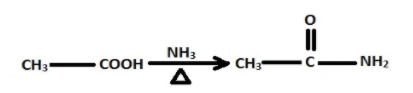
The ethanamide then reacts with $B{H_2}$ /alkali to form methylamine.
$C{H_3} - CON{H_2}\xrightarrow[{alkali}]{{B{H_2}}}C{H_3}N{H_2}$
This is Hoffmann bromamide reaction. The amide formed contains one carbon atom less than amide.
Thus, the sequential conversion can be written as –

Option (C) is the correct option.
Note:
Students should understand that associated colloids, also called micelles, are generally electrolytes. They exist as ions at low concentration. It is above a particular concentration called critical micelle concentration (CMC) and above a temperature called Kraft temperature; these get associated and exhibit colloidal behavior. It is very important to note that the primary distinguishing features between a true solution and a colloidal solution is fundamentally the dimension of the constituent part.
Complete step by step answer:
$C{H_3}C{H_2}Br\xrightarrow{{aqKOH}}A\xrightarrow{{KMn{O_4}/{H^ + }}}B\xrightarrow[\vartriangle ]{{N{H_3}}}C\xrightarrow[{alkali}]{{B{r_2}}}D$
First of all, let us break the sequential conversion, in order to make the conversion process easier for us.
Let us first look at this part of the reaction $C{H_3}C{H_2}Br\xrightarrow{{aqKOH}}A$.
aqKOH acts a nucleophile here and the reaction is a bimolecular nucleophilic substitution reaction (${S_N}2$ reaction) as the ethyl bromide is a primary alkyl halide. Thus, we get
$C{H_3}C{H_2} - Br\xrightarrow{{aqKOH}}C{H_3} - CH - OH$
The ethanol formed in the reaction is then oxidized by acidified potassium permanganate to give the corresponding carboxylic acid.
That is,
$C{H_3} - C{H_2} - OH\xrightarrow{{KMn{O_4}/{H^ + }}}C{H_3} - COOH$
The $N{H_3}$ then takes up proton from the carboxylic forming ammonium ethanoate which when heated gives ethanamide.
The ethanamide then reacts with $B{H_2}$ /alkali to form methylamine.
$C{H_3} - CON{H_2}\xrightarrow[{alkali}]{{B{H_2}}}C{H_3}N{H_2}$
This is Hoffmann bromamide reaction. The amide formed contains one carbon atom less than amide.
Thus, the sequential conversion can be written as –
Option (C) is the correct option.
Note:
Students should understand that associated colloids, also called micelles, are generally electrolytes. They exist as ions at low concentration. It is above a particular concentration called critical micelle concentration (CMC) and above a temperature called Kraft temperature; these get associated and exhibit colloidal behavior. It is very important to note that the primary distinguishing features between a true solution and a colloidal solution is fundamentally the dimension of the constituent part.
Recently Updated Pages
JEE Main Mock Test 2025-26: Principles Related To Practical

JEE Main 2025-26 Organic Compounds Containing Nitrogen Mock Test
JEE Main Chemical Kinetics Mock Test 2025-26: Free Practice Online
JEE Main 2025-26 Organic Compounds Containing Oxygen Mock Test
JEE Main 2025-26 Mock Test: Organic Compounds Containing Oxygen
JEE Main 2025-26 Organic Compounds Containing Halogens Mock Test
Trending doubts
JEE Main 2026: Exam Dates, Session 2 Updates, City Slip, Admit Card & Latest News
JEE Main Participating Colleges 2026 - A Complete List of Top Colleges
Hybridisation in Chemistry – Concept, Types & Applications
Understanding the Electric Field of a Uniformly Charged Ring
Derivation of Equation of Trajectory Explained for Students
How to Convert a Galvanometer into an Ammeter or Voltmeter
Other Pages
JEE Advanced 2026 Notification Out with Exam Date, Registration (Extended), Syllabus and More
CBSE Class 12 Chemistry Question Paper 2026 PDF Download (All Sets) with Answer Key
JEE Advanced Percentile vs Marks 2026: JEE Main Cutoff, AIR & IIT Admission Guide
NCERT Solutions For Class 12 Chemistry Chapter 2 Electrochemistry - 2025-26
NCERT Solutions For Class 12 Chemistry Chapter 1 Solutions - 2025-26
NCERT Solutions For Class 12 Chemistry Chapter 3 Chemical Kinetics - 2025-26