




Can you distinguish between concave and convex mirrors without touching them? How?
Answer
 Verified
561.4k+ views
- Hint: – In this question use the concept that concave mirror forms enlarged image and convex mirror formed forms diminished image so use these concepts to reach the solution of the question.
Complete step-by-step solution -
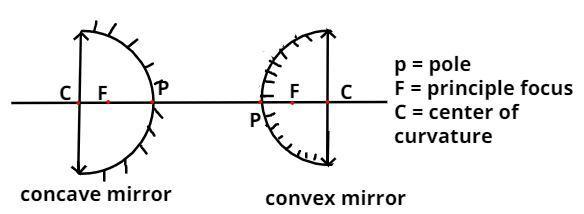
Yes, we can distinguish between concave and convex mirrors without touching them.
As we know that in a concave mirror the size of the image formed is enlarged w.r.t. the real image.
And in the convex mirror the size of the image formed is diminished w.r.t. the real image.
This is the basic difference by which we can distinguish between concave and convex mirrors without touching them.
For example: Remember the rear mirror of the car which is a convex mirror, so in this mirror if we see the image of the incoming car we see the complete image which is smaller in size so without touching the mirror we can say that this is a convex mirror.
And when we see objects from the telescope we see enlarged images so we can say that this is a concave mirror without touching them.
So this is the required answer.
Note – Whenever we face such types of questions always remember all the properties of concave and convex mirror such as convex mirror rounded or curved like the exterior of a circle or sphere and concave mirror is rounded or hollowed like the interior of a circle or a sphere as shown in the figure which will help us to find out the solution.
Complete step-by-step solution -
Yes, we can distinguish between concave and convex mirrors without touching them.
As we know that in a concave mirror the size of the image formed is enlarged w.r.t. the real image.
And in the convex mirror the size of the image formed is diminished w.r.t. the real image.
This is the basic difference by which we can distinguish between concave and convex mirrors without touching them.
For example: Remember the rear mirror of the car which is a convex mirror, so in this mirror if we see the image of the incoming car we see the complete image which is smaller in size so without touching the mirror we can say that this is a convex mirror.
And when we see objects from the telescope we see enlarged images so we can say that this is a concave mirror without touching them.
So this is the required answer.
Note – Whenever we face such types of questions always remember all the properties of concave and convex mirror such as convex mirror rounded or curved like the exterior of a circle or sphere and concave mirror is rounded or hollowed like the interior of a circle or a sphere as shown in the figure which will help us to find out the solution.
Recently Updated Pages
Circuit Switching vs Packet Switching: Key Differences Explained

JEE General Topics in Chemistry Important Concepts and Tips
JEE Extractive Metallurgy Important Concepts and Tips for Exam Preparation
JEE Atomic Structure and Chemical Bonding important Concepts and Tips
JEE Amino Acids and Peptides Important Concepts and Tips for Exam Preparation
Electricity and Magnetism Explained: Key Concepts & Applications
Trending doubts
JEE Main 2026: Exam Dates, Session 2 Updates, City Slip, Admit Card & Latest News
JEE Main Participating Colleges 2026 - A Complete List of Top Colleges
Kinematics Mock Test for JEE Main 2025-26: Comprehensive Practice
Understanding the Electric Field of a Uniformly Charged Ring
Understanding Atomic Structure for Beginners
Derivation of Equation of Trajectory Explained for Students
Other Pages
CBSE Class 12 Physics Question Paper 2026: Download SET-wise PDF with Answer Key & Analysis
JEE Advanced 2026 Notification Out with Exam Date, Registration (Extended), Syllabus and More
JEE Advanced Percentile vs Marks 2026: JEE Main Cutoff, AIR & IIT Admission Guide
JEE Advanced 2026 Marks vs Rank: Estimate IIT Rank from Your Score
JEE Advanced Weightage Chapter Wise 2026 for Physics, Chemistry, and Mathematics
JEE Main Marking Scheme 2026- Paper-Wise Marks Distribution and Negative Marking Details