




Aniline on treatment with excess of bromine water gives:
A. Aniline Bromide
B. o-bromoaniline
C. p-bromoaniline
D. Benzene
Answer
 Verified
293.1k+ views
Hint: Aniline acts as a strong base in acidic solution. It can donate its electron pair. Aniline has a basic amine or $NH_2$ group attached with benzene ring. The amine group is a electron donating group or $+I$ effect group.
Formula Used:
Complete step-by-step answer:In aniline the amine group attached to benzene ring is a strong electron donating group or $+I$ effect group. It is a ortho-para detecting group that means it direct the incoming electrophile to attack at ortho or para position of benzene ring.
Water is a polar solvent which activates the amine group of aniline so much that on treatment with bromine water the electrophile or the bromine atom attacks the two ortho and one para positions at a time and gives $2,4,6-tribromoaniline$ as a major product.
The bromination reaction of aniline in presence of excess bromine water is given as follows-
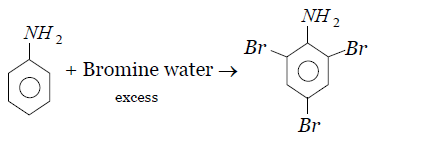
In this reaction aniline reacts with excess bromine water to produce $2,4,6-tribromoaniline$ as a major product with the minor product three moles of hydrogen bromide.
Option ‘ ’ is correct
Additional Information:
Note: Bromination reaction is an aromatic electrophilic substitution reaction where an electrophile attacks a benzene ring. If any electron donating group is connected with the benzene ring then reactivity of the benzene ring increases. Again if any electron withdrawing group is connected with the benzene ring then reactivity of the benzene ring decreases.
Formula Used:
Complete step-by-step answer:In aniline the amine group attached to benzene ring is a strong electron donating group or $+I$ effect group. It is a ortho-para detecting group that means it direct the incoming electrophile to attack at ortho or para position of benzene ring.
Water is a polar solvent which activates the amine group of aniline so much that on treatment with bromine water the electrophile or the bromine atom attacks the two ortho and one para positions at a time and gives $2,4,6-tribromoaniline$ as a major product.
The bromination reaction of aniline in presence of excess bromine water is given as follows-
In this reaction aniline reacts with excess bromine water to produce $2,4,6-tribromoaniline$ as a major product with the minor product three moles of hydrogen bromide.
Option ‘ ’ is correct
Additional Information:
Note: Bromination reaction is an aromatic electrophilic substitution reaction where an electrophile attacks a benzene ring. If any electron donating group is connected with the benzene ring then reactivity of the benzene ring increases. Again if any electron withdrawing group is connected with the benzene ring then reactivity of the benzene ring decreases.
Recently Updated Pages
How will you convert i Propene to propan1ol ii Ethanal class 12 chemistry JEE_Main

Atomic Structure JEE Main Mock Test 2026-27: Free Practice Online
JEE Main 2025-26 Mock Test: Classification of Elements & Periodicity
JEE Main Mock Test 2025-26: Free Practice, Analysis & Tips
JEE Main Mock Test 2026-27: Some Basic Concepts in Chemistry
Class 12 Chemistry Mock Test Series for JEE Main – Free Online Practice
Trending doubts
Electron Gain Enthalpy and Electron Affinity Explained
Understanding the Different Types of Solutions in Chemistry
What Are Current and Potential Difference in Electricity?
Understanding the Angle of Deviation in a Prism
Isoelectronic Species: Definition, Examples & Importance
Understanding Average and RMS Value in Electrical Circuits
Other Pages
JEE Advanced 2026 Notification Out with Exam Date, Registration (Extended), Syllabus and More
NCERT Solutions For Class 12 Chemistry Chapter 8 Aldehydes Ketones And Carboxylic Acids - 2026-27 Free PDF Download (Sign-in Required)
NCERT Solutions For Class 12 Chemistry Chapter 10 Biomolecules - 2026-27 Free PDF Download (Sign-in Required)
Understanding Collisions: Types and Examples for Students
Understanding Inertial and Non-Inertial Frames of Reference
What Are Elastic Collisions in One Dimension?
JEE Advanced 2026 Notification Out with Exam Date, Registration (Extended), Syllabus and More
NCERT Solutions For Class 12 Chemistry Chapter 8 Aldehydes Ketones And Carboxylic Acids - 2026-27 Free PDF Download (Sign-in Required)
NCERT Solutions For Class 12 Chemistry Chapter 10 Biomolecules - 2026-27 Free PDF Download (Sign-in Required)