




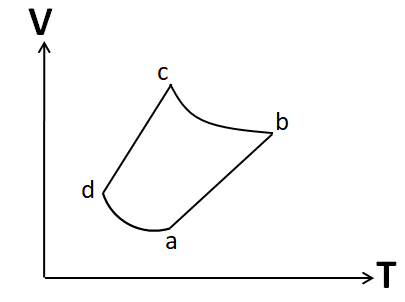
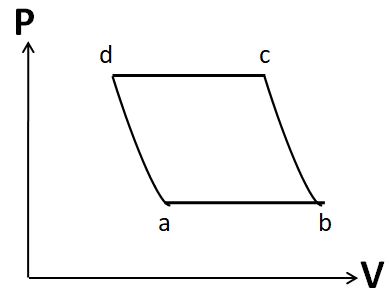
An ideal gas goes through a reversible cycle $a \to b \to c \to d$ has the V- T diagram shown below. Process $d \to a$ and $b \to c$ are adiabatic. The corresponding P- V diagram for the process is (all figures are schematic and not drawn to scale).
(A)
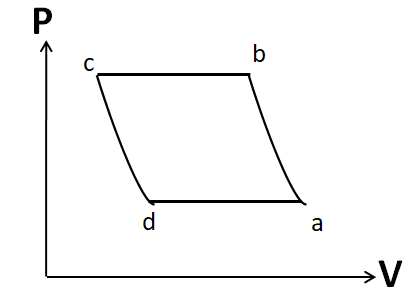
(B)
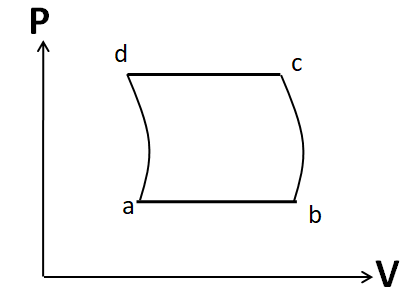
(C)
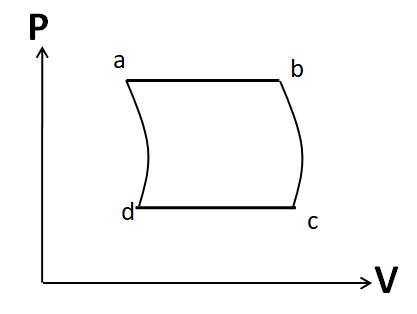
(D)
Answer
 Verified
257.7k+ views
Hint: To solve this question, we need to obtain the equation for each of the four processes given in the cycle. We also have to use the ideal equation for identifying each process.
Complete step-by-step solution:
Process a to b:
In the given V-T diagram, the process a-b is represented by a straight line. From the ideal gas equation we have
$PV = nRT$
$ \Rightarrow T = \dfrac{P}{{nR}}V$
Comparing with the equation of the straight line $y = mx$, we have the slope of the diagram for this process as
${m_{ab}} = \dfrac{P}{{nR}}$
Since the slope of a straight line is a constant, so we have
\[\dfrac{P}{{nR}} = constant\]
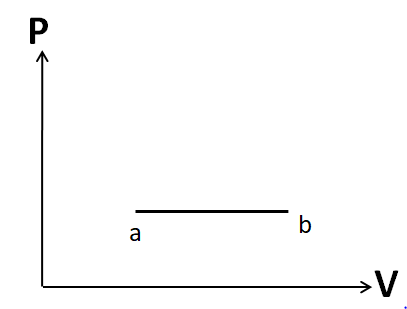
Since the number of moles is constant, we have a constant pressure. So this process is isobaric. Hence it must be represented by a horizontal line. So the P-V diagram for this process will look like
Process b to c:
According to the question, this process is adiabatic. We know that the adiabatic process is represented by the equation
$P{V^\gamma } = Constant$
So we can write
$P = \dfrac{k}{{{V^\gamma }}}$
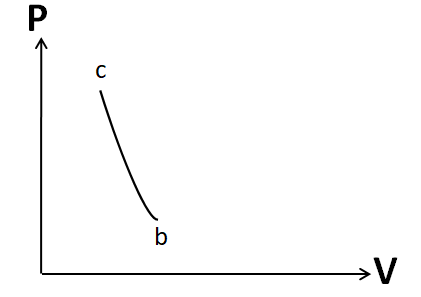
So the P-V graph for this process will look like
Similarly, we can show that the process c to d is also isobaric. So its P-V graph will be similar to the P-V graph of the process a to b.
Also the process d to a is given to be adiabatic. So its P-V graph will be similar to that of the process b to c. Hence, the P-V graph for the cycle given in the question is
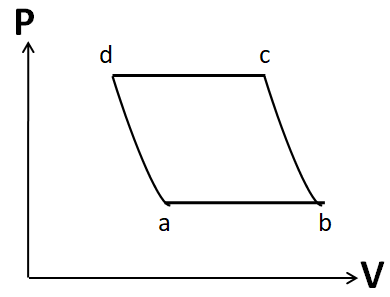
Hence, the correct answer is option D.
Note: It is important to draw the P-V plot in the same order as that given in the question. Otherwise you may get the same shape, but due to a different order you may tick the incorrect option. For example, the P-V diagram given in option A is similar to that in the correct option D. But it has different order.
Complete step-by-step solution:
Process a to b:
In the given V-T diagram, the process a-b is represented by a straight line. From the ideal gas equation we have
$PV = nRT$
$ \Rightarrow T = \dfrac{P}{{nR}}V$
Comparing with the equation of the straight line $y = mx$, we have the slope of the diagram for this process as
${m_{ab}} = \dfrac{P}{{nR}}$
Since the slope of a straight line is a constant, so we have
\[\dfrac{P}{{nR}} = constant\]
Since the number of moles is constant, we have a constant pressure. So this process is isobaric. Hence it must be represented by a horizontal line. So the P-V diagram for this process will look like
Process b to c:
According to the question, this process is adiabatic. We know that the adiabatic process is represented by the equation
$P{V^\gamma } = Constant$
So we can write
$P = \dfrac{k}{{{V^\gamma }}}$
So the P-V graph for this process will look like
Similarly, we can show that the process c to d is also isobaric. So its P-V graph will be similar to the P-V graph of the process a to b.
Also the process d to a is given to be adiabatic. So its P-V graph will be similar to that of the process b to c. Hence, the P-V graph for the cycle given in the question is
Hence, the correct answer is option D.
Note: It is important to draw the P-V plot in the same order as that given in the question. Otherwise you may get the same shape, but due to a different order you may tick the incorrect option. For example, the P-V diagram given in option A is similar to that in the correct option D. But it has different order.
Recently Updated Pages
Circuit Switching vs Packet Switching: Key Differences Explained

Dimensions of Pressure in Physics: Formula, Derivation & SI Unit
JEE General Topics in Chemistry Important Concepts and Tips
JEE Extractive Metallurgy Important Concepts and Tips for Exam Preparation
JEE Atomic Structure and Chemical Bonding important Concepts and Tips
JEE Amino Acids and Peptides Important Concepts and Tips for Exam Preparation
Trending doubts
JEE Main 2026: Exam Dates, Session 2 Updates, City Slip, Admit Card & Latest News
JEE Main Participating Colleges 2026 - A Complete List of Top Colleges
JEE Main 2026 Application Login: Direct Link, Registration, Form Fill, and Steps
JEE Main Colleges 2026: Complete List of Participating Institutes
JEE Main Marking Scheme 2026- Paper-Wise Marks Distribution and Negative Marking Details
Hybridisation in Chemistry – Concept, Types & Applications
Other Pages
JEE Advanced 2026 - Exam Date (Released), Syllabus, Registration, Eligibility, Preparation, and More
JEE Advanced Marks vs Ranks 2025: Understanding Category-wise Qualifying Marks and Previous Year Cut-offs
CBSE Notes Class 11 Physics Chapter 1 - Units And Measurements - 2025-26
NCERT Solutions For Class 11 Physics Chapter 1 Units And Measurements - 2025-26
Important Questions For Class 11 Physics Chapter 1 Units and Measurement - 2025-26
JEE Advanced Weightage 2025 Chapter-Wise for Physics, Maths and Chemistry