




Amylopectin is a polymer of
(A) $\alpha -D$ glucose
(B) $\alpha -D$ fructose
(C) Lactose
(D) Amylose
Answer
 Verified
250.2k+ views
Hint: Polymer is a substance consisting of a large number of molecules or macromolecules and composed of many repeating units.
Example. silk, wool, DNA, cellulose, proteins are all natural polymers.
Complete step by step answer:
Amylopectin is polysaccharide and a highly branched polymer. They are found in plants.
Amylopectin is one of the two important components of starch. It is water soluble.
The repeating unit in Amylopectin is $\alpha - D - $ glucose.
$\alpha - D - $glucose units are linked in a linear way with ${C_1} \to {C_4}$ glycosidic bonds.
A glycosidic linkage is a covalent bond that allows the linking of two monosaccharides together.
Amylopectin contributes about 80% of starch $\alpha - D - $ glucose linked ${C_1} - {C_4}$ atoms through glycosidic linkage branching occurs by the formation of glycosidic linkage between${C_1}$ of one$\alpha - D - $ glucose and ${C_6}$ of another $\alpha - D - $ glucose unit.
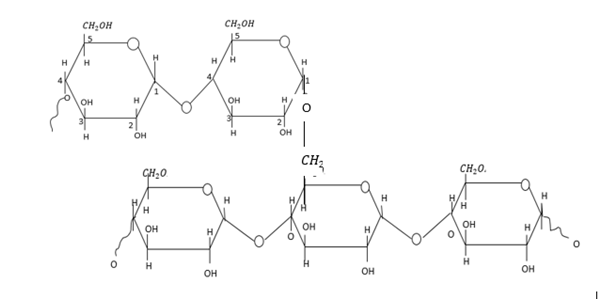
Linkage between two monosaccharide molecules through oxygen is called glycosidic linkage.
Therefore, by the above explanation, the correct option is [A]
Note: Polysaccharides have a large number of same or different monosaccharides, linked together by glycosidic linkage. They have molecular formula ${({C_6}{H_{10}}{O_5})_n}$
Another part of starch is Amylose. This is a water soluble part of starch.
Example. silk, wool, DNA, cellulose, proteins are all natural polymers.
Complete step by step answer:
Amylopectin is polysaccharide and a highly branched polymer. They are found in plants.
Amylopectin is one of the two important components of starch. It is water soluble.
The repeating unit in Amylopectin is $\alpha - D - $ glucose.
$\alpha - D - $glucose units are linked in a linear way with ${C_1} \to {C_4}$ glycosidic bonds.
A glycosidic linkage is a covalent bond that allows the linking of two monosaccharides together.
Amylopectin contributes about 80% of starch $\alpha - D - $ glucose linked ${C_1} - {C_4}$ atoms through glycosidic linkage branching occurs by the formation of glycosidic linkage between${C_1}$ of one$\alpha - D - $ glucose and ${C_6}$ of another $\alpha - D - $ glucose unit.
Linkage between two monosaccharide molecules through oxygen is called glycosidic linkage.
Therefore, by the above explanation, the correct option is [A]
Note: Polysaccharides have a large number of same or different monosaccharides, linked together by glycosidic linkage. They have molecular formula ${({C_6}{H_{10}}{O_5})_n}$
Another part of starch is Amylose. This is a water soluble part of starch.
Recently Updated Pages
JEE Isolation, Preparation and Properties of Non-metals Important Concepts and Tips for Exam Preparation

Isoelectronic Definition in Chemistry: Meaning, Examples & Trends
Ionisation Energy and Ionisation Potential Explained
Iodoform Reactions - Important Concepts and Tips for JEE
Introduction to Dimensions: Understanding the Basics
Instantaneous Velocity Explained: Formula, Examples & Graphs
Trending doubts
JEE Main 2026: Exam Dates, Session 2 Updates, City Slip, Admit Card & Latest News
Hybridisation in Chemistry – Concept, Types & Applications
JEE Main 2026 Application Login: Direct Link, Registration, Form Fill, and Steps
Understanding the Electric Field of a Uniformly Charged Ring
JEE Main Marking Scheme 2026- Paper-Wise Marks Distribution and Negative Marking Details
Derivation of Equation of Trajectory Explained for Students
Other Pages
CBSE Class 12 Chemistry Question Paper 2026 PDF Download (All Sets) with Answer Key
NCERT Solutions For Class 12 Chemistry Chapter 10 Biomolecules - 2025-26
JEE Advanced Marks vs Ranks 2025: Understanding Category-wise Qualifying Marks and Previous Year Cut-offs
NCERT Solutions For Class 12 Chemistry Chapter 2 Electrochemistry - 2025-26
NCERT Solutions For Class 12 Chemistry Chapter 1 Solutions - 2025-26
NCERT Solutions For Class 12 Chemistry Chapter 3 Chemical Kinetics - 2025-26