




When a wheel rolls on a level road, the direction of frictional force at the point of contact of wheel and ground is:
Answer
 Verified
271.2k+ views
Hint: Static friction holds a wheel or a ball on the surface. A torque has to be applied to the wheel in order to start the rolling motion. The frictional force prevents the wheel from sliding and thus initiates the rolling motion. Static friction opposes the motion that would take place. Apply this logic to obtain the direction of frictional force.
Complete step by step solution:
Frictional force is the opposing force which plays between two surfaces and it destroys the relative motion between them. Frictional force is a non-conservative force. The force produced by two surfaces that contact and slide against each other, that force is called the frictional force. These forces are affected by the nature of the surface and amount of force acting on them.
In case of a bicycle, the front wheel of the bicycle is connected to a rod passing through its centre. The force acting on the wheel about its central axis by the force coming from the rest of the bicycle is zero. Front wheel obtains linear velocity by pedalling but it cannot rotate it.
Wheel or ball can also be rolled by pushing on it. The frictional force prevents the wheel from sliding forward at the point of contact. Here, the frictional force prevents the wheel from sliding forward and it is in the opposite direction.
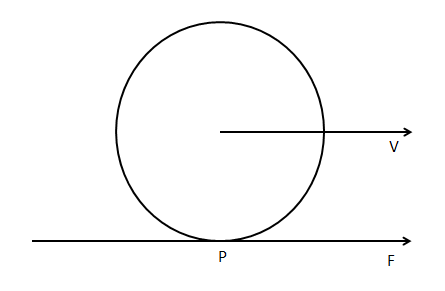
So, in the case of the wheel, the point P which is in contact with the ground tries to go backward due to rotation. Frictional force will oppose this motion. Hence it will move forward.
Hence the direction of frictional force at the point P of the wheel is in forward direction.
Note: Frictional force opposes the motion. Here static friction holds a wheel or a ball on the surface. Frictional force is equal and opposite in direction to the applied force parallel to the contacting surfaces. The resistance due to the rolling body on a surface is called rolling friction. Torque is a force that acts on a body that is undergoing rotation.
Complete step by step solution:
Frictional force is the opposing force which plays between two surfaces and it destroys the relative motion between them. Frictional force is a non-conservative force. The force produced by two surfaces that contact and slide against each other, that force is called the frictional force. These forces are affected by the nature of the surface and amount of force acting on them.
In case of a bicycle, the front wheel of the bicycle is connected to a rod passing through its centre. The force acting on the wheel about its central axis by the force coming from the rest of the bicycle is zero. Front wheel obtains linear velocity by pedalling but it cannot rotate it.
Wheel or ball can also be rolled by pushing on it. The frictional force prevents the wheel from sliding forward at the point of contact. Here, the frictional force prevents the wheel from sliding forward and it is in the opposite direction.
So, in the case of the wheel, the point P which is in contact with the ground tries to go backward due to rotation. Frictional force will oppose this motion. Hence it will move forward.
Hence the direction of frictional force at the point P of the wheel is in forward direction.
Note: Frictional force opposes the motion. Here static friction holds a wheel or a ball on the surface. Frictional force is equal and opposite in direction to the applied force parallel to the contacting surfaces. The resistance due to the rolling body on a surface is called rolling friction. Torque is a force that acts on a body that is undergoing rotation.
Recently Updated Pages
JoSAA Counselling 2026: JoSAA 2026 Mock Seat Allotment LIVE: Round 2 Result Released, Registration, Choice Filling and Ranks

Circuit Switching vs Packet Switching: Key Differences Explained
Dimensions of Pressure in Physics: Formula, Derivation & SI Unit
JEE General Topics in Chemistry Important Concepts and Tips
JEE Extractive Metallurgy Important Concepts and Tips for Exam Preparation
JEE Atomic Structure and Chemical Bonding important Concepts and Tips
Trending doubts
JEE Main 2026: Exam Dates, Session 2 Updates, City Slip, Admit Card & Latest News
JEE Main Participating Colleges 2026 - A Complete List of Top Colleges
Understanding the Electric Field of a Uniformly Charged Ring
Understanding Atomic Structure for Beginners
Derivation of Equation of Trajectory Explained for Students
JEE Main Marking Scheme 2026- Paper-Wise Marks Distribution and Negative Marking Details
Other Pages
JEE Advanced 2026 Notification Out with Exam Date, Registration (Extended), Syllabus and More
JEE Advanced Percentile vs Marks 2026: JEE Main Cutoff, AIR & IIT Admission Guide
CBSE Notes Class 11 Physics Chapter 1 - Units And Measurements - 2026-27
NCERT Solutions For Class 11 Physics Chapter 1 Units And Measurements - 2025-26
Important Questions For Class 11 Physics Chapter 1 Units and Measurement - 2025-26
JEE Advanced Weightage Chapter Wise 2026 for Physics, Chemistry, and Mathematics