




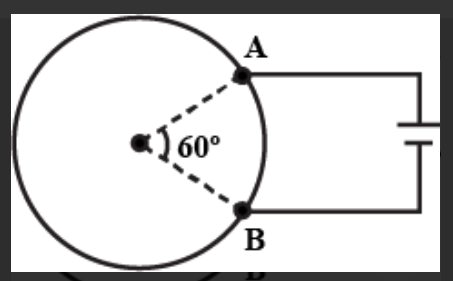
A uniform wire of resistance 36 ohm is it a circle. A battery is connected between A and B as shown. The effective resistance between A and B is 60
Answer
 Verified
249.6k+ views
Hint: We know that in a series circuit, the equivalent resistance is the algebraic sum of the resistances. The current through the circuit can be found from Ohm's law and is equal to the voltage divided by the equivalent resistance. The potential drop across each resistor can be found using Ohm's law. The method we use to calculate equivalent resistance is different for each type of circuit. For a series circuit, we simply add up the resistances of each component. However, in a parallel circuit, the reciprocal of the total resistance is equal to the sums of the reciprocals of the resistances of each branch.
Complete step by step answer
We know components connected in series are connected along a single conductive path, so the same current flows through all of the components but voltage is dropped (lost) across each of the resistances. In a series circuit, the sum of the voltages consumed by each individual resistance is equal to the source voltage.
In a parallel circuit, all components are connected across each other, forming exactly two sets of electrically common points. A “branch” in a parallel circuit is a path for electric current formed by one of the load components (such as a resistor).
There is no division of voltage among the appliances when connected in parallel. The potential difference across each appliance is equal to the supplied voltage. The total effective resistance of the circuit can be reduced by connecting electrical appliances in parallel.
The wire in bent to circle,
The simplified diagram will be as the resistors of whole wire is $36 \Omega$ so the resistors at $60^{0}$ are of
circle will be $\dfrac{60}{360} \times 36=6 \Omega$
and at remaining part will be $36-6=30 \Omega$
$\operatorname{Reff}=\dfrac{30 \times 6}{30+6}=\dfrac{180}{36}=5 \Omega$
Note: We know that the most common everyday series circuits are the electrical circuits found in homes and vehicles, with the difference being the type of voltage used in each one. Series circuits are used in areas where the operation of the circuit is required to be linear. Water heaters use a series circuit. The two ways to connect components in a circuit are in series and in parallel. In a series connection, components are connected end to end, so that current flows first through one, then through the other. In the series connection, the current goes through one lamp and then the other. In a series circuit, the current is the same at each resistor. The voltage drop will be the same for each resistor since the current at and the resistance of each resistor is the same. Thus, the electric potential difference across any one of the bulbs will be the same as that across any one of the other bulbs.
Complete step by step answer
We know components connected in series are connected along a single conductive path, so the same current flows through all of the components but voltage is dropped (lost) across each of the resistances. In a series circuit, the sum of the voltages consumed by each individual resistance is equal to the source voltage.
In a parallel circuit, all components are connected across each other, forming exactly two sets of electrically common points. A “branch” in a parallel circuit is a path for electric current formed by one of the load components (such as a resistor).
There is no division of voltage among the appliances when connected in parallel. The potential difference across each appliance is equal to the supplied voltage. The total effective resistance of the circuit can be reduced by connecting electrical appliances in parallel.
The wire in bent to circle,
The simplified diagram will be as the resistors of whole wire is $36 \Omega$ so the resistors at $60^{0}$ are of
circle will be $\dfrac{60}{360} \times 36=6 \Omega$
and at remaining part will be $36-6=30 \Omega$
$\operatorname{Reff}=\dfrac{30 \times 6}{30+6}=\dfrac{180}{36}=5 \Omega$
Note: We know that the most common everyday series circuits are the electrical circuits found in homes and vehicles, with the difference being the type of voltage used in each one. Series circuits are used in areas where the operation of the circuit is required to be linear. Water heaters use a series circuit. The two ways to connect components in a circuit are in series and in parallel. In a series connection, components are connected end to end, so that current flows first through one, then through the other. In the series connection, the current goes through one lamp and then the other. In a series circuit, the current is the same at each resistor. The voltage drop will be the same for each resistor since the current at and the resistance of each resistor is the same. Thus, the electric potential difference across any one of the bulbs will be the same as that across any one of the other bulbs.
Recently Updated Pages
JEE Isolation, Preparation and Properties of Non-metals Important Concepts and Tips for Exam Preparation

Isoelectronic Definition in Chemistry: Meaning, Examples & Trends
Ionisation Energy and Ionisation Potential Explained
Iodoform Reactions - Important Concepts and Tips for JEE
Introduction to Dimensions: Understanding the Basics
Instantaneous Velocity Explained: Formula, Examples & Graphs
Trending doubts
JEE Main 2026: Exam Dates, Session 2 Updates, City Slip, Admit Card & Latest News
Hybridisation in Chemistry – Concept, Types & Applications
JEE Main 2026 Application Login: Direct Link, Registration, Form Fill, and Steps
Understanding the Electric Field of a Uniformly Charged Ring
Derivation of Equation of Trajectory Explained for Students
JEE Main Marking Scheme 2026- Paper-Wise Marks Distribution and Negative Marking Details
Other Pages
JEE Advanced Marks vs Ranks 2025: Understanding Category-wise Qualifying Marks and Previous Year Cut-offs
JEE Advanced 2026 - Exam Date (Released), Syllabus, Registration, Eligibility, Preparation, and More
CBSE Notes Class 11 Physics Chapter 1 - Units And Measurements - 2025-26
Important Questions For Class 11 Physics Chapter 1 Units and Measurement - 2025-26
NCERT Solutions For Class 11 Physics Chapter 1 Units And Measurements - 2025-26
CBSE Notes Class 11 Physics Chapter 4 - Laws of Motion - 2025-26