




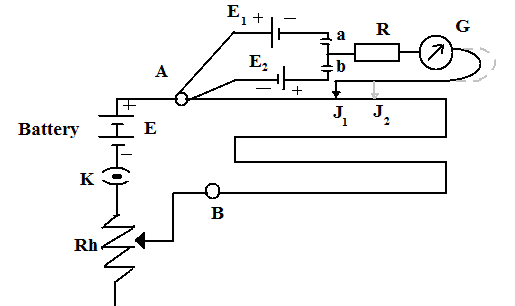
A student uses the circuit diagram of a potentiometer as shown in the figure.
a) For a steady current $I$ passing through the potentiometer wire, he gets a null point for the cell ${e_1}$ and not for ${e_2}$ . Give reason for this observation and suggest how this difficulty can be resolved?
b) What is the function of resistance $R$ used in the circuit? How will the change in its value affect the null point?
c) How can the sensitivity of the potentiometer be increased?
Answer
 Verified
261.6k+ views
Hint: A null point is obtained by balancing the EMFs so that there is no potential difference between them. Voltage in the potentiometer wire depends on the length of the wire. The galvanometer has limitations in showing a particular range of current values.
Complete step by step solution:
Let us first define the potentiometer.
A potentiometer is used to compare potential differences by altering the potential difference in the potentiometer wire. This is carried out by moving the slider (Jockey) $J$ on the potentiometer wire. At a particular point, the galvanometer shows zero reading. This is the point when there is no current flow.
Now, For the null point, the potential between the primary cell and the cell in the slider have to get balanced so that there is no potential difference and thereby will have no current flowing in the potentiometer wire. To observe this, we will consider some points which are given below:
a) Here, for cell ${e_1}$ and $E$, they have the same polarity terminals attached to the point $A$. Hence they will obtain a null point when there will be no potential difference between them. But for the cell ${e_2}$ and $E$, the polarity of ${e_2}$ is opposite to that of $E$. Hence there will be no point when the potentials can be balanced. So, that’s why the student did not observe a null point from the cell ${e_2}$.
However, this difficulty can be resolved by simply changing the polarity of the cell ${e_2}$, i.e. by reversing the terminals of the cell.
b) The resistance $R$ is kept in the circuit for the voltage drop across the cell circuit so that it can limit the current flowing through the galvanometer. Changing the value of $R$ does not change the value of the null point.
c) The sensitivity of the potentiometer is proportional to the length of potentiometer wire and inversely proportional to the amount of the current flowing through the potentiometer wire.
Hence, the sensitivity can be increased by simply increasing the length of potentiometer wire.It can also be increased by limiting the current flowing through the potentiometer wire. This is achieved by changing the value of the resistance in the circuit using a rheostat.
Note: The galvanometer can show both direction and magnitude of the current flowing through it. Also, There are various types of potentiometer that have different methods of altering the value of voltage. For example, a Rotary Potentiometer that has a rotary knob as a slider to vary voltage. Potentiometers are used in audio devices to control volume or in an equaliser. They are also used in displays where they can control brightness, contrast and colour.
Complete step by step solution:
Let us first define the potentiometer.
A potentiometer is used to compare potential differences by altering the potential difference in the potentiometer wire. This is carried out by moving the slider (Jockey) $J$ on the potentiometer wire. At a particular point, the galvanometer shows zero reading. This is the point when there is no current flow.
Now, For the null point, the potential between the primary cell and the cell in the slider have to get balanced so that there is no potential difference and thereby will have no current flowing in the potentiometer wire. To observe this, we will consider some points which are given below:
a) Here, for cell ${e_1}$ and $E$, they have the same polarity terminals attached to the point $A$. Hence they will obtain a null point when there will be no potential difference between them. But for the cell ${e_2}$ and $E$, the polarity of ${e_2}$ is opposite to that of $E$. Hence there will be no point when the potentials can be balanced. So, that’s why the student did not observe a null point from the cell ${e_2}$.
However, this difficulty can be resolved by simply changing the polarity of the cell ${e_2}$, i.e. by reversing the terminals of the cell.
b) The resistance $R$ is kept in the circuit for the voltage drop across the cell circuit so that it can limit the current flowing through the galvanometer. Changing the value of $R$ does not change the value of the null point.
c) The sensitivity of the potentiometer is proportional to the length of potentiometer wire and inversely proportional to the amount of the current flowing through the potentiometer wire.
Hence, the sensitivity can be increased by simply increasing the length of potentiometer wire.It can also be increased by limiting the current flowing through the potentiometer wire. This is achieved by changing the value of the resistance in the circuit using a rheostat.
Note: The galvanometer can show both direction and magnitude of the current flowing through it. Also, There are various types of potentiometer that have different methods of altering the value of voltage. For example, a Rotary Potentiometer that has a rotary knob as a slider to vary voltage. Potentiometers are used in audio devices to control volume or in an equaliser. They are also used in displays where they can control brightness, contrast and colour.
Recently Updated Pages
Circuit Switching vs Packet Switching: Key Differences Explained

JEE Extractive Metallurgy Important Concepts and Tips for Exam Preparation
JEE Atomic Structure and Chemical Bonding important Concepts and Tips
JEE Amino Acids and Peptides Important Concepts and Tips for Exam Preparation
Electricity and Magnetism Explained: Key Concepts & Applications
JEE Energetics Important Concepts and Tips for Exam Preparation
Trending doubts
JEE Main 2026: Exam Dates, Session 2 Updates, City Slip, Admit Card & Latest News
JEE Main Participating Colleges 2026 - A Complete List of Top Colleges
Hybridisation in Chemistry – Concept, Types & Applications
Understanding the Electric Field of a Uniformly Charged Ring
Derivation of Equation of Trajectory Explained for Students
Understanding Atomic Structure for Beginners
Other Pages
CBSE Class 12 Physics Question Paper 2026: Download SET-wise PDF with Answer Key & Analysis
JEE Advanced 2026 Notification Out with Exam Date, Registration (Extended), Syllabus and More
JEE Advanced Marks vs Ranks 2025: Understanding Category-wise Qualifying Marks and Previous Year Cut-offs
JEE Advanced Weightage Chapter Wise 2026 for Physics, Chemistry, and Mathematics
JEE Advanced Marks vs Rank 2025 - Predict Your IIT Rank Based on Score
How to Convert a Galvanometer into an Ammeter or Voltmeter