




A student obtained a clear image of window grills on the screen. But the teacher told him to get the image of a tree far away, instead of the window. To get a clear image the lens must be:
A) Moved towards the screen
B) Moved away from the screen
C) Moved very close to the screen
D) None of these.
Answer
 Verified
254.4k+ views
Hint: from the above question it is clear that the distance of the tree from the lens is greater than the distance of the window grills. Now a lens is kept between the window grills and a screen and the student getting a clear image of the grills. The lens should be converging as the tree is far away from the grills. In the converging lens, the nearer the object the more distance the image from the lens. Therefore for the faraway tree, the image will be near the lens.
Complete solution:
Step 1: First let us understand how a converging lens forms the image and how the position of the object affects the position of the image. Consider the following diagram.
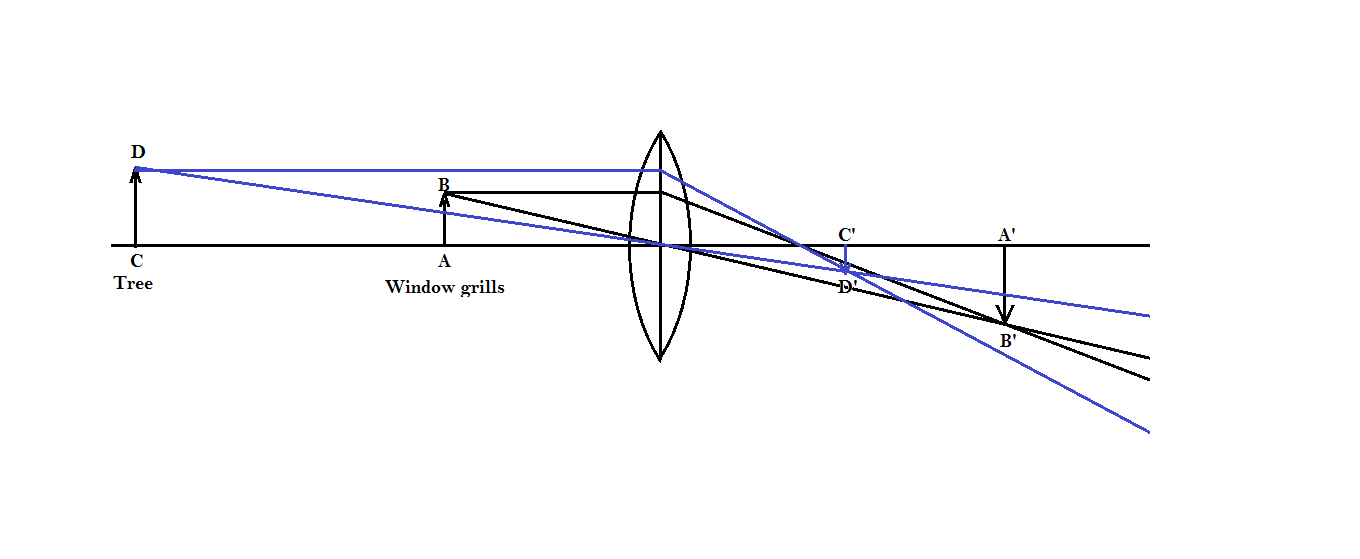 In the ray diagram window grills, AB is closer to the lens in comparison to the tree CD. Since the student is getting a clear image of the window grill therefore the screen kept by the student will be at the same distance as the distance of the image of the window grills A’B’.
Step 2: From the above diagram it is also clear that when the student was getting a clear image of the window grills then the image of the tree which is far away from the grills was being formed between the screen and the lens. The screen is fixed. If we can only move the lens then it is pretty clear that the lens should be moved towards the screen to get a clear image of the tree. Then only the image C’D’ can be found clearly on the screen.
Hence the correct option is Option A.
Note: The lens cannot be moved away from the screen if we want a clear image of the tree. Because the distance of the image from the lens of an object depends on the distance of the object from the lens. In the case of the converging lens the far the object is kept nearer the image is formed. If we took the lens away from the screen then the image of the tree will go away from the screen.
Complete solution:
Step 1: First let us understand how a converging lens forms the image and how the position of the object affects the position of the image. Consider the following diagram.
In the ray diagram window grills, AB is closer to the lens in comparison to the tree CD. Since the student is getting a clear image of the window grill therefore the screen kept by the student will be at the same distance as the distance of the image of the window grills A’B’.Step 2: From the above diagram it is also clear that when the student was getting a clear image of the window grills then the image of the tree which is far away from the grills was being formed between the screen and the lens. The screen is fixed. If we can only move the lens then it is pretty clear that the lens should be moved towards the screen to get a clear image of the tree. Then only the image C’D’ can be found clearly on the screen.
Hence the correct option is Option A.
Note: The lens cannot be moved away from the screen if we want a clear image of the tree. Because the distance of the image from the lens of an object depends on the distance of the object from the lens. In the case of the converging lens the far the object is kept nearer the image is formed. If we took the lens away from the screen then the image of the tree will go away from the screen.
Recently Updated Pages
Mass vs Weight: Key Differences Explained for Students

Uniform Acceleration Explained: Formula, Examples & Graphs
JEE Main 2022 (June 25th Shift 2) Chemistry Question Paper with Answer Key
Average Atomic Mass - Important Concepts and Tips for JEE
JEE Main 2023 (April 15th Shift 1) Physics Question Paper with Answer Key
JEE Main 2022 (June 27th Shift 2) Chemistry Question Paper with Answer Key
Trending doubts
JEE Main 2026: Exam Dates, Session 2 Updates, City Slip, Admit Card & Latest News
JEE Main Marking Scheme 2026- Paper-Wise Marks Distribution and Negative Marking Details
JEE Main 2026 Application Login: Direct Link, Registration, Form Fill, and Steps
Hybridisation in Chemistry – Concept, Types & Applications
Understanding the Electric Field of a Uniformly Charged Ring
Derivation of Equation of Trajectory Explained for Students
Other Pages
CBSE Class 12 Physics Question Paper 2026: Download SET-wise PDF with Answer Key & Analysis
JEE Advanced 2026 - Exam Date (Released), Syllabus, Registration, Eligibility, Preparation, and More
JEE Advanced Marks vs Ranks 2025: Understanding Category-wise Qualifying Marks and Previous Year Cut-offs
JEE Advanced Weightage 2025 Chapter-Wise for Physics, Maths and Chemistry
Understanding Atomic Structure for Beginners
Ideal and Non-Ideal Solutions Explained for Class 12 Chemistry