




A solution of sodium chloride will turn:
A. Red litmus blue
B. Blue litmus red
C. Red litmus orange
D. No change in color of either red or blue litmus
Answer
 Verified
274.8k+ views
Hint: Sodium chloride is an ionic compound in which the sodium and chloride ions are in the ratio of $1:1$. It is commonly called table salt, common salt or halite (the mineral form of common salt). It is the salt which is mainly responsible for the salinity of seawater and for the extracellular fluid which is present in many multicellular organisms.
Complete step by step answer:
Sodium chloride finds its application from household to industrial processes. Seawater is a major source of this salt. The chemical formula of sodium chloride is NaCl. Its crystals are as shown:
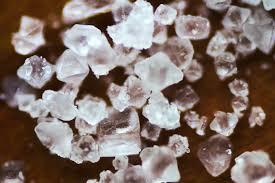
Thus, sodium and chloride respond together to generate a substance that is familiar to nearly everybody in the globe i.e. sodium chloride or table salt or common salt.
The reaction is as shown:
$2Na(s) + C{l_2} \to 2NaCl(s)$
However, a solution of sodium chloride does not show any change towards the litmus paper. This is because sodium chloride is a salt and an ionic compound and it is neither a base or an acid. It is formed from the neutralization of HCl by NaOH. Hence, the solution of NaCl in water has no acidic or basic properties, since neither ion is capable of hydrolyzing.
Hence, option D is correct.
Note:
In its aqueous state, NaCl acts as a good conductor of electricity due to the free movement of the ions. It has a melting point of ${801^ \circ }C$ and a boiling point of ${1413^ \circ }C$. Moreover, in cold countries, it is used to prevent the build-up of ice on roads, bridges etc. which further results in safe driving conditions.
Complete step by step answer:
Sodium chloride finds its application from household to industrial processes. Seawater is a major source of this salt. The chemical formula of sodium chloride is NaCl. Its crystals are as shown:
Thus, sodium and chloride respond together to generate a substance that is familiar to nearly everybody in the globe i.e. sodium chloride or table salt or common salt.
The reaction is as shown:
$2Na(s) + C{l_2} \to 2NaCl(s)$
However, a solution of sodium chloride does not show any change towards the litmus paper. This is because sodium chloride is a salt and an ionic compound and it is neither a base or an acid. It is formed from the neutralization of HCl by NaOH. Hence, the solution of NaCl in water has no acidic or basic properties, since neither ion is capable of hydrolyzing.
Hence, option D is correct.
Note:
In its aqueous state, NaCl acts as a good conductor of electricity due to the free movement of the ions. It has a melting point of ${801^ \circ }C$ and a boiling point of ${1413^ \circ }C$. Moreover, in cold countries, it is used to prevent the build-up of ice on roads, bridges etc. which further results in safe driving conditions.
Recently Updated Pages
Wheatstone Bridge – Principle, Formula, Diagram & Applications

Classification of Drugs in Chemistry: Types, Examples & Exam Guide
Mass vs Weight: Key Differences Explained for Students
Area vs Volume: Key Differences Explained for Students
Mutually Exclusive vs Independent Events: Key Differences Explained
Circuit Switching vs Packet Switching: Key Differences Explained
Trending doubts
JEE Main 2026: Exam Dates, Session 2 Updates, City Slip, Admit Card & Latest News
Understanding the Electric Field of a Uniformly Charged Ring
Understanding Atomic Structure for Beginners
Derivation of Equation of Trajectory Explained for Students
Understanding the Different Types of Solutions in Chemistry
Electron Gain Enthalpy and Electron Affinity Explained
Other Pages
JEE Advanced 2026 Notification Out with Exam Date, Registration (Extended), Syllabus and More
JEE Advanced Percentile vs Marks 2026: JEE Main Cutoff, AIR & IIT Admission Guide
JEE Advanced Weightage Chapter Wise 2026 for Physics, Chemistry, and Mathematics
NCERT Solutions For Class 11 Chemistry In Hindi Chapter 1 Some Basic Concepts Of Chemistry - 2026-27
How to Convert a Galvanometer into an Ammeter or Voltmeter
Understanding Electromagnetic Waves and Their Importance