




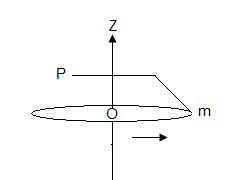
A small mass m is attached to a massless string whose other end is fixed at P as shown in the figure. The mass is undergoing circular motion in the x−y plane with centre at O and constant angular speed ω. lf the angular momentum of the system, calculated about O and P are denoted by $L_O$ and $L_P$, respectively, then:
$\left( A \right)$ ${L_o}$ and ${L_p}$ do not vary with time.
$\left( B \right)$${L_o}$ varies with time while ${L_p}$ remains constant.
$\left( C \right)$ ${L_o}$ remains constant while ${L_p}$ varies with time.
$\left( D \right)$${L_o}$ and ${L_p}$ both vary with time.
Answer
 Verified
292.5k+ views
Hint: The angular momentum is a vector quantity since it has both direction and magnitude. It varies with point under consideration. In the above question the angular momentum of the same body as observed from the two points the fixed-point P and the centre of rotation O. Using the above statement find the statement that is true.
Complete step by step solution:
Every physical quantity is categorised as either linear or angular based on their motion. The angular momentum is a vector quantity since it has both direction and magnitude. The direction of angular momentum is given by the right thumb rule.
The angular momentum at point O is
${L_0} = m\left( {\vec r \times \vec v} \right)$
We know that the velocity vector and radius vectors are always pointed in a vertically upward direction.
Hence ${L_o}$ remains constant.
The angular momentum at P
${\vec L_P} = m\left( {OP \times \vec v} \right)$
Here the cross product of OP and the velocity changes direction at every point along the motion of the mass.
Hence ${L_p}$ changes with time.
Angular momentum depends on the radial vector. There are two different points on the same line, the radius vector is different.
Option C is the correct option.
Note: Angular momentum comes into picture for a body undergoing rotational motion about an axis that may pass through the object. The angular momentum magnitude is equal to the linear momentum. Angular momentum is the product of mass, velocity and the perpendicular distance. The direction of angular momentum is given by the right thumb rule.
Complete step by step solution:
Every physical quantity is categorised as either linear or angular based on their motion. The angular momentum is a vector quantity since it has both direction and magnitude. The direction of angular momentum is given by the right thumb rule.
The angular momentum at point O is
${L_0} = m\left( {\vec r \times \vec v} \right)$
We know that the velocity vector and radius vectors are always pointed in a vertically upward direction.
Hence ${L_o}$ remains constant.
The angular momentum at P
${\vec L_P} = m\left( {OP \times \vec v} \right)$
Here the cross product of OP and the velocity changes direction at every point along the motion of the mass.
Hence ${L_p}$ changes with time.
Angular momentum depends on the radial vector. There are two different points on the same line, the radius vector is different.
Option C is the correct option.
Note: Angular momentum comes into picture for a body undergoing rotational motion about an axis that may pass through the object. The angular momentum magnitude is equal to the linear momentum. Angular momentum is the product of mass, velocity and the perpendicular distance. The direction of angular momentum is given by the right thumb rule.
Recently Updated Pages
JEE Main 2023 (February 1st Shift 2) Physics Question Paper with Answer Key

JEE Main 2023 (February 1st Shift 1) Maths Question Paper with Answer Key
JEE Main 2023 (February 1st Shift 2) Chemistry Question Paper with Answer Key
Hydrogen and Its Type Important Concepts and Tips for JEE Exam Preparation
JEE Main 2023 (February 1st Shift 2) Maths Question Paper with Answer Key
JEE Main 2023 (February 1st Shift 1) Physics Question Paper with Answer Key
Trending doubts
JEE Main 2026: Exam Dates, Session 2 Updates, City Slip, Admit Card & Latest News
Understanding the Electric Field of a Uniformly Charged Ring
Understanding Atomic Structure for Beginners
Electron Gain Enthalpy and Electron Affinity Explained
Derivation of Equation of Trajectory Explained for Students
How to Convert a Galvanometer into an Ammeter or Voltmeter
Other Pages
CBSE Notes Class 11 Physics Chapter 1 - Units And Measurements - 2026-27 PDF Download (Login Required)
NCERT Solutions For Class 11 Physics Chapter 1 Units And Measurements - 2026-27 Free PDF Download (Login Required)
NCERT Solutions For Class 11 Physics Chapter 2 Motion In A Straight Line - 2026-27 Free PDF Download (Login Required)
Important Questions For Class 11 Physics Chapter 1 Units and Measurement - 2026-27 Free PDF Download (Sign-in Required)
JEE Advanced Percentile vs Marks 2026: JEE Main Cutoff, AIR & IIT Admission Guide
CBSE Notes Class 11 Physics Chapter 2 - Motion in a Straight Line - 2026-27 PDF Download (Login Required)
CBSE Notes Class 11 Physics Chapter 1 - Units And Measurements - 2026-27 PDF Download (Login Required)
NCERT Solutions For Class 11 Physics Chapter 1 Units And Measurements - 2026-27 Free PDF Download (Login Required)
NCERT Solutions For Class 11 Physics Chapter 2 Motion In A Straight Line - 2026-27 Free PDF Download (Login Required)