




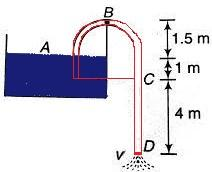
A siphon tube is discharging a liquid of specific gravity 0.9 from a reservoir as shown in the figure to find the pressure at the highest point B.
Answer
 Verified
266.4k+ views
Hint: Here we have to use Bernoulli's equation; the equation is based upon the principle of conservation of energy. It states that the total energy that is related with a flowing fluid remains constant. The energy related with the flowing fluid is potential energy, kinetic energy and pressure. Here to find out the pressure at the highest point B one has to equate pressure at point A to pressure at point B.
Formula used:
$P + \dfrac{1}{2}\rho {v^2} + \rho gh = {\text{constant}}$ ;
P = Pressure;
$\rho $= Relative density or specific gravity (0.9);
g = Gravitational Constant;
h = Height;
v = Velocity.
Complete step by step solution:
Equate the Bernoulli’s equation for two points A and D, Find v
${P_A} + \dfrac{1}{2}\rho {v^2} + \rho gh = {P_D}$;
Here ${P_A}$ and ${P_D}$ are atmospheric pressure which is $1.01 \times {10^5}$Pa.
${P_A} + \dfrac{1}{2}\rho {v^2} + \rho gh = {P_D} + \dfrac{1}{2}\rho {v^2} + \rho gh$;
Here ${P_A}$ and ${P_D}$ are equal, they will cancel out,
$\dfrac{1}{2}\rho {v^2} + \rho gh = \dfrac{1}{2}\rho {v^2} + \rho gh$;
Put the given values in the above equation
$\dfrac{1}{2}\rho {v^2} + \rho g \times 5 = \dfrac{1}{2}\rho {v^2} + \rho g \times 0$;
At point A there will be no velocity in the liquid , v = 0;
$\rho g \times 5 = \dfrac{1}{2}\rho {v^2}$
Here the relative densities are equal as the liquid is same,
$g \times 5 = \dfrac{1}{2}{v^2}$;
Solve,
$g \times 5 \times 2 = {v^2}$;
$v = \sqrt {10g} $ ;
$v = \sqrt {9.8 \times 10} $ ;
$v = 9.9{\text{ m/s}}$ ;
Now, equate the Bernoulli’s equation at point A and at point B,
${P_A} + \dfrac{1}{2}\rho {v^2} + \rho gh = {P_B} + \dfrac{1}{2}\rho {v^2} + \rho gh$;
Put the values in the above equation,
${P_A} + \dfrac{1}{2}\rho \times 0 + \rho g \times 0 = {P_B} + \dfrac{1}{2}\rho {v^2} + \rho g(1 \cdot 5)$;
Simplify the above equation,
${P_A} + 0 + 0 = {P_B} + \dfrac{1}{2}\rho {v^2} + \rho g(1 \cdot 5)$;
Here,${P_A} = {P_o}$, Put value $1.01 \times {10^5}$Pa.
$1.01 \times {10^5} = {P_B} + \dfrac{1}{2} \times 900 \times {(9.9)^2} + 900 \times 9 \cdot 8 \times 1 \cdot 5$
Take ${P_B}$ to LHS and the rest to RHS and solve,
${P_B} = 1.01 \times {10^5} - \dfrac{1}{2} \times 900 \times {(9.9)^2} - 900 \times 9 \cdot 8 \times 1 \cdot 5$;
Do the necessary calculation,
${P_B} = 4.36 \times {10^4}{\text{ Pa}}$;
Pressure at the highest point B is ${P_B} = 4.36 \times {10^4}{\text{ Pa}}$.
Note: Here we have to first equate point A and D by using the Bernoulli’s equation and find out the velocity and after that to find out the pressure at the highest point B we have to equate the Bernoulli’s equation at point A and B.
Formula used:
$P + \dfrac{1}{2}\rho {v^2} + \rho gh = {\text{constant}}$ ;
P = Pressure;
$\rho $= Relative density or specific gravity (0.9);
g = Gravitational Constant;
h = Height;
v = Velocity.
Complete step by step solution:
Equate the Bernoulli’s equation for two points A and D, Find v
${P_A} + \dfrac{1}{2}\rho {v^2} + \rho gh = {P_D}$;
Here ${P_A}$ and ${P_D}$ are atmospheric pressure which is $1.01 \times {10^5}$Pa.
${P_A} + \dfrac{1}{2}\rho {v^2} + \rho gh = {P_D} + \dfrac{1}{2}\rho {v^2} + \rho gh$;
Here ${P_A}$ and ${P_D}$ are equal, they will cancel out,
$\dfrac{1}{2}\rho {v^2} + \rho gh = \dfrac{1}{2}\rho {v^2} + \rho gh$;
Put the given values in the above equation
$\dfrac{1}{2}\rho {v^2} + \rho g \times 5 = \dfrac{1}{2}\rho {v^2} + \rho g \times 0$;
At point A there will be no velocity in the liquid , v = 0;
$\rho g \times 5 = \dfrac{1}{2}\rho {v^2}$
Here the relative densities are equal as the liquid is same,
$g \times 5 = \dfrac{1}{2}{v^2}$;
Solve,
$g \times 5 \times 2 = {v^2}$;
$v = \sqrt {10g} $ ;
$v = \sqrt {9.8 \times 10} $ ;
$v = 9.9{\text{ m/s}}$ ;
Now, equate the Bernoulli’s equation at point A and at point B,
${P_A} + \dfrac{1}{2}\rho {v^2} + \rho gh = {P_B} + \dfrac{1}{2}\rho {v^2} + \rho gh$;
Put the values in the above equation,
${P_A} + \dfrac{1}{2}\rho \times 0 + \rho g \times 0 = {P_B} + \dfrac{1}{2}\rho {v^2} + \rho g(1 \cdot 5)$;
Simplify the above equation,
${P_A} + 0 + 0 = {P_B} + \dfrac{1}{2}\rho {v^2} + \rho g(1 \cdot 5)$;
Here,${P_A} = {P_o}$, Put value $1.01 \times {10^5}$Pa.
$1.01 \times {10^5} = {P_B} + \dfrac{1}{2} \times 900 \times {(9.9)^2} + 900 \times 9 \cdot 8 \times 1 \cdot 5$
Take ${P_B}$ to LHS and the rest to RHS and solve,
${P_B} = 1.01 \times {10^5} - \dfrac{1}{2} \times 900 \times {(9.9)^2} - 900 \times 9 \cdot 8 \times 1 \cdot 5$;
Do the necessary calculation,
${P_B} = 4.36 \times {10^4}{\text{ Pa}}$;
Pressure at the highest point B is ${P_B} = 4.36 \times {10^4}{\text{ Pa}}$.
Note: Here we have to first equate point A and D by using the Bernoulli’s equation and find out the velocity and after that to find out the pressure at the highest point B we have to equate the Bernoulli’s equation at point A and B.
Recently Updated Pages
States of Matter Chapter For JEE Main Chemistry

Circuit Switching vs Packet Switching: Key Differences Explained
Mass vs Weight: Key Differences Explained for Students
[Awaiting the three content sources: Ask AI Response, Competitor 1 Content, and Competitor 2 Content. Please provide those to continue with the analysis and optimization.]
Sign up for JEE Main 2026 Live Classes - Vedantu
JEE Main 2026 Helpline Numbers - Center Contact, Phone Number, Address
Trending doubts
JEE Main 2026: Exam Dates, Session 2 Updates, City Slip, Admit Card & Latest News
JEE Main Participating Colleges 2026 - A Complete List of Top Colleges
Hybridisation in Chemistry – Concept, Types & Applications
Understanding the Electric Field of a Uniformly Charged Ring
Derivation of Equation of Trajectory Explained for Students
Understanding Atomic Structure for Beginners
Other Pages
JEE Advanced 2026 Notification Out with Exam Date, Registration (Extended), Syllabus and More
JEE Advanced Percentile vs Marks 2026: JEE Main Cutoff, AIR & IIT Admission Guide
CBSE Notes Class 11 Physics Chapter 1 - Units And Measurements - 2025-26
JEE Advanced 2026 Marks vs Rank: Estimate IIT Rank from Your Score
NCERT Solutions For Class 11 Physics Chapter 1 Units And Measurements - 2025-26
Important Questions For Class 11 Physics Chapter 1 Units and Measurement - 2025-26