




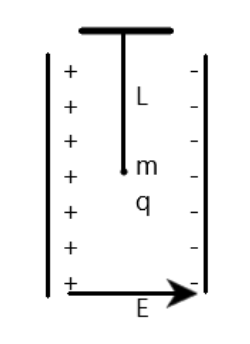
A simple pendulum of length \[L\] is placed between the plates of a parallel plate capacitor having electric field \[E\], as shown in figure. The bob has mass \[m\] and charge \[q\], the time period of the pendulum is given by
(A) \[2\pi \sqrt {\dfrac{L}{{\sqrt {{g^2} + {{\left( {{a_e} = \dfrac{{qE}}{m}} \right)}^2}} }}} \]
(B) \[2\pi \sqrt {\dfrac{L}{{{g^2} + {{\left( {\dfrac{{qE}}{m}} \right)}^2}}}} \]
(C) \[2\pi \sqrt {\dfrac{L}{{{g^2} - {{\left( {\dfrac{{qE}}{m}} \right)}^2}}}} \]
(D) \[2\pi \sqrt {\dfrac{L}{{\sqrt {{g^2} - {{\left( {{a_e} = \dfrac{{qE}}{m}} \right)}^2}} }}} \]
Answer
 Verified
264.9k+ views
Hint: The weight (gravitational force) and the electric force are perpendicular to each other. Net force acting on the body should be used to calculate the net acceleration.
Formula used: In this solution we will be using the following formulae;
\[T = 2\pi \sqrt {\dfrac{L}{{{a_r}}}} \] where \[T\] is the period of oscillation of a simple pendulum, \[L\] is the length of the pendulum, and \[{a_r}\] is the resultant acceleration or net acceleration of the system.
Complete Step-by-Step Solution:
In the above, we see a pendulum placed between parallel plates capacitors. The bob has both a mass and a charge, we are to determine the period of oscillation of such a system.
Generally, the well known equation for the time period of a simple pendulum is given as
\[T = 2\pi \sqrt {\dfrac{L}{g}} \] where \[L\] is the length of the pendulum and \[g\] is the acceleration due to gravity.
However, this equation is valid when no other forces are acting on the pendulum but the force of gravity (or weight) on the bob.
However, in our question above, the weight is not the only force acting on the bob, since the bob is charged and placed between a parallel plates capacitor.
Nonetheless, as obvious, the direction of the weight of a bob is perpendicular to the direction of the force of electric field (gravity acts downward while electric field acts rightwards), hence the net acceleration is given as
\[a = \sqrt {{g^2} + {{\left( {\dfrac{{qE}}{m}} \right)}^2}} \]
And the general equation, is given as
\[T = 2\pi \sqrt {\dfrac{L}{{{a_r}}}} \] where \[T\] is the period of oscillation of a simple pendulum, \[L\] is the length of the pendulum, and \[{a_r}\] is the resultant acceleration or net acceleration of the system.
Hence,
\[T = 2\pi \sqrt {\dfrac{L}{{\sqrt {{g^2} + {{\left( {\dfrac{{qE}}{m}} \right)}^2}} }}} \]
Hence, the correct option is A
Note: For clarity the resultant of the acceleration is given by \[a = \sqrt {{g^2} + {{\left( {\dfrac{{qE}}{m}} \right)}^2}} \] because from principle of vectors, the magnitude of the resultant of two vectors which are perpendicular to each other can be given as the hypotenuse of the right angled triangle they may form.
Note that the acceleration of a charge in an electric field is given as
\[{a_e} = \dfrac{{qE}}{m}\] where \[E\] is the electric field, \[q\] is the charge and \[m\] is the mass.
Formula used: In this solution we will be using the following formulae;
\[T = 2\pi \sqrt {\dfrac{L}{{{a_r}}}} \] where \[T\] is the period of oscillation of a simple pendulum, \[L\] is the length of the pendulum, and \[{a_r}\] is the resultant acceleration or net acceleration of the system.
Complete Step-by-Step Solution:
In the above, we see a pendulum placed between parallel plates capacitors. The bob has both a mass and a charge, we are to determine the period of oscillation of such a system.
Generally, the well known equation for the time period of a simple pendulum is given as
\[T = 2\pi \sqrt {\dfrac{L}{g}} \] where \[L\] is the length of the pendulum and \[g\] is the acceleration due to gravity.
However, this equation is valid when no other forces are acting on the pendulum but the force of gravity (or weight) on the bob.
However, in our question above, the weight is not the only force acting on the bob, since the bob is charged and placed between a parallel plates capacitor.
Nonetheless, as obvious, the direction of the weight of a bob is perpendicular to the direction of the force of electric field (gravity acts downward while electric field acts rightwards), hence the net acceleration is given as
\[a = \sqrt {{g^2} + {{\left( {\dfrac{{qE}}{m}} \right)}^2}} \]
And the general equation, is given as
\[T = 2\pi \sqrt {\dfrac{L}{{{a_r}}}} \] where \[T\] is the period of oscillation of a simple pendulum, \[L\] is the length of the pendulum, and \[{a_r}\] is the resultant acceleration or net acceleration of the system.
Hence,
\[T = 2\pi \sqrt {\dfrac{L}{{\sqrt {{g^2} + {{\left( {\dfrac{{qE}}{m}} \right)}^2}} }}} \]
Hence, the correct option is A
Note: For clarity the resultant of the acceleration is given by \[a = \sqrt {{g^2} + {{\left( {\dfrac{{qE}}{m}} \right)}^2}} \] because from principle of vectors, the magnitude of the resultant of two vectors which are perpendicular to each other can be given as the hypotenuse of the right angled triangle they may form.
Note that the acceleration of a charge in an electric field is given as
\[{a_e} = \dfrac{{qE}}{m}\] where \[E\] is the electric field, \[q\] is the charge and \[m\] is the mass.
Recently Updated Pages
JEE Main Mock Test 2025-26: Principles Related To Practical

JEE Main 2025-26 Experimental Skills Mock Test – Free Practice
JEE Main 2025-26 Electronic Devices Mock Test: Free Practice Online
JEE Main 2025-26 Mock Tests: Free Practice Papers & Solutions
JEE Main 2025-26: Magnetic Effects of Current & Magnetism Mock Test
JEE Main Statistics and Probability Mock Test 2025-26
Trending doubts
JEE Main 2026: Exam Dates, Session 2 Updates, City Slip, Admit Card & Latest News
JEE Main Participating Colleges 2026 - A Complete List of Top Colleges
Hybridisation in Chemistry – Concept, Types & Applications
Understanding the Electric Field of a Uniformly Charged Ring
Derivation of Equation of Trajectory Explained for Students
How to Convert a Galvanometer into an Ammeter or Voltmeter
Other Pages
JEE Advanced 2026 Notification Out with Exam Date, Registration (Extended), Syllabus and More
JEE Advanced Percentile vs Marks 2026: JEE Main Cutoff, AIR & IIT Admission Guide
CBSE Notes Class 11 Physics Chapter 1 - Units And Measurements - 2025-26
NCERT Solutions For Class 11 Physics Chapter 1 Units And Measurements - 2025-26
Important Questions For Class 11 Physics Chapter 1 Units and Measurement - 2025-26
JEE Advanced Weightage Chapter Wise 2026 for Physics, Chemistry, and Mathematics