




A simple pendulum is oscillating without damping. When the displacement of the bob is less than maximum, its acceleration vector $\vec a$ is correctly shown in:
(A)
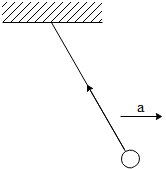
(B)
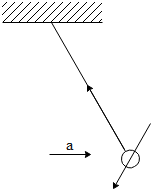
(C)
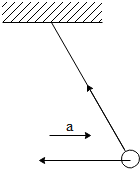
(D)
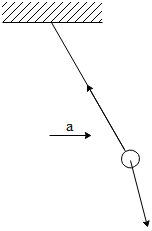
Answer
 Verified
246.6k+ views
Hint The simple pendulum is known to us as a pendulum which consists of a mass m hanging from a string which has a length of L and is fixed at a pivot point P. Whenever the pendulum is displaced to an initial angle and is released, the pendulum will swing back and forth with a periodic motion. Based on this concept we have to solve this question.
Complete step by step answer
We know that the bob has both radial as well as tangential acceleration when it is at a displacement less than its maximum displacement.
Let us draw the figure:
From the figure,
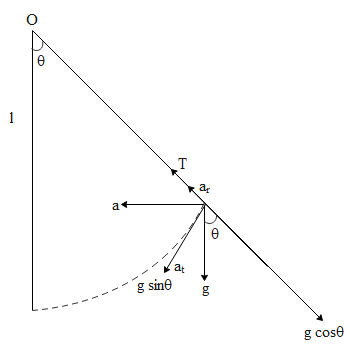
${a_t} = g\sin \theta$and,
${a_r} = \dfrac{T}{m} - g\cos \theta$
The resultant acceleration $\vec a = {\vec a_r} + {\vec a_t}$ points in the direction as shown in the figure
NoteDamping, as we know, is defined as the restraining of the vibratory motion, such as mechanical oscillations, noise or even alternating currents, by the dissipation of energy. IN case of waves, a damped wave is one whose amplitude of oscillation decreases with the time and ultimately goes to zero.
Complete step by step answer
We know that the bob has both radial as well as tangential acceleration when it is at a displacement less than its maximum displacement.
Let us draw the figure:
From the figure,
${a_t} = g\sin \theta$and,
${a_r} = \dfrac{T}{m} - g\cos \theta$
The resultant acceleration $\vec a = {\vec a_r} + {\vec a_t}$ points in the direction as shown in the figure
NoteDamping, as we know, is defined as the restraining of the vibratory motion, such as mechanical oscillations, noise or even alternating currents, by the dissipation of energy. IN case of waves, a damped wave is one whose amplitude of oscillation decreases with the time and ultimately goes to zero.
Recently Updated Pages
JEE Main 2026 Expected Cutoff: General, OBC, EWS, SC, ST Qualifying Marks & Score

JEE Main 2026 Syllabus: Latest Updates & Exam Pattern
JEE Main Chapter Wise Weightage 2026 (Updated): Important Chapters, Subject-wise Analysis & PDF
JEE Main Marks vs Percentile 2026: Marks vs Rank Analysis & Predictor
JEE Main Previous Year Question Papers (2014–2026) with Solutions – Free PDF Download
JEE Main Syllabus 2026 – Download Detailed Syllabus PDF
Trending doubts
JEE Main 2026: Exam Dates, Session 2 Updates, City Slip, Admit Card & Latest News
Hybridisation in Chemistry – Concept, Types & Applications
Understanding the Electric Field of a Uniformly Charged Ring
JEE Main 2026 Application Login: Direct Link, Registration, Form Fill, and Steps
Derivation of Equation of Trajectory Explained for Students
Understanding Collisions: Types and Examples for Students
Other Pages
JEE Advanced Marks vs Ranks 2025: Understanding Category-wise Qualifying Marks and Previous Year Cut-offs
JEE Advanced 2026 - Exam Date (Released), Syllabus, Registration, Eligibility, Preparation, and More
CBSE Notes Class 11 Physics Chapter 1 - Units And Measurements - 2025-26
Important Questions For Class 11 Physics Chapter 1 Units and Measurement - 2025-26
NCERT Solutions For Class 11 Physics Chapter 1 Units And Measurements - 2025-26
CBSE Notes Class 11 Physics Chapter 4 - Laws of Motion - 2025-26