




A rod of mass $m$ is hinged at upper end A as shown in the figure. A point object mass $m$ strike at the lower end and stops. The maximum angle through which the rod will rotate (Given${v^2} < \dfrac{{2gl}}{3}$)
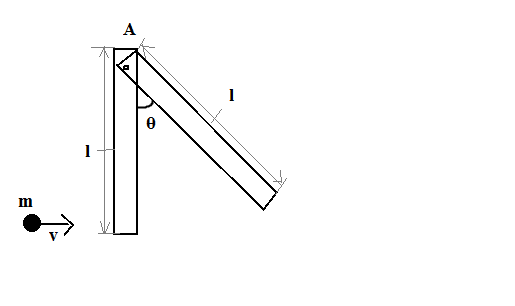
A) ${\cos ^{ - 1}}(1 - \dfrac{{3{v^2}}}{{2gl}})$
B) ${\cos ^{ - 1}}(1 - \dfrac{{3{v^2}}}{{gl}})$
C) ${\cos ^{ - 1}}(1 - \dfrac{{{v^2}}}{{2gl}})$
D) ${\cos ^{ - 1}}(1 - \dfrac{{{v^2}}}{{gl}})$
Answer
 Verified
233.1k+ views
Hint: Conservation of momentum, general law of physics in which there are no changes in an isolated object collection in the quantity called momentum, which characterises motion; namely the overall momentum of a system remains constant. Mullion is equal to the mass of an object multiplied by its speed and corresponds to the force needed in order to stop the object in a unit duration
Complete step by step solution:
The conservation of momentum and the conservation of energy and mass is a central principle of physics. Momentum is known as an object's mass multiplied by the object's speed. Momentum preservation indicates that the amount of momentum remains constant in some problem field; momentum is not created nor destroyed, but only changed through forces, as defined by Newton's laws of movement. It is harder to deal with momentum than mass and energy, as momentum is both a large and a directional vector quantity. In all three physical directions the momentum is maintained simultaneously. When dealing with gases, it is still more difficult because forces in one direction can influence momentum in another because of the collisions between many molecules. We will present a very, very simplified flow issue on this slide, where properties shift only in one direction.
Momentum conservation,
$mv = m {v_1} $
Where $m$ is the mass and $v, {v_1} $ is the velocity
${v_1} = v$
$mgh = \dfrac{1}{2}m{v_1}^2$
Where $h$ is the height
$mgh = \dfrac{1}{2}m{v^2}$
$h = \dfrac{l}{2} - \dfrac{l}{2}\cos \theta $
$mg\dfrac {l} {2} (1 - \cos \theta) = \dfrac{{m{v^2}}}{2}$
$\theta = {\cos ^ {- 1}} (1 - \dfrac{{{v^2}}}{{gl}})$
Note: The conservation of angular momentum is also fully determined by experimentation and can show mathematically that space is uniform in orientation, which means that there is nothing in the laws of nature which defines one direction of space as peculiar to any other.
Complete step by step solution:
The conservation of momentum and the conservation of energy and mass is a central principle of physics. Momentum is known as an object's mass multiplied by the object's speed. Momentum preservation indicates that the amount of momentum remains constant in some problem field; momentum is not created nor destroyed, but only changed through forces, as defined by Newton's laws of movement. It is harder to deal with momentum than mass and energy, as momentum is both a large and a directional vector quantity. In all three physical directions the momentum is maintained simultaneously. When dealing with gases, it is still more difficult because forces in one direction can influence momentum in another because of the collisions between many molecules. We will present a very, very simplified flow issue on this slide, where properties shift only in one direction.
Momentum conservation,
$mv = m {v_1} $
Where $m$ is the mass and $v, {v_1} $ is the velocity
${v_1} = v$
$mgh = \dfrac{1}{2}m{v_1}^2$
Where $h$ is the height
$mgh = \dfrac{1}{2}m{v^2}$
$h = \dfrac{l}{2} - \dfrac{l}{2}\cos \theta $
$mg\dfrac {l} {2} (1 - \cos \theta) = \dfrac{{m{v^2}}}{2}$
$\theta = {\cos ^ {- 1}} (1 - \dfrac{{{v^2}}}{{gl}})$
Note: The conservation of angular momentum is also fully determined by experimentation and can show mathematically that space is uniform in orientation, which means that there is nothing in the laws of nature which defines one direction of space as peculiar to any other.
Recently Updated Pages
JEE Main 2023 April 6 Shift 1 Question Paper with Answer Key

JEE Main 2023 April 6 Shift 2 Question Paper with Answer Key
JEE Main 2023 (January 31 Evening Shift) Question Paper with Solutions [PDF]
JEE Main 2023 January 30 Shift 2 Question Paper with Answer Key
JEE Main 2023 January 25 Shift 1 Question Paper with Answer Key
JEE Main 2023 January 24 Shift 2 Question Paper with Answer Key
Trending doubts
JEE Main 2026: Session 2 Registration Open, City Intimation Slip, Exam Dates, Syllabus & Eligibility
JEE Main 2026 Application Login: Direct Link, Registration, Form Fill, and Steps
JEE Main Marking Scheme 2026- Paper-Wise Marks Distribution and Negative Marking Details
Understanding the Angle of Deviation in a Prism
Hybridisation in Chemistry – Concept, Types & Applications
How to Convert a Galvanometer into an Ammeter or Voltmeter
Other Pages
JEE Advanced Marks vs Ranks 2025: Understanding Category-wise Qualifying Marks and Previous Year Cut-offs
Laws of Motion Class 11 Physics Chapter 4 CBSE Notes - 2025-26
Waves Class 11 Physics Chapter 14 CBSE Notes - 2025-26
Mechanical Properties of Fluids Class 11 Physics Chapter 9 CBSE Notes - 2025-26
Thermodynamics Class 11 Physics Chapter 11 CBSE Notes - 2025-26
Units And Measurements Class 11 Physics Chapter 1 CBSE Notes - 2025-26