




A projectile thrown with a speed of 100m/s making an angle of ${\text{6}}{{\text{0}}^{\text{0}}}$ with the horizontal. Find the time after which it’s inclination with the horizontal is ${45^0}$?
(A) $5\left( {\sqrt 3 - 1} \right)$
(B) $5\left( {\sqrt {\dfrac{3}{2}} - 1} \right)$
(C) $5\sqrt 3 $
(D) $5\left( {\sqrt 3 - 2} \right)$
Answer
 Verified
283.8k+ views
Hint: The velocity of the projectile keeps on changing in tangential direction. So, the angle of projection keeps on decreasing from ${\text{6}}{{\text{0}}^{\text{0}}}$ to ${0^0}$ and the inclination of ${45^0}$ comes somewhere in the middle. Taking the components in vertical and horizontal direction will help in solving further.
Formula used: We will start by resolving the components in vertical and horizontal direction.
${{\text{u}}_{\text{x}}}{\text{ = ucos}}\theta $
${{\text{v}}_{\text{x}}}{\text{ = vsin}}\theta $
We will also be using the equations of motion.
${v_y} = {u_y} + {a_y}t$
Complete step by step answer:
Here, we already know that there will be no change in magnitude of the horizontal component. Only the vertical component will change.
So, we start with initial horizontal component:
${{\text{u}}_{\text{x}}}{\text{ = 100}} \times {\text{cos6}}{{\text{0}}^{\text{0}}}$
= 50 m/s
Similarly, we will find the vertical component:
${{\text{U}}_{\text{y}}}{\text{ = usin6}}{{\text{0}}^{\text{0}}}$
$ \Rightarrow 50\sqrt 3 $ m/s
Using the equation of motion:
${v_y} = {u_y} + {a_y}t$
\[ \Rightarrow {\text{50}}\sqrt[{}]{{\text{3}}}{\text{ - gt}}\]
We already know the horizontal components are same,
So, \[{{\text{v}}_{\text{x}}}{\text{ = }}{{\text{u}}_{\text{x}}}{\text{ = 50}}\] m/s
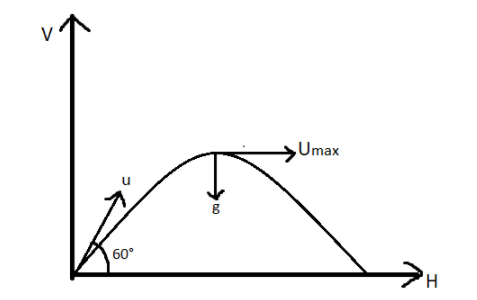
When the angle is ${45^0}$,
$\dfrac{{{\text{sin4}}{{\text{5}}^{\text{0}}}}}{{{\text{cos4}}{{\text{5}}^{\text{0}}}}}{\text{ = }}\dfrac{{{{\text{v}}_{\text{y}}}}}{{{{\text{v}}_{\text{x}}}}}$
$ \Rightarrow {{\text{v}}_{\text{y}}}{\text{ = }}{{\text{v}}_{\text{x}}}$
On putting the values in the above equation:
\[ \Rightarrow {\text{50}}\sqrt 3 {\text{ - gt = 50}}\]
$ \Rightarrow {\text{50}}\left( {\sqrt {\text{3}} {\text{ - 1}}} \right){\text{ = gt}}$
So, we get the value of t as:
${\text{t = 5}}\left( {\sqrt {\text{3}} {\text{ - 1}}} \right){\text{sec}}$
So, we need to see from the above options, and select the correct value.
Thus, the correct answer is option A.
Note: The common mistake during the evaluation is in taking the components. It should be done carefully. Also, it should be noted that the range of projectile is maximum at ${45^0}$, as the sine function reaches its largest output value at ${90^0}$
Also, acceleration due to gravity $\left( {\text{g}} \right)$ always acts vertically downwards and there is no acceleration in horizontal direction unless mentioned.
Take the value of $\left( {\text{g}} \right)$ to be $9.81m/{s^2}$ if not mentioned in the question. Generally, the value is considered to be 10 m/s2 for the sake of calculation.
Formula used: We will start by resolving the components in vertical and horizontal direction.
${{\text{u}}_{\text{x}}}{\text{ = ucos}}\theta $
${{\text{v}}_{\text{x}}}{\text{ = vsin}}\theta $
We will also be using the equations of motion.
${v_y} = {u_y} + {a_y}t$
Complete step by step answer:
Here, we already know that there will be no change in magnitude of the horizontal component. Only the vertical component will change.
So, we start with initial horizontal component:
${{\text{u}}_{\text{x}}}{\text{ = 100}} \times {\text{cos6}}{{\text{0}}^{\text{0}}}$
= 50 m/s
Similarly, we will find the vertical component:
${{\text{U}}_{\text{y}}}{\text{ = usin6}}{{\text{0}}^{\text{0}}}$
$ \Rightarrow 50\sqrt 3 $ m/s
Using the equation of motion:
${v_y} = {u_y} + {a_y}t$
\[ \Rightarrow {\text{50}}\sqrt[{}]{{\text{3}}}{\text{ - gt}}\]
We already know the horizontal components are same,
So, \[{{\text{v}}_{\text{x}}}{\text{ = }}{{\text{u}}_{\text{x}}}{\text{ = 50}}\] m/s
When the angle is ${45^0}$,
$\dfrac{{{\text{sin4}}{{\text{5}}^{\text{0}}}}}{{{\text{cos4}}{{\text{5}}^{\text{0}}}}}{\text{ = }}\dfrac{{{{\text{v}}_{\text{y}}}}}{{{{\text{v}}_{\text{x}}}}}$
$ \Rightarrow {{\text{v}}_{\text{y}}}{\text{ = }}{{\text{v}}_{\text{x}}}$
On putting the values in the above equation:
\[ \Rightarrow {\text{50}}\sqrt 3 {\text{ - gt = 50}}\]
$ \Rightarrow {\text{50}}\left( {\sqrt {\text{3}} {\text{ - 1}}} \right){\text{ = gt}}$
So, we get the value of t as:
${\text{t = 5}}\left( {\sqrt {\text{3}} {\text{ - 1}}} \right){\text{sec}}$
So, we need to see from the above options, and select the correct value.
Thus, the correct answer is option A.
Note: The common mistake during the evaluation is in taking the components. It should be done carefully. Also, it should be noted that the range of projectile is maximum at ${45^0}$, as the sine function reaches its largest output value at ${90^0}$
Also, acceleration due to gravity $\left( {\text{g}} \right)$ always acts vertically downwards and there is no acceleration in horizontal direction unless mentioned.
Take the value of $\left( {\text{g}} \right)$ to be $9.81m/{s^2}$ if not mentioned in the question. Generally, the value is considered to be 10 m/s2 for the sake of calculation.
Recently Updated Pages
How to Calculate Moment of Inertia: Step-by-Step Guide & Formulas

Dimensions of Charge: Dimensional Formula, Derivation, SI Units & Examples
JEE Main 2025-26 Mock Test: Binomial Theorem & Quick Practice
Properties of Solids and Liquids Mock Test 2025
JEE Main Mock Test 2025-26: Principles Related To Practical
JEE Main Mock Test 2025-26: Dual Nature of Matter & Radiation
Trending doubts
JEE Main 2026: Exam Dates, Session 2 Updates, City Slip, Admit Card & Latest News
Understanding the Electric Field of a Uniformly Charged Ring
Understanding Atomic Structure for Beginners
Derivation of Equation of Trajectory Explained for Students
Electron Gain Enthalpy and Electron Affinity Explained
How to Convert a Galvanometer into an Ammeter or Voltmeter
Other Pages
JEE Advanced Percentile vs Marks 2026: JEE Main Cutoff, AIR & IIT Admission Guide
CBSE Notes Class 11 Physics Chapter 1 - Units And Measurements - 2026-27
NCERT Solutions For Class 11 Physics Chapter 1 Units And Measurements - 2026-27 Free PDF Download (Login Required)
NCERT Solutions For Class 11 Physics Chapter 2 Motion In A Straight Line - 2026-27 Free PDF Download (Login Required)
Important Questions For Class 11 Physics Chapter 1 Units and Measurement - 2026-27
CBSE Notes Class 11 Physics Chapter 2 - Motion in a Straight Line - 2026-27