




A ping - pong ball strikes a wall with a velocity of $10m{s^{ - 1}}$. If the collision is perfectly elastic. Find the velocity of the ball after impact?
A) $-20m{s^{ - 1}}$
B) $-5m{s^{ - 1}}$
C) $1m{s^{ - 1}}$
D) $-10m{s^{ - 1}}$
Answer
 Verified
249.9k+ views
Hint: To solve this question we have to use the formulae of conservation of linear momentum. Here perfectly elastic collision is taking place. Hence the total momentum before and after collision will be equal. The wall will have no velocity as it will be stationary.
Formulae used:
$e = \dfrac{{{v_2} - {v_1}}}{{{u_1} - {u_2}}}$
Here ${v_2}$ is the final velocity of the second body, ${v_1}$ is the final velocity of the first body , $e$ is the coefficient of elasticity, ${u_2}$ is the initial velocity of the second body, ${u_2}$ is the initial velocity of the first body.
Complete step by step answer:
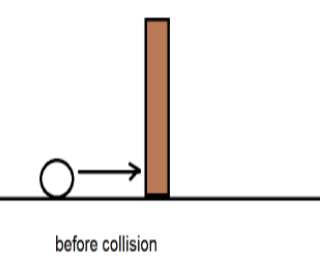
In the question it's said that a ball moving with velocity $10m{s^{ - 1}}$ collides with a wall. We can say that,
${u_b} = 10m{s^{ - 1}}$ and ${u_w} = 0$
Here ${u_b}$ and ${u_w}$ are the initial velocities of ball and wall respectively.
Let the velocities after collision be ${v_b}$ and ${v_w}$ of the ball and wall respectively.
It is said that the collision is perfectly elastic. So the coefficient of elasticity will be
$ \Rightarrow e = 1$
Applying the conservation of momentum for a perfectly elastic, we get
$e = \dfrac{{{v_w} - {v_b}}}{{{u_b} - {u_w}}}$
Here ${v_w}$ is the final velocity of the wall, ${v_b}$ is the final velocity of the ball, $e$ is the coefficient of elasticity, ${u_w}$ is the initial velocity of the wall body, ${u_b}$ is the initial velocity of the ball.
Substituting the value of
${u_b} = 10m{s^{ - 1}}$ ,${u_w} = 0$, ${v_w} = 0$ and $e = 1$
We get,
$ \Rightarrow 1 = \dfrac{{0 - {v_b}}}{{10 - 0}}$
$ \Rightarrow {v_b} = - 10$
Hence the final velocity of the ball will be $ - 10m{s^{ - 1}}$.
This means the ball will move in the opposition direction of its initial direction.
Hence option (D) is the correct answer.
Note: Collision are of three types:
1. Perfectly elastic collision- The momentum and energy is conserved before and after collision.
2. Inelastic collision- The momentum and energy is conserved before and after collision but the total kinetic energy is not conserved after collision.
Formulae used:
$e = \dfrac{{{v_2} - {v_1}}}{{{u_1} - {u_2}}}$
Here ${v_2}$ is the final velocity of the second body, ${v_1}$ is the final velocity of the first body , $e$ is the coefficient of elasticity, ${u_2}$ is the initial velocity of the second body, ${u_2}$ is the initial velocity of the first body.
Complete step by step answer:
In the question it's said that a ball moving with velocity $10m{s^{ - 1}}$ collides with a wall. We can say that,
${u_b} = 10m{s^{ - 1}}$ and ${u_w} = 0$
Here ${u_b}$ and ${u_w}$ are the initial velocities of ball and wall respectively.
Let the velocities after collision be ${v_b}$ and ${v_w}$ of the ball and wall respectively.
It is said that the collision is perfectly elastic. So the coefficient of elasticity will be
$ \Rightarrow e = 1$
Applying the conservation of momentum for a perfectly elastic, we get
$e = \dfrac{{{v_w} - {v_b}}}{{{u_b} - {u_w}}}$
Here ${v_w}$ is the final velocity of the wall, ${v_b}$ is the final velocity of the ball, $e$ is the coefficient of elasticity, ${u_w}$ is the initial velocity of the wall body, ${u_b}$ is the initial velocity of the ball.
Substituting the value of
${u_b} = 10m{s^{ - 1}}$ ,${u_w} = 0$, ${v_w} = 0$ and $e = 1$
We get,
$ \Rightarrow 1 = \dfrac{{0 - {v_b}}}{{10 - 0}}$
$ \Rightarrow {v_b} = - 10$
Hence the final velocity of the ball will be $ - 10m{s^{ - 1}}$.
This means the ball will move in the opposition direction of its initial direction.
Hence option (D) is the correct answer.
Note: Collision are of three types:
1. Perfectly elastic collision- The momentum and energy is conserved before and after collision.
2. Inelastic collision- The momentum and energy is conserved before and after collision but the total kinetic energy is not conserved after collision.
Recently Updated Pages
JEE Isolation, Preparation and Properties of Non-metals Important Concepts and Tips for Exam Preparation

Isoelectronic Definition in Chemistry: Meaning, Examples & Trends
Ionisation Energy and Ionisation Potential Explained
Iodoform Reactions - Important Concepts and Tips for JEE
Introduction to Dimensions: Understanding the Basics
Instantaneous Velocity Explained: Formula, Examples & Graphs
Trending doubts
Understanding the Angle of Deviation in a Prism
Understanding Centrifugal Force in Physics
Understanding Charging and Discharging of Capacitors
Understanding Electromagnetic Waves and Their Importance
The least count of a stop watch is 02s The time of class 11 physics JEE_Main
A Polaroid examines two adjacent plane polarised beams class 11 physics JEE_Main
Other Pages
NCERT Solutions For Class 11 Physics Chapter 3 Motion In A Plane - 2025-26
NCERT Solutions For Class 11 Physics Chapter 4 Laws Of Motion - 2025-26
NCERT Solutions For Class 11 Physics Chapter 10 Thermal Properties Of Matter - 2025-26
NCERT Solutions For Class 11 Physics Chapter 13 Oscillations - 2025-26
CBSE Notes Class 11 Physics Chapter 5 - Work Energy and Power - 2025-26
Class 11 JEE Main Physics Mock Test 2025