




When a person uses a convex lens as a simple magnifying glass, the object must be placed at a distance
A. less than one focal length
B. more than one focal length
C. less than twice the focal length
D. more than twice the focal length
Answer
 Verified
262.8k+ views
Hint A magnifying is an optical device that uses a converging lens (such as a convex lens) to form a virtual, upright and magnified image. The only condition is that the object should be placed between the optical centre and the focus of the lens. The distance between the optical centre and the focus is called focal length of the lens.
Complete step by step answer
Let us first discuss magnifying glass.
A magnifying is an optical device that uses a converging lens (such as a convex lens) to form a virtual, upright and magnified image. The only condition is that the object should be placed between the optical centre and the focus of the lens.
So, if we want a magnified, virtual and erect image, we have to place the object not beyond the focal length of the convex lens. The distance between the optical centre and the focus is called focal length of the lens.
A ray diagram of formation of a magnified virtual and erect image using a convex lens is shown in the figure.
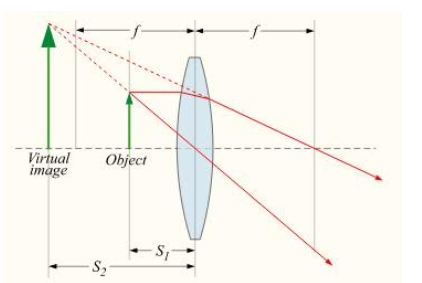
Here, ${S_1}$ is the distance of the object from the optical centre, ${S_2}$ is the distance of the image formed and $f$ is the focal length of the lens.
It is clearly seen from the ray diagram that the image formed is virtual, erect and has size larger than the object. It is formed behind the lens.
Therefore, when a person uses a convex lens as a simple magnifying glass, the object must be placed at a distance less than one focal length.
Hence, option A is correct.
Note Apart from the location of the object, the magnifying power or magnification of a magnifying glass also depends upon the place it is placed between the observer's eye and the object being viewed, and the total distance between them. The magnifying power is also equivalent to the angular magnification which is the ratio of the size of the image formed on the observer's retina with and without the lens.
Complete step by step answer
Let us first discuss magnifying glass.
A magnifying is an optical device that uses a converging lens (such as a convex lens) to form a virtual, upright and magnified image. The only condition is that the object should be placed between the optical centre and the focus of the lens.
So, if we want a magnified, virtual and erect image, we have to place the object not beyond the focal length of the convex lens. The distance between the optical centre and the focus is called focal length of the lens.
A ray diagram of formation of a magnified virtual and erect image using a convex lens is shown in the figure.
Here, ${S_1}$ is the distance of the object from the optical centre, ${S_2}$ is the distance of the image formed and $f$ is the focal length of the lens.
It is clearly seen from the ray diagram that the image formed is virtual, erect and has size larger than the object. It is formed behind the lens.
Therefore, when a person uses a convex lens as a simple magnifying glass, the object must be placed at a distance less than one focal length.
Hence, option A is correct.
Note Apart from the location of the object, the magnifying power or magnification of a magnifying glass also depends upon the place it is placed between the observer's eye and the object being viewed, and the total distance between them. The magnifying power is also equivalent to the angular magnification which is the ratio of the size of the image formed on the observer's retina with and without the lens.
Recently Updated Pages
Circuit Switching vs Packet Switching: Key Differences Explained

JEE Extractive Metallurgy Important Concepts and Tips for Exam Preparation
JEE Atomic Structure and Chemical Bonding important Concepts and Tips
JEE Amino Acids and Peptides Important Concepts and Tips for Exam Preparation
Electricity and Magnetism Explained: Key Concepts & Applications
JEE Energetics Important Concepts and Tips for Exam Preparation
Trending doubts
JEE Main 2026: Exam Dates, Session 2 Updates, City Slip, Admit Card & Latest News
JEE Main Participating Colleges 2026 - A Complete List of Top Colleges
Hybridisation in Chemistry – Concept, Types & Applications
Understanding the Electric Field of a Uniformly Charged Ring
Derivation of Equation of Trajectory Explained for Students
Understanding Atomic Structure for Beginners
Other Pages
CBSE Class 12 Physics Question Paper 2026: Download SET-wise PDF with Answer Key & Analysis
JEE Advanced 2026 Notification Out with Exam Date, Registration (Extended), Syllabus and More
JEE Advanced Marks vs Ranks 2025: Understanding Category-wise Qualifying Marks and Previous Year Cut-offs
JEE Advanced Weightage Chapter Wise 2026 for Physics, Chemistry, and Mathematics
JEE Advanced Marks vs Rank 2025 - Predict Your IIT Rank Based on Score
How to Convert a Galvanometer into an Ammeter or Voltmeter