




A particle located at $x = 0$ and time $t = 0$ starts moving along the positive x−direction with a velocity $v$ that varies as $v = \alpha \sqrt x $. Where $a$ is a constant. Then The displacement of the particle at time t:
A) ${\alpha ^2}{t^2}$
B) $\dfrac{{{\alpha ^2}{t^2}}}{2}$
C) $\dfrac{{{\alpha ^2}{t^2}}}{4}$
D) None
Answer
 Verified
268.8k+ views
Hint: Displacement can be obtained by the differentiation of velocity.we will equate the velocity with the displacement and integrating the equation at x = 0 and t = 0.
Formula used:
$v = \dfrac{{ds}}{{dt}}$
Complete step by step answer:
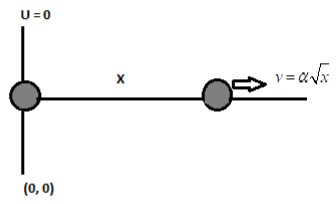
As per the question we have,
$v = \alpha \sqrt x $
$v = \dfrac{{ds}}{{dt}}$
$\dfrac{{ds}}{{dt}} = \alpha \sqrt x $
$\dfrac{{ds}}{{\sqrt x }} = \alpha \;dt$
Integrating on both sides we have,
$\mathop \smallint \nolimits_0^x \dfrac{{ds}}{{\sqrt x }} = \mathop \smallint \nolimits_0^t \alpha \;dt$
$\left( {2\sqrt x } \right)_0^x = \alpha \left( t \right)_0^t$
$2\sqrt x = \alpha t \Rightarrow \sqrt x = \dfrac{{\alpha t}}{2}$
By squaring on both sides we have,
$x = \dfrac{{{\alpha ^2}{t^2}}}{4}$
Additional information:
The by-product of a function representing the position of a particle on a line at a time is the instantaneous velocity. The by-product of the velocity, which is the second by-product of the position function, represents the acceleration of the particle at the time $t$
A positive velocity shows that the position is increasing as time increases, whereas a negative velocity indicates that the position is decreasing with respect to time. If the distance remains constant, then the velocity will be zero.
The average velocity between two points on the path in the limit that the time between the two points approaches zero.
Note: A positive acceleration shows that the velocity is increasing with respect to time, and the negative acceleration implies that the velocity is decreasing with respect to time.
If the velocity remains constant at an interval of time, then the acceleration will be zero in the interval.
Formula used:
$v = \dfrac{{ds}}{{dt}}$
Complete step by step answer:
As per the question we have,
$v = \alpha \sqrt x $
$v = \dfrac{{ds}}{{dt}}$
$\dfrac{{ds}}{{dt}} = \alpha \sqrt x $
$\dfrac{{ds}}{{\sqrt x }} = \alpha \;dt$
Integrating on both sides we have,
$\mathop \smallint \nolimits_0^x \dfrac{{ds}}{{\sqrt x }} = \mathop \smallint \nolimits_0^t \alpha \;dt$
$\left( {2\sqrt x } \right)_0^x = \alpha \left( t \right)_0^t$
$2\sqrt x = \alpha t \Rightarrow \sqrt x = \dfrac{{\alpha t}}{2}$
By squaring on both sides we have,
$x = \dfrac{{{\alpha ^2}{t^2}}}{4}$
Additional information:
The by-product of a function representing the position of a particle on a line at a time is the instantaneous velocity. The by-product of the velocity, which is the second by-product of the position function, represents the acceleration of the particle at the time $t$
A positive velocity shows that the position is increasing as time increases, whereas a negative velocity indicates that the position is decreasing with respect to time. If the distance remains constant, then the velocity will be zero.
The average velocity between two points on the path in the limit that the time between the two points approaches zero.
Note: A positive acceleration shows that the velocity is increasing with respect to time, and the negative acceleration implies that the velocity is decreasing with respect to time.
If the velocity remains constant at an interval of time, then the acceleration will be zero in the interval.
Recently Updated Pages
Circuit Switching vs Packet Switching: Key Differences Explained

Dimensions of Pressure in Physics: Formula, Derivation & SI Unit
JEE General Topics in Chemistry Important Concepts and Tips
JEE Extractive Metallurgy Important Concepts and Tips for Exam Preparation
JEE Atomic Structure and Chemical Bonding important Concepts and Tips
JEE Amino Acids and Peptides Important Concepts and Tips for Exam Preparation
Trending doubts
JEE Main 2026: Exam Dates, Session 2 Updates, City Slip, Admit Card & Latest News
JEE Main Participating Colleges 2026 - A Complete List of Top Colleges
Understanding the Electric Field of a Uniformly Charged Ring
Derivation of Equation of Trajectory Explained for Students
Understanding Atomic Structure for Beginners
JEE Main Marking Scheme 2026- Paper-Wise Marks Distribution and Negative Marking Details
Other Pages
JEE Advanced 2026 Notification Out with Exam Date, Registration (Extended), Syllabus and More
JEE Advanced Percentile vs Marks 2026: JEE Main Cutoff, AIR & IIT Admission Guide
CBSE Notes Class 11 Physics Chapter 1 - Units And Measurements - 2026-27
JEE Advanced 2026 Marks vs Rank: Estimate IIT Rank from Your Score
NCERT Solutions For Class 11 Physics Chapter 1 Units And Measurements - 2025-26
Important Questions For Class 11 Physics Chapter 1 Units and Measurement - 2025-26