




A particle is executing simple harmonic motion with a time period $T$. At the time $t = 0$, it is at its position of equilibrium. The kinetic energy-time graph of the particle will look like:
$\left( a \right)$
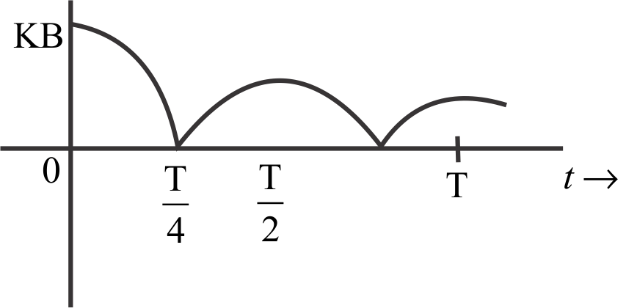
$\left( b \right)$
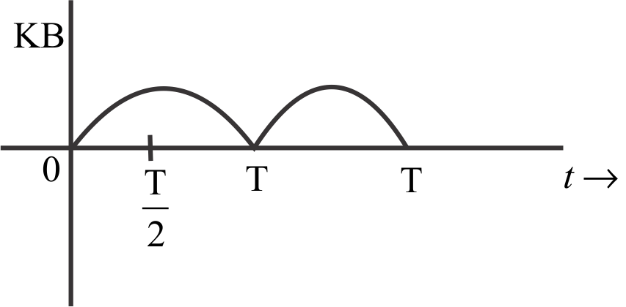
$\left( c \right)$
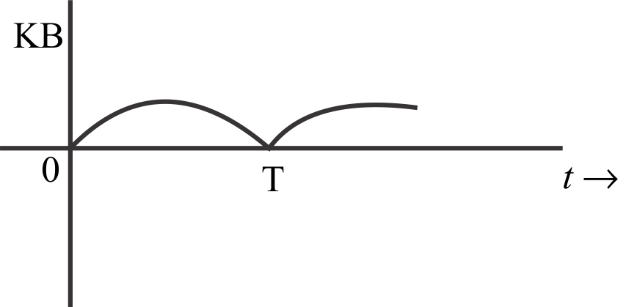
$\left( d \right)$
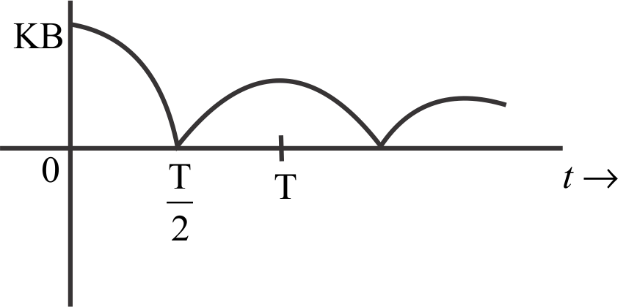
Answer
 Verified
253.2k+ views
Hint: We have been given a particle having a simple harmonic motion about its equilibrium position. And we know whenever a particle performs the simple harmonic motion, it varies with time. And velocity at the mean position will be maximum. By using all this information we can answer this question.
Complete Step By Step Solution:
After executing the simple harmonic motion, the position of the particle will be
So it can be represented as -
$x = A\sin \omega t$
Now the velocity function can be represented by,
Velocity function is $v = \dfrac{{dx}}{{dt}}$
Since,
$v = A\omega \cos \omega t$
Kinetic energy, K.E. will be written as
$K.E = \dfrac{1}{2}m{v^2}$
On substituting the values of the velocity, we get
$ \Rightarrow \dfrac{1}{2}m{A^2}{\omega ^2}{\cos ^2}\omega t$
From this, we can say that the kinetic energy will be directly proportional to the ${\cos ^2}\omega t$
Mathematically, it can be written as
$ \Rightarrow K.E \propto {\cos ^2}\omega t$
But at $t = \dfrac{T}{4}$
The value of the angle will be
$ \Rightarrow \cos \left( {\omega \dfrac{r}{4}} \right) = 0$
Therefore by putting the values, we get the kinetic energy will be equal to zero.
Mathematically, it can be written as
$ \Rightarrow K.E = 0$
Now we will check at $t = \dfrac{T}{2}$
The value of the angle will be
$ \Rightarrow \cos \left( {\omega \dfrac{r}{2}} \right) = - 1$
Therefore by putting the values, we get the kinetic energy will be positive and hence kinetic energy will be maximum.
Now we will check it$t = T$, we get
The value of the angle will be
$\cos \left( {\omega T} \right) = 1$
Therefore by putting the values, we get the kinetic energy will be positive and hence kinetic energy will be maximum
So from all the equations we had got the options $A$ to match all the criteria.
Note: When harmonic motion occurs harmonic functions are the waveforms of the motions that result. In other cases, for example, various musical instruments, when the player stimulates the instrument in a certain way, multiple wavelengths of response are being stimulated at the same time. In that case, the waveform produced will be a combination of different frequencies.
Complete Step By Step Solution:
After executing the simple harmonic motion, the position of the particle will be
So it can be represented as -
$x = A\sin \omega t$
Now the velocity function can be represented by,
Velocity function is $v = \dfrac{{dx}}{{dt}}$
Since,
$v = A\omega \cos \omega t$
Kinetic energy, K.E. will be written as
$K.E = \dfrac{1}{2}m{v^2}$
On substituting the values of the velocity, we get
$ \Rightarrow \dfrac{1}{2}m{A^2}{\omega ^2}{\cos ^2}\omega t$
From this, we can say that the kinetic energy will be directly proportional to the ${\cos ^2}\omega t$
Mathematically, it can be written as
$ \Rightarrow K.E \propto {\cos ^2}\omega t$
But at $t = \dfrac{T}{4}$
The value of the angle will be
$ \Rightarrow \cos \left( {\omega \dfrac{r}{4}} \right) = 0$
Therefore by putting the values, we get the kinetic energy will be equal to zero.
Mathematically, it can be written as
$ \Rightarrow K.E = 0$
Now we will check at $t = \dfrac{T}{2}$
The value of the angle will be
$ \Rightarrow \cos \left( {\omega \dfrac{r}{2}} \right) = - 1$
Therefore by putting the values, we get the kinetic energy will be positive and hence kinetic energy will be maximum.
Now we will check it$t = T$, we get
The value of the angle will be
$\cos \left( {\omega T} \right) = 1$
Therefore by putting the values, we get the kinetic energy will be positive and hence kinetic energy will be maximum
So from all the equations we had got the options $A$ to match all the criteria.
Note: When harmonic motion occurs harmonic functions are the waveforms of the motions that result. In other cases, for example, various musical instruments, when the player stimulates the instrument in a certain way, multiple wavelengths of response are being stimulated at the same time. In that case, the waveform produced will be a combination of different frequencies.
Recently Updated Pages
States of Matter Chapter For JEE Main Chemistry

JEE Main Participating Colleges 2026 - A Complete List of Top Colleges
Circuit Switching vs Packet Switching: Key Differences Explained
Mass vs Weight: Key Differences Explained for Students
[Awaiting the three content sources: Ask AI Response, Competitor 1 Content, and Competitor 2 Content. Please provide those to continue with the analysis and optimization.]
JEE Isolation, Preparation and Properties of Non-metals Important Concepts and Tips for Exam Preparation
Trending doubts
JEE Main 2026: Exam Dates, Session 2 Updates, City Slip, Admit Card & Latest News
JEE Main Marking Scheme 2026- Paper-Wise Marks Distribution and Negative Marking Details
JEE Main 2026 Application Login: Direct Link, Registration, Form Fill, and Steps
Hybridisation in Chemistry – Concept, Types & Applications
Understanding the Electric Field of a Uniformly Charged Ring
Derivation of Equation of Trajectory Explained for Students
Other Pages
JEE Advanced 2026 - Exam Date (Released), Syllabus, Registration, Eligibility, Preparation, and More
JEE Advanced Marks vs Ranks 2025: Understanding Category-wise Qualifying Marks and Previous Year Cut-offs
CBSE Notes Class 11 Physics Chapter 1 - Units And Measurements - 2025-26
NCERT Solutions For Class 11 Physics Chapter 1 Units And Measurements - 2025-26
Important Questions For Class 11 Physics Chapter 1 Units and Measurement - 2025-26
CBSE Notes Class 11 Physics Chapter 4 - Laws of Motion - 2025-26