




A one-meter rod of mass 1.2kg is pivoted at one end and hangs vertically. It is displaced through an angle of 60 degrees. The increase in the potential energy is ( $g = 10m/{s^2}$ )
A) 1 joule
B) 1.5 joule
C) 3 joules
D) 6 joules
Answer
 Verified
233.1k+ views
Hint: Potential energy is the energy held by an object because of its position relative to other objects. the mass of the rod is distributed all over the length of it. But we use the center of mass of the rod that is the midpoint of the rod because the resultant effect can be observed with the change in the center of mass. According to the question when the rod, pivoted at one end, is displaced at an angle of 60 degrees the center of mass will go upward. We can calculate the change in position of the center of mass by using Pythagoras theorem. Calculate potential energy in both the conditions and calculate the change.
Complete step by step solution:
Step 1: consider the following figure.
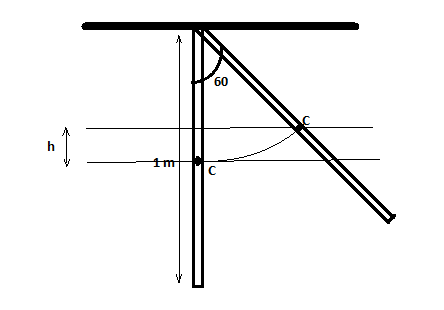
First, calculate the potential energy of the rod when it is pivoted at one end before displacing. Express the formula for the potential energy of the rod
\[\therefore {U_1} = mgh\]
Where $m$ is the mass of the rod, $g$ is the acceleration due to the gravitational force, $h$ is the height of the center of mass of the rod.
Take $h = \dfrac{l}{2} = \dfrac{1}{2}$ , $l = 1m$ is the length of the rod.
Step 2: substitute the values in the above formula
$\therefore {U_1} = 1.2 \times 10 \times \dfrac{1}{2}$
$ \Rightarrow {U_1} = 6.0joules$
Therefore, the PE of the rod is 6.0 joules.
Step 3: Now, when the rod is displaced 60 degrees, then the height $h = \dfrac{l}{2}\cos \theta $ will be the resultant height. Therefore, the potential energy of the rod is
$\therefore {U_2} = mg\dfrac{l}{2}\cos \theta $
Substitute the values in the above formula
$\therefore {U_2} = 1.2 \times 10 \times \dfrac{1}{2} \times \cos 60$
$ \Rightarrow {U_2} = 6 \times 0.5$
$ \Rightarrow {U_2} = 3.0joules$
Step 4: Now calculate the change in the potential energy.
$\therefore \Delta U = {U_1} - {U_2}$
$ \Rightarrow \Delta U = 6 - 3$
$ \Rightarrow \Delta U = 3joules$
Hence the potential energy will increase by 3 joules.
The correct answer is option C.
Note: The potential energy is directly proportional to the height of the object. More height means more energy is stored as potential energy. The potential energy will increase irrespective of the direction of displacement. Therefore, always remember the height of the center of mass increases then the PE of the body increases.
Complete step by step solution:
Step 1: consider the following figure.
First, calculate the potential energy of the rod when it is pivoted at one end before displacing. Express the formula for the potential energy of the rod
\[\therefore {U_1} = mgh\]
Where $m$ is the mass of the rod, $g$ is the acceleration due to the gravitational force, $h$ is the height of the center of mass of the rod.
Take $h = \dfrac{l}{2} = \dfrac{1}{2}$ , $l = 1m$ is the length of the rod.
Step 2: substitute the values in the above formula
$\therefore {U_1} = 1.2 \times 10 \times \dfrac{1}{2}$
$ \Rightarrow {U_1} = 6.0joules$
Therefore, the PE of the rod is 6.0 joules.
Step 3: Now, when the rod is displaced 60 degrees, then the height $h = \dfrac{l}{2}\cos \theta $ will be the resultant height. Therefore, the potential energy of the rod is
$\therefore {U_2} = mg\dfrac{l}{2}\cos \theta $
Substitute the values in the above formula
$\therefore {U_2} = 1.2 \times 10 \times \dfrac{1}{2} \times \cos 60$
$ \Rightarrow {U_2} = 6 \times 0.5$
$ \Rightarrow {U_2} = 3.0joules$
Step 4: Now calculate the change in the potential energy.
$\therefore \Delta U = {U_1} - {U_2}$
$ \Rightarrow \Delta U = 6 - 3$
$ \Rightarrow \Delta U = 3joules$
Hence the potential energy will increase by 3 joules.
The correct answer is option C.
Note: The potential energy is directly proportional to the height of the object. More height means more energy is stored as potential energy. The potential energy will increase irrespective of the direction of displacement. Therefore, always remember the height of the center of mass increases then the PE of the body increases.
Recently Updated Pages
JEE Main 2023 April 6 Shift 1 Question Paper with Answer Key

JEE Main 2023 April 6 Shift 2 Question Paper with Answer Key
JEE Main 2023 (January 31 Evening Shift) Question Paper with Solutions [PDF]
JEE Main 2023 January 30 Shift 2 Question Paper with Answer Key
JEE Main 2023 January 25 Shift 1 Question Paper with Answer Key
JEE Main 2023 January 24 Shift 2 Question Paper with Answer Key
Trending doubts
JEE Main 2026: Session 2 Registration Open, City Intimation Slip, Exam Dates, Syllabus & Eligibility
JEE Main 2026 Application Login: Direct Link, Registration, Form Fill, and Steps
Understanding the Angle of Deviation in a Prism
Hybridisation in Chemistry – Concept, Types & Applications
How to Convert a Galvanometer into an Ammeter or Voltmeter
Understanding Uniform Acceleration in Physics
Other Pages
JEE Advanced Marks vs Ranks 2025: Understanding Category-wise Qualifying Marks and Previous Year Cut-offs
Laws of Motion Class 11 Physics Chapter 4 CBSE Notes - 2025-26
Waves Class 11 Physics Chapter 14 CBSE Notes - 2025-26
Mechanical Properties of Fluids Class 11 Physics Chapter 9 CBSE Notes - 2025-26
Thermodynamics Class 11 Physics Chapter 11 CBSE Notes - 2025-26
Units And Measurements Class 11 Physics Chapter 1 CBSE Notes - 2025-26