




A man is 180cm tall and his eyes are 10cm below the top of his head. In order to see his entire height right from toe to head, he uses plane mirror kept at a distance of 1m from him, The minimum length of the plane mirror required is:
(A) 180cm
(B) 90cm
(C) 85cm
(D) 170cm
Answer
 Verified
525.8k+ views
Hint: First of all make a diagram for the given situation then think about what is the must condition to see the full image of its own body. If you notice hard you will find that the height of the mirror will be independent of its distance from the body. And there is a simple relation, you can also generalize the result for any case.
Complete step-by-step answer:
For any person to see its full image in a mirror the following conditions must satisfy.
Suppose he is seeing his head then from the first property of reflection i.e. angle of incidence is equal to the angle of reflection we will find that the top of the mirror should be placed at exactly middle of the eyes and head. And the same case occurs when you want to see your toe.
See the following figure to understand the concept clearly: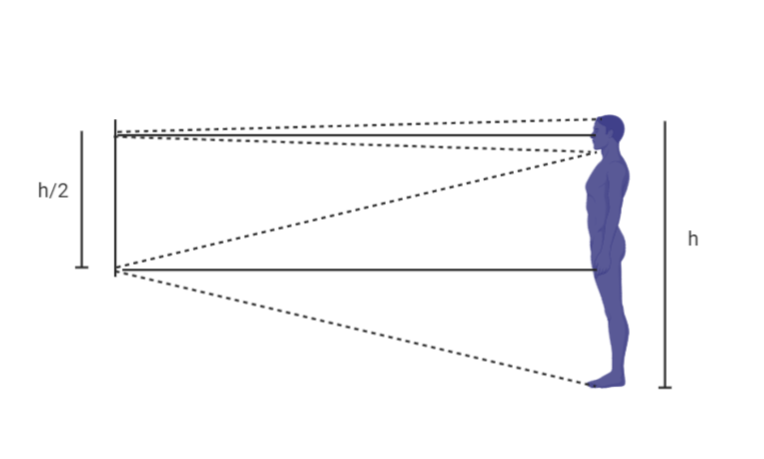
So here we observe that the mirror must be at least half of the height of the body to see its full image in the mirror.
Therefore,
\[{H_{mirror}} = \dfrac{{{H_{body}}}}{2}\]
\[{H_{mirror}} = \dfrac{{180}}{2}\]
\[{H_{mirror}} = 90cm\]
Hence option B is correct.
Note: So here we have generalized equation: \[{H_{mirror}} = \dfrac{{{H_{body}}}}{2}\] to calculate the height of the mirror whenever you are the height of body. You can even observe the same phenomena at your home with a wall mirror and the same experiment hand mirror. In vehicles convex mirrors are used so that is a different case in which you see big images in such a small mirror.
Complete step-by-step answer:
For any person to see its full image in a mirror the following conditions must satisfy.
Suppose he is seeing his head then from the first property of reflection i.e. angle of incidence is equal to the angle of reflection we will find that the top of the mirror should be placed at exactly middle of the eyes and head. And the same case occurs when you want to see your toe.
See the following figure to understand the concept clearly:
So here we observe that the mirror must be at least half of the height of the body to see its full image in the mirror.
Therefore,
\[{H_{mirror}} = \dfrac{{{H_{body}}}}{2}\]
\[{H_{mirror}} = \dfrac{{180}}{2}\]
\[{H_{mirror}} = 90cm\]
Hence option B is correct.
Note: So here we have generalized equation: \[{H_{mirror}} = \dfrac{{{H_{body}}}}{2}\] to calculate the height of the mirror whenever you are the height of body. You can even observe the same phenomena at your home with a wall mirror and the same experiment hand mirror. In vehicles convex mirrors are used so that is a different case in which you see big images in such a small mirror.
Recently Updated Pages
JEE Main 2023 April 6 Shift 1 Question Paper with Answer Key

JEE Main 2023 April 6 Shift 2 Question Paper with Answer Key
JEE Main 2023 (January 31 Evening Shift) Question Paper with Solutions [PDF]
JEE Main 2023 January 30 Shift 2 Question Paper with Answer Key
JEE Main 2023 January 25 Shift 1 Question Paper with Answer Key
JEE Main 2023 January 24 Shift 2 Question Paper with Answer Key
Trending doubts
JEE Main 2026: Session 2 Registration Open, City Intimation Slip, Exam Dates, Syllabus & Eligibility
JEE Main 2026 Application Login: Direct Link, Registration, Form Fill, and Steps
Understanding the Angle of Deviation in a Prism
Hybridisation in Chemistry – Concept, Types & Applications
How to Convert a Galvanometer into an Ammeter or Voltmeter
Understanding Uniform Acceleration in Physics
Other Pages
JEE Advanced Marks vs Ranks 2025: Understanding Category-wise Qualifying Marks and Previous Year Cut-offs
Laws of Motion Class 11 Physics Chapter 4 CBSE Notes - 2025-26
Waves Class 11 Physics Chapter 14 CBSE Notes - 2025-26
Mechanical Properties of Fluids Class 11 Physics Chapter 9 CBSE Notes - 2025-26
Thermodynamics Class 11 Physics Chapter 11 CBSE Notes - 2025-26
Units And Measurements Class 11 Physics Chapter 1 CBSE Notes - 2025-26