




A man can swim with a speed of $4km{h^{ - 1}}$ in still water. He crosses a river $1km$ wide that follows steadily at $3km{h^{ - 1}}$. If he makes his strokes normal to the river current, how far down the river does he go when he reaches the other bank?
A) $500m$
B) $600m$
C) $750m$
D) $850m$
Answer
 Verified
233.1k+ views
Hint: The time the swimmer spends swimming in the river is responsible for two things: he moves from one bank of the river to the other and also moves in the direction of the river due to the flow of the river. Therefore, if one calculates the time he spends crossing the river, that time can be used in calculating the distance moved in the direction of the river flow.
Complete step by step solution:
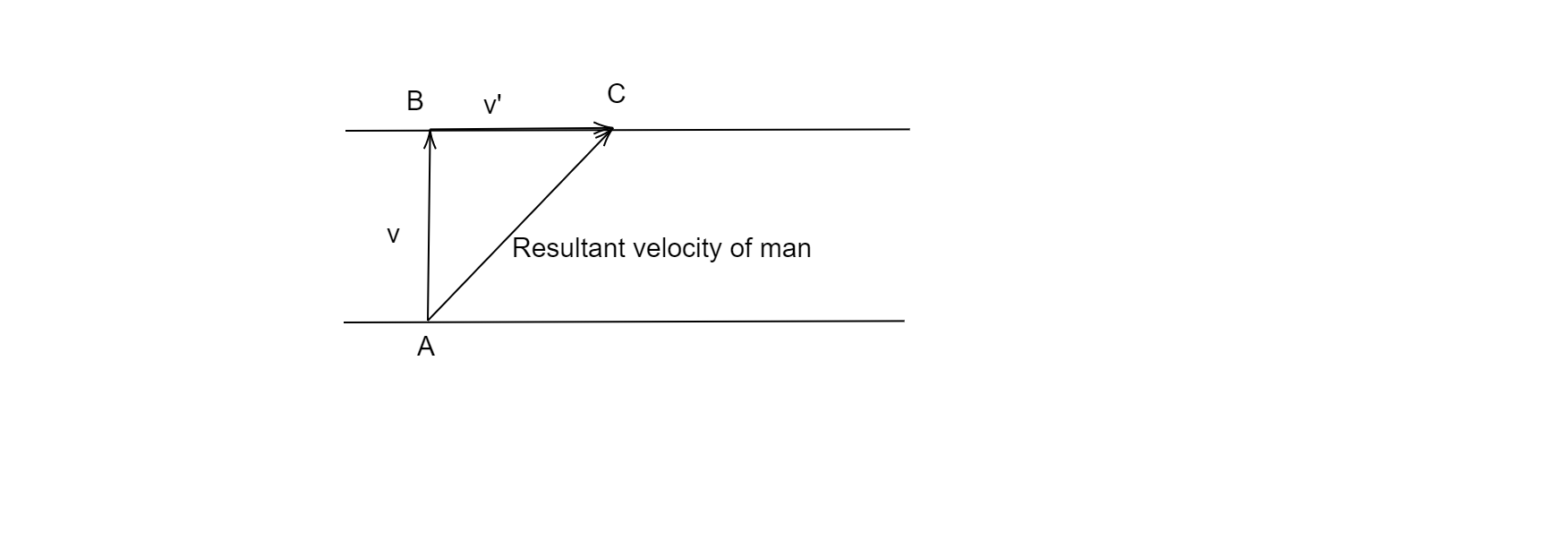 As the river flows steadily and the swimmer makes his strokes, i.e., dives in the normal direction to the river current, i.e., swims in the normal direction to the flow of the river,
Let the time that the man takes to cross the river be $t$
The width of the river $(w = AB)$ is $1km$
The velocity of the man $(v)$ is $4km{h^{ - 1}}$
Therefore, $t = \dfrac{w}{v}$
$t = \dfrac{{1km}}{{4km{h^{ - 1}}}} = \dfrac{1}{4}hr = 0.25hr$
Since the river flows with a velocity $(v')$ of $3km{h^{ - 1}}$ and the man would also move along the direction of the flow of the river due to the speed of the river, given he would swim in the river for $0.25hr$.
Therefore, the distance $(d = BC)$ moved by the man in the direction of the flow of the river will be:
$\Rightarrow d = v' \times t$
$\Rightarrow d = 3km{h^{ - 1}} \times 0.25h$
$\Rightarrow d = 0.75km$
On converting the distance in kilometers $(km)$ to meters, $(m)$ we get:
$\Rightarrow d = 750m$
Therefore, the man went $750m$ in the direction of the river flow when he reached the river bank.
Note: We should focus on the time that the swimmer takes to cross the river and reach the other bank. The swimmer has to cross the river that time and at the same time moves in the direction of the flow of the river.
Complete step by step solution:
As the river flows steadily and the swimmer makes his strokes, i.e., dives in the normal direction to the river current, i.e., swims in the normal direction to the flow of the river,Let the time that the man takes to cross the river be $t$
The width of the river $(w = AB)$ is $1km$
The velocity of the man $(v)$ is $4km{h^{ - 1}}$
Therefore, $t = \dfrac{w}{v}$
$t = \dfrac{{1km}}{{4km{h^{ - 1}}}} = \dfrac{1}{4}hr = 0.25hr$
Since the river flows with a velocity $(v')$ of $3km{h^{ - 1}}$ and the man would also move along the direction of the flow of the river due to the speed of the river, given he would swim in the river for $0.25hr$.
Therefore, the distance $(d = BC)$ moved by the man in the direction of the flow of the river will be:
$\Rightarrow d = v' \times t$
$\Rightarrow d = 3km{h^{ - 1}} \times 0.25h$
$\Rightarrow d = 0.75km$
On converting the distance in kilometers $(km)$ to meters, $(m)$ we get:
$\Rightarrow d = 750m$
Therefore, the man went $750m$ in the direction of the river flow when he reached the river bank.
Note: We should focus on the time that the swimmer takes to cross the river and reach the other bank. The swimmer has to cross the river that time and at the same time moves in the direction of the flow of the river.
Recently Updated Pages
JEE Main 2023 April 6 Shift 1 Question Paper with Answer Key

JEE Main 2023 April 6 Shift 2 Question Paper with Answer Key
JEE Main 2023 (January 31 Evening Shift) Question Paper with Solutions [PDF]
JEE Main 2023 January 30 Shift 2 Question Paper with Answer Key
JEE Main 2023 January 25 Shift 1 Question Paper with Answer Key
JEE Main 2023 January 24 Shift 2 Question Paper with Answer Key
Trending doubts
JEE Main 2026: Session 2 Registration Open, City Intimation Slip, Exam Dates, Syllabus & Eligibility
JEE Main 2026 Application Login: Direct Link, Registration, Form Fill, and Steps
Understanding the Angle of Deviation in a Prism
Hybridisation in Chemistry – Concept, Types & Applications
How to Convert a Galvanometer into an Ammeter or Voltmeter
Understanding Uniform Acceleration in Physics
Other Pages
JEE Advanced Marks vs Ranks 2025: Understanding Category-wise Qualifying Marks and Previous Year Cut-offs
Laws of Motion Class 11 Physics Chapter 4 CBSE Notes - 2025-26
Waves Class 11 Physics Chapter 14 CBSE Notes - 2025-26
Mechanical Properties of Fluids Class 11 Physics Chapter 9 CBSE Notes - 2025-26
Thermodynamics Class 11 Physics Chapter 11 CBSE Notes - 2025-26
Units And Measurements Class 11 Physics Chapter 1 CBSE Notes - 2025-26